Productbeschrijving
HangZhou STAR MACHINE TECHNOLOGY CO.,LTD. is an professional manufacturer with 20 years of production experience for motocycle chains. We have the most advanced technical team and the most advanced processing experimental equipment and service team all over the world. Our products are mainly sold to Russia, Uzbekistan, Malaysia, Germany, Egypt, Brazil, mainland China and ZheJiang . Reliable quality and attractive price, we sincerely look CHINAMFG to working with you! Do not hesitate to contact us in any time if you have any needs or questions. We would supply you with high quality and cheap products and technical advice and support.
BASIC INFO
SMCC roller chain is 1 of the most widely used and welcome products in the market. Its continuous innovative development is suitable to be the solutions for many conditions, standard roller chains, motorcycle driving chain, O-ring motorcycle chain, high strength roller chain, conveyor chains, agricultural driving chain, galvanized chain, nickel-plated chain, lubrication-free chain and oilfield chain etc.
| ISO Kettingnr. |
Kettingnr. | Pitch P mm |
Roldiameter d1max mm |
Width between inner plates b1min mm |
Pin diameter d2max mm |
Pin length | Inner plate depth h2max |
Plate thickness t/Tmax |
Tensile strength Qmin |
Gemiddelde treksterkte Q0 |
Weight per meter q |
|
| Lmax | Lcmax | |||||||||||
| mm | mm | mm | mm | kN/lbf | kN | kg/m | ||||||
| – | 9.525 | 6 | 9.5 | 4.5 | 18.6 | 20 | 9.3 | 1.85/1.50 | 11.80/2653 | 13.6 | 0.61 | |
| 420 | 420 | 12.7 | 7.77 | 6.25 | 3.96 | 14.7 | 16.1 | 12 | 1.5 | 16.00/3597 | 17.6 | 0.55 |
| – | 420F3 | 12.7 | 7.77 | 6.4 | 3.97 | 15 | 16.6 | 11.8 | 1.60/1.45 | 16.00/3597 | 17.6 | 0.64 |
| – | 420HF1 | 12.7 | 7.77 | 6.25 | 3.96 | 17 | 18.4 | 12 | 2.03 | 16.00/3597 | 17.6 | 0.76 |
| – | 420HT | 12.7 | 7.77 | 6.25 | 3.96 | 17 | – | 12 | 2.03 | 21.40/4811 | 23.5 | 0.76 |
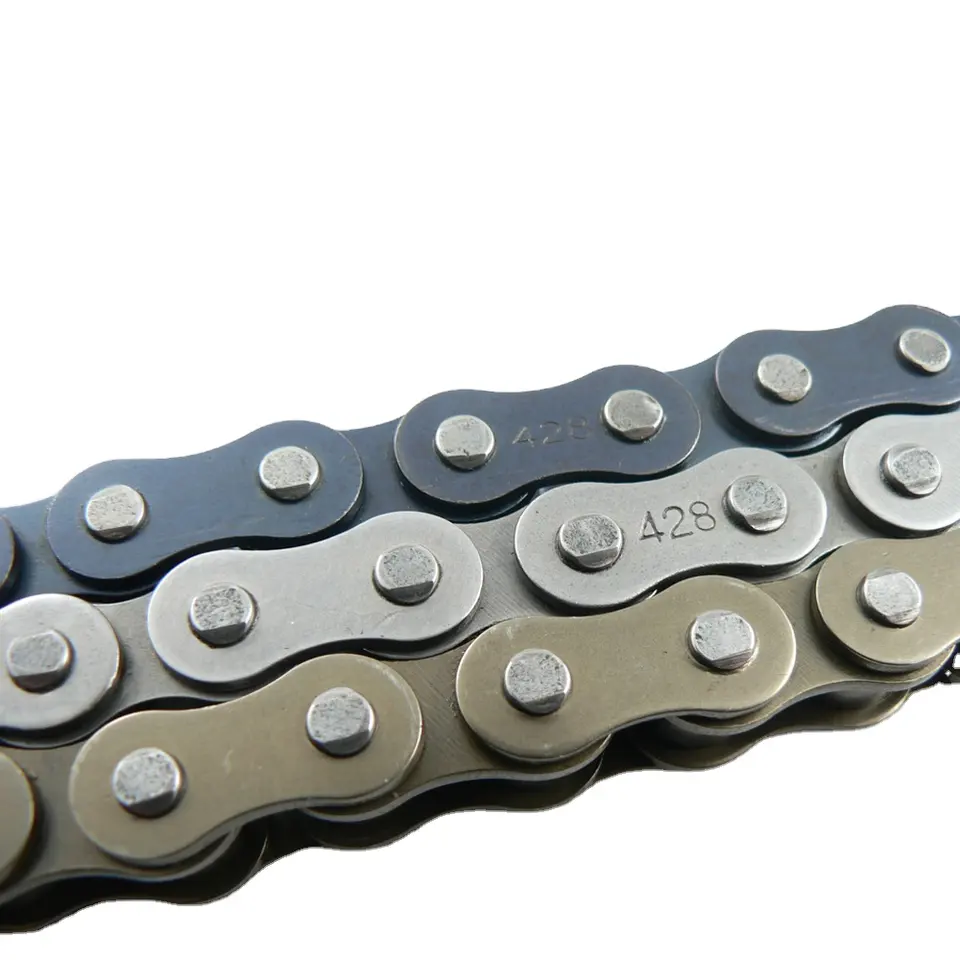
| 428 | 428 | 12.7 | 8.51 | 7.75 | 4.45 | 16.7 | 18.2 | 11.8 | 1.6 | 17.80/4002 | 19.6 | 0.7 |
| – | 428F1 | 12.7 | 8.51 | 7.94 | 4.5 | 16.7 | 18.05 | 11.8 | 1.6 | 17.15/3855 | 19.4 | 0.71 |
| – | 428DS | 12.7 | 8.51 | 7.94 | 4.45 | 17.9 | 19.3 | 12 | 1.85 | 18.62/4186 | 21 | 0.76 |
| 428MH | 428H | 12.7 | 8.51 | 7.85 | 4.45 | 18.8 | 19.9 | 11.8 | 2.03 | 20.60/4631 | 23.4 | 0.79 |
| – | 428HF1 | 12.7 | 8.51 | 7.85 | 4.45 | 17.9 | 19 | 11.8 | 1.8 | 19.50/4384 | 20.7 | 0.74 |
| – | 428HSH | 12.7 | 8.51 | 7.75 | 4.45 | 20 | – | 12 | 2.42 | 27.00/6070 | 29.4 | 0.89 |
| – | 428HF4 | 12.7 | 8.51 | 7.94 | 4.5 | 18.9 | 20.1 | 11.8 | 2.03 | 20.50/4609 | 23.4 | 0.82 |
| – | 428HD | 12.7 | 8.51 | 7.85 | 4.45 | 18.8 | 19.9 | 11.8 | 2.03 | 20.60/4631 | 23.4 | 0.85 |
| – | 428F3 | 12.7 | 8.51 | 7.85 | 4.45 | 16.7 | 18.2 | 11.7 | 1.6 | 17.80/4002 | 19.6 | 0.77 |
| – | 428F4 | 12.7 | 8.51 | 7.85 | 4.45 | 16.7 | 18.2 | 11.8 | 1.6 | 17.80/4002 | 19.6 | 0.72 |
| 520 | 520 | 15.875 | 10.16 | 6.25 | 5.08 | 17.5 | 19 | 15.09 | 2.03 | 26.50/5957 | 29.7 | 0.89 |
| – | 520F2 | 15.875 | 10.16 | 6.35 | 5.24 | 17.5 | 19.05 | 15.09 | 2.03 | 26.50/5957 | 29.7 | 0.97 |
| – | 520F3 | 15.875 | 10.16 | 6.48 | 5.08 | 17.5 | 19 | 15.09 | 2.03 | 26.50/5957 | 29.7 | 0.89 |
| 520MH | 520MH | 15.875 | 10.22 | 6.25 | 5.25 | 19 | 21.2 | 15.3 | 2.2 | 30.50/6857 | 33.6 | – |
| – | 520HD | 15.875 | 10.16 | 6.35 | 5.34 | 18.6 | 20 | 15.09 | 2.2 | 35.00/7868 | 38.5 | 1.04 |
| 525 | 525 | 15.875 | 10.16 | 7.95 | 5.08 | 19.3 | 20.7 | 15.09 | 2.03 | 26.50/5957 | 29.7 | 1.06 |
| 525MH | 525MH | 15.875 | 10.22 | 7.85 | 5.25 | 21.2 | 23.2 | 15.3 | 2.2 | 30.50/6857 | 33.6 | – |
| – | 525HF1 | 15.875 | 10.16 | 7.95 | 5.08 | 20.9 | 22.3 | 15.09 | 2.42 | 26.50/5957 | 29.7 | 1.2 |
| 530 | 530 | 15.875 | 10.16 | 9.4 | 5.08 | 20.7 | 22.2 | 15.09 | 2.03 | 26.50/5957 | 29.7 | 1.06 |
| – | 530SH | 15.875 | 10.16 | 9.4 | 5.08 | 22.1 | – | 15.09 | 2.42 | 32.80/7374 | 33.5 | 1.24 |
| – | 520F12 | 15.875 | 10.16 | 6.25 | 5.25 | 17.6 | – | 15 | 2.03 | 29.43/6615 | 32.3 | 0.98 |
| – | 520HF7 | 15.875 | 10.22 | 7.8 | 5.3 | 21.35 | – | 15.3 | 2.8/2.42 | 40.00/8992 | 44 | 1.43 |
| 630 | 630 | 19.05 | 11.91 | 9.4 | 5.94 | 23 | 24.8 | 18 | 2.42 | 35.30/7936 | 38.8 | – |
|
Kettingnr. |
Toonhoogte
P |
Roldiameter
d1 max |
Width between inner plates b1 min |
Pin diameter
d2 max |
Pin length | Inner plate depth h2 max |
Plate thickness
T |
Tensile strength
Q |
Average tensile strength Q0 |
Weight per meter q kg/m |
|
| Lmax mm |
Lcmax mm |
||||||||||
| 420 OR | 12.700 | 7.77 | 6.25 | 3.96 | 16.65 | 17.95 | 12.00 | 1.50 | 16.0/3599 | 17.00 | 0.62 |
| 420H OR | 12.700 | 7.77 | 6.25 | 3.96 | 18.80 | 20.10 | 12.00 | 2.03 | 16.0/3599 | 17.00 | 0.74 |
| 428HVS | 12.700 | 8.51 | 7.94 | 4.45 | 21.70 | 22.70 | 12.30 | 2.03 | 22.0/4946 | 23.00 | 0.85 |
| 50LD | 15.875 | 10.16 | 9.53 | 5.08 | 23.40 | 24.60 | 15.09 | 2.03 | 22.2/5045 | 26.50 | 1.12 |
| 520 OR | 15.875 | 10.16 | 6.70 | 5.30 | 21.20 | 22.30 | 15.09 | 2.20 | 32.0/7200 | 34.00 | 1.11 |
| 520F1 OR | 15.875 | 10.16 | 6.25 | 5.30 | 21.20 | 22.30 | 15.09 | 2.20 | 32.0/7200 | 34.00 | 1.09 |
| 520F2 OR | 15.875 | 10.16 | 9.65 | 5.30 | 24.10 | 25.50 | 15.09 | 2.20 | 32.0/7200 | 34.00 | 1.21 |
| 520V6 | 15.875 | 10.16 | 6.25 | 5.08 | 19.80 | 21.30 | 15.09 | 2.03 | 22.2/5045 | 26.50 | 0.96 |
| 520H OR | 15.875 | 10.16 | 6.25 | 5.24 | 21.52 | 22.92 | 15.09 | 2.42 | 26.5/6571 | 29.60 | 1.26 |
| 525 OR | 15.875 | 10.16 | 7.95 | 5.30 | 21.50 | 22.90 | 15.09 | 2.03 | 26.5/6571 | 29.60 | 1.30 |
| 525F1 OR | 15.875 | 10.16 | 7.95 | 5.30 | 23.10 | 24.00 | 15.09 | 2.20 | 32.0/7200 | 34.00 | 1.16 |
| 520F14 OR | 15.875 | 10.20 | 6.25 | 5.09 | 19.90 | – | 14.90 | 1.80 | 28.4/6391 | 30.60 | 0.92 |
| 525H OR | 15.875 | 10.16 | 7.95 | 5.30 | 23.10 | 24.50 | 15.09 | 2.42 | 26.5/6571 | 29.60 | 1.44 |
| 530H OR | 15.875 | 10.16 | 9.53 | 5.24 | 24.80 | 26.20 | 15.09 | 2.42 | 29.0/6524 | 30.00 | 1.39 |
| 630F1 OR | 19.050 | 11.91 | 9.53 | 5.94 | 25.50 | 27.30 | 18.00 | 2.42 | 31.8/7149 | 35.00 | 1.50 |
| ISO Kettingnr. |
Kettingnr. |
Toonhoogte
P |
Bush diameter
d1 max |
Width between inner plates b1 min mm |
Pin diameter
d2 max |
Pin length
L |
Inner plate depth h2 max mm |
Plate thickness
t/T max |
Tensile strength
Q |
Average tensile strength Q0 kN |
Weight per meter q kg/m |
| – | 25 | 6.350 | 3.30 | 3.18 | 2.31 | 7.90 | 6.00 | 0.80 | 3.5/795 | 4.6 | 0.15 |
| 25H | 25H | 6.350 | 3.30 | 3.18 | 2.31 | 8.90 | 6.00 | 1.04 | 4.8/1091 | 5.5 | 0.17 |
| – | 25H(E) | 6.350 | 3.30 | 3.18 | 2.31 | 8.90 | 6.00 | 1.04 | 5.8/1304 | 6.4 | 0.18 |
| – | 25HF2 | 6.350 | 3.30 | 3.18 | 2.31 | 9.10 | 5.80 | 1.2/1.10 | 5.8/1304 | 6.4 | 0.19 |
| – | 25SHF1 | 6.350 | 3.30 | 3.18 | 2.01 | 8.95 | 5.90 | 1.04 | 4.8/1091 | 5.5 | 0.19 |
| 219H | 219H | 7.774 | 4.59 | 5.00 | 3.01 | 11.90 | 7.40 | 1.2/1.04 | 7.3/1641 | 8.0 | 0.28 |
| – | *C219H | 7.774 | 4.59 | 5.00 | 3.01 | 11.90 | 7.40 | 1.2/1.04 | 7.3/1641 | 8.0 | 0.33 |
| – | 219HT | 7.774 | 4.59 | 4.60 | 3.01 | 12.15 | 7.55 | 1.4/1.3 | 6.6/1483 | 7.2 | 0.33 |
| – | 219HF2 | 7.774 | 4.59 | 4.50 | 3.01 | 11.90 | 7.40 | 1.4/1.3 | 6.6/1483 | 7.2 | 0.31 |
| – | 219HF1 | 7.785 | 4.60 | 4.50 | 3.28 | 13.00 | 7.00 | 2.0/1.40 | 9.0/2571 | 9.8 | 0.37 |
| 270H | 270H | 8.500 | 5.00 | 4.75 | 3.28 | 13.15 | 8.45 | 1.8/1.40 | 10.8/2428 | 11.9 | 0.43 |
Package & Delivery
SMCC Chains is 1 of the most widely used and welcome products in the market. Its continuous innovative development is suitable to be the solutions for many conditions, standard roller chains, motorcycle driving chain, O-ring motorcycle chain, high strength roller chain, conveyor chains, agricultural driving chain, galvanized chain, nickel-plated chain, lubrication-free chain and oilfield chain etc.
Our CHINAMFG chain was produced by machinery processing from raw materials to finished products and a full set of quality testing equipment. Mechanical processing equipment include grinding machines, high speed punching machines, milling machines, high speed automatic rolling and assembling machine. Heat treatment was processed by continuous mesh belt conveyor furnace, mesh belt conveyor annealing furnace, advanced central control system of heat treatment, rotary CHINAMFG for chain component heat treatment, which ensure the stability and consistency of the key function of chain components.
We are the best suppliers of Chinese largest palletizing robot enterprises. These items are durable quality with affordable prices, replace of Japan chains, ZheJiang chains exported to Europe, America, Asia and other countries and regions.
CONSTRUCTION OF THE CHAIN
Two different sizes of roller chain, showing construction.
There are 2 types of links alternating in the bush roller chain. The first type is inner links, having 2 inner plates held together by 2 sleeves or bushings CHINAMFG which rotate 2 rollers. Inner links alternate with the second type, the outer links, consisting of 2 outer plates held together by pins passing through the bushings of the inner links. The “bushingless” roller chain is similar in operation though not in construction; instead of separate bushings or sleeves holding the inner plates together, the plate has a tube stamped into it protruding from the hole which serves the same purpose. This has the advantage of removing 1 step in assembly of the chain.
The roller chain design reduces friction compared to simpler designs, resulting in higher efficiency and less wear. The original power transmission chain varieties lacked rollers and bushings, with both the inner and outer plates held by pins which directly contacted the sprocket teeth; however this configuration exhibited extremely rapid wear of both the sprocket teeth, and the plates where they pivoted on the pins. This problem was partially solved by the development of bushed chains, with the pins holding the outer plates passing through bushings or sleeves connecting the inner plates. This distributed the wear over a greater area; however the teeth of the sprockets still wore more rapidly than is desirable, from the sliding friction against the bushings. The addition of rollers surrounding the bushing sleeves of the chain and provided rolling contact with the teeth of the sprockets resulting in excellent resistance to wear of both sprockets and chain as well. There is even very low friction, as long as the chain is sufficiently lubricated. Continuous, clean, lubrication of roller chains is of primary importance for efficient operation as well as correct tensioning.
LUBRICATION
Many driving chains (for example, in factory equipment, or driving a camshaft inside an internal combustion engine) operate in clean environments, and thus the wearing surfaces (that is, the pins and bushings) are safe from precipitation and airborne grit, many even in a sealed environment such as an oil bath. Some roller chains are designed to have o-rings built into the space between the outside link plate and the inside roller link plates. Chain manufacturers began to include this feature in 1971 after the application was invented by Joseph Montano while working for Whitney Chain of Hartford, Connecticut. O-rings were included as a way to improve lubrication to the links of power transmission chains, a service that is vitally important to extending their working life. These rubber fixtures form a barrier that holds factory applied lubricating grease inside the pin and bushing wear areas. Further, the rubber o-rings prevent dirt and other contaminants from entering inside the chain linkages, where such particles would otherwise cause significant wear.[citation needed]
There are also many chains that have to operate in dirty conditions, and for size or operational reasons cannot be sealed. Examples include chains on farm equipment, bicycles, and chain saws. These chains will necessarily have relatively high rates of wear, particularly when the operators are prepared to accept more friction, less efficiency, more noise and more frequent replacement as they neglect lubrication and adjustment.
Many oil-based lubricants attract dirt and other particles, eventually forming an CHINAMFG paste that will compound wear on chains. This problem can be circumvented by use of a “dry” PTFE spray, which forms a CHINAMFG film after application and repels both particles and moisture.
MOTORCYCLE CHAIN LUBRICATION
Chains operating at high speeds comparable to those on motorcycles should be used in conjunction with an oil bath. For modern motorcycles this is not possible, and most motorcycle chains run unprotected. Thus, motorcycle chains tend to wear very quickly relative to other applications. They are subject to extreme forces and are exposed to rain, dirt, sand and road salt.
Motorcycle chains are part of the drive train to transmit the motor power to the back wheel. Properly lubricated chains can reach an efficiency of 98% or greater in the transmission. Unlubricated chains will significantly decrease performance and increase chain and sprocket wear.
Two types of CHINAMFG lubricants are available for motorcycle chains: spray on lubricants and oil drip feed systems.
Spray lubricants may contain wax or PTFE. While these lubricants use tack additives to stay on the chain they can also attract dirt and sand from the road and over time produce a grinding paste that accelerates component wear.
Oil drip feed systems continuously lubricate the chain and use light oil that does not stick to the chain. Research has shown that oil drip feed systems provide the greatest wear protection and greatest power saving.
VARIANTS DESIGN
Layout of a roller chain: 1. Outer plate, 2. Inner plate, 3. Pin, 4. Bushing, 5. Roller
If the chain is not being used for a high wear application (for instance if it is just transmitting motion from a hand-operated lever to a control shaft on a machine, or a sliding door on an oven), then 1 of the simpler types of chain may still be used. Conversely, where extra strength but the smooth drive of a smaller pitch is required, the chain may be “siamesed”; instead of just 2 rows of plates on the outer sides of the chain, there may be 3 (“duplex”), 4 (“triplex”), or more rows of plates running parallel, with bushings and rollers between each adjacent pair, and the same number of rows of teeth running in parallel on the sprockets to match. Timing chains on automotive engines, for example, typically have multiple rows of plates called strands.
Roller chain is made in several sizes, the most common American National Standards Institute (ANSI) standards being 40, 50, 60, and 80. The first digit(s) indicate the pitch of the chain in eighths of an inch, with the last digit being 0 for standard chain, 1 for lightweight chain, and 5 for bushed chain with no rollers. Thus, a chain with half-inch pitch would be a #40 while a #160 sprocket would have teeth spaced 2 inches apart, etc. Metric pitches are expressed in sixteenths of an inch; thus a metric #8 chain (08B-1) would be equivalent to an ANSI #40. Most roller chain is made from plain carbon or alloy steel, but stainless steel is used in food processing machinery or other places where lubrication is a problem, and nylon or brass are occasionally seen for the same reason.
Roller chain is ordinarily hooked up using a master link (also known as a connecting link), which typically has 1 pin held by a horseshoe clip rather than friction fit, allowing it to be inserted or removed with simple tools. Chain with a removable link or pin is also known as cottered chain, which allows the length of the chain to be adjusted. Half links (also known as offsets) are available and are used to increase the length of the chain by a single roller. Riveted roller chain has the master link (also known as a connecting link) “riveted” or mashed on the ends. These pins are made to be durable and are not removable.
USE
An example of 2 ‘ghost’ sprockets tensioning a triplex roller chain system
Roller chains are used in low- to mid-speed drives at around 600 to 800 feet per minute; however, at higher speeds, around 2,000 to 3,000 feet per minute, V-belts are normally used due to wear and noise issues.
A bicycle chain is a form of roller chain. Bicycle chains may have a master link, or may require a chain tool for removal and installation. A similar but larger and thus stronger chain is used on most motorcycles although it is sometimes replaced by either a toothed belt or a shaft drive, which offer lower noise level and fewer maintenance requirements.
The great majority of automobile engines use roller chains to drive the camshaft(s). Very high performance engines often use gear drive, and starting in the early 1960s toothed belts were used by some manufacturers.
Chains are also used in forklifts using hydraulic rams as a pulley to raise and lower the carriage; however, these chains are not considered roller chains, but are classified as lift or leaf chains.
Chainsaw cutting chains superficially resemble roller chains but are more closely related to leaf chains. They are driven by projecting drive links which also serve to locate the chain CHINAMFG the bar.
Sea Harrier FA.2 ZA195 front (cold) vector thrust nozzle – the nozzle is rotated by a chain drive from an air motor
A perhaps unusual use of a pair of motorcycle chains is in the Harrier Jump Jet, where a chain drive from an air motor is used to rotate the movable engine nozzles, allowing them to be pointed downwards for hovering flight, or to the rear for normal CHINAMFG flight, a system known as Thrust vectoring.
BICYCLE CHAIN WEAR
The lightweight chain of a bicycle with derailleur gears can snap (or rather, come apart at the side-plates, since it is normal for the “riveting” to fail first) because the pins inside are not cylindrical, they are barrel-shaped. Contact between the pin and the bushing is not the regular line, but a point which allows the chain’s pins to work its way through the bushing, and finally the roller, ultimately causing the chain to snap. This form of construction is necessary because the gear-changing action of this form of transmission requires the chain to both bend sideways and to twist, but this can occur with the flexibility of such a narrow chain and relatively large free lengths on a bicycle.
Chain failure is much less of a problem on hub-geared systems (e.g. Bendix 2-speed, Sturmey-Archer AW) since the parallel pins have a much bigger wearing surface in contact with the bush. The hub-gear system also allows complete enclosure, a great aid to lubrication and protection from grit.
CHAIN STRENGTH
The most common measure of roller chain’s strength is tensile strength. Tensile strength represents how much load a chain can withstand under a one-time load before breaking. Just as important as tensile strength is a chain’s fatigue strength. The critical factors in a chain’s fatigue strength is the quality of steel used to manufacture the chain, the heat treatment of the chain components, the quality of the pitch hole fabrication of the linkplates, and the type of shot plus the intensity of shot peen coverage on the linkplates. Other factors can include the thickness of the linkplates and the design (contour) of the linkplates. The rule of thumb for roller chain operating on a continuous drive is for the chain load to not exceed a mere 1/6 or 1/9 of the chain’s tensile strength, depending on the type of master links used (press-fit vs. slip-fit)[citation needed]. Roller chains operating on a continuous drive beyond these thresholds can and typically do fail prematurely via linkplate fatigue failure.
The standard minimum ultimate strength of the ANSI 29.1 steel chain is 12,500 x (pitch, in inches)2. X-ring and O-Ring chains greatly decrease wear by means of internal lubricants, increasing chain life. The internal lubrication is inserted by means of a vacuum when riveting the chain together.
CHAIN STHangZhouRDS
Standaardisatieorganisaties (zoals ANSI en ISO) handhaven normen voor het ontwerp, de afmetingen en de uitwisselbaarheid van aandrijfkettingen. De volgende tabel toont bijvoorbeeld gegevens uit de ANSI-norm B29.1-2011 (Precisie aandrijfkettingen, -accessoires en -tandwielen), ontwikkeld door de American Society of Mechanical Engineers (ASME). Zie de referenties.[8][9][10] voor meer informatie.
ASME/ANSI B29.1-2011 Standaardmaten voor rollenkettingen: Afmeting Steek Maximale roldiameter Minimale treksterkte Meetbelasting 25
| ASME/ANSI B29.1-2011 Standaardmaten voor rollenkettingen | ||||
| Maat | Toonhoogte | Maximale roldiameter | Minimale ultieme treksterkte | Belasting meten |
|---|---|---|---|---|
| 25 | 0,250 inch (6,35 mm) | 0,130 inch (3,30 mm) | 780 lb (350 kg) | 18 lb (8,2 kg) |
| 35 | 0,375 inch (9,53 mm) | 0,200 inch (5,08 mm) | 1.760 lb (800 kg) | 18 lb (8,2 kg) |
| 41 | 0,500 inch (12,70 mm) | 0,306 inch (7,77 mm) | 1.500 lb (680 kg) | 18 lb (8,2 kg) |
| 40 | 0,500 inch (12,70 mm) | 0,312 inch (7,92 mm) | 3.125 lb (1.417 kg) | 31 lb (14 kg) |
| 50 | 0,625 inch (15,88 mm) | 0,400 inch (10,16 mm) | 4.880 lb (2.210 kg) | 49 lb (22 kg) |
| 60 | 0,750 inch (19,05 mm) | 0,469 inch (11,91 mm) | 7.030 lb (3.190 kg) | 70 lb (32 kg) |
| 80 | 1.000 inch (25,40 mm) | 0,625 inch (15,88 mm) | 12.500 lb (5.700 kg) | 125 lb (57 kg) |
| 100 | 1,250 inch (31,75 mm) | 0,750 inch (19,05 mm) | 19.531 lb (8.859 kg) | 195 lb (88 kg) |
| 120 | 1.500 inch (38,10 mm) | 0,875 inch (22,23 mm) | 28.125 lb (12.757 kg) | 281 lb (127 kg) |
| 140 | 1,750 inch (44,45 mm) | 1.000 inch (25,40 mm) | 38.280 lb (17.360 kg) | 383 lb (174 kg) |
| 160 | 2.000 inch (50,80 mm) | 1,125 inch (28,58 mm) | 50.000 lb (23.000 kg) | 500 lb (230 kg) |
| 180 | 2,250 inch (57,15 mm) | 1,460 inch (37,08 mm) | 63.280 lb (28.700 kg) | 633 lb (287 kg) |
| 200 | 2.500 inch (63,50 mm) | 1,562 inch (39,67 mm) | 78.175 lb (35.460 kg) | 781 lb (354 kg) |
| 240 | 3.000 inch (76,20 mm) | 1,875 inch (47,63 mm) | 112.500 lb (51.000 kg) | 1.000 lb (450 kg) |
Ter vergemakkelijking van het geheugen volgt hieronder een andere weergave van de belangrijkste afmetingen uit dezelfde norm, uitgedrukt in fracties van een inch (wat mede de overweging was achter de keuze voor de voorkeursgetallen in de ANSI-norm):
| Steek (inches) | Pitch gaf aan in achtsten |
ANSI-standaard kettingnummer |
Breedte (inches) |
|---|---|---|---|
| 1⁄4 | 2⁄8 | 25 | 1⁄8 |
| 3⁄8 | 3⁄8 | 35 | 3⁄16 |
| 1⁄2 | 4⁄8 | 41 | 1⁄4 |
| 1⁄2 | 4⁄8 | 40 | 5⁄16 |
| 5⁄8 | 5⁄8 | 50 | 3⁄8 |
| 3⁄4 | 6⁄8 | 60 | 1⁄2 |
| 1 | 8⁄8 | 80 | 5⁄8 |
Opmerkingen:
1. De steek is de afstand tussen de middelpunten van de rollen. De breedte is de afstand tussen de verbindingsplaten (dus iets meer dan de breedte van de rollen om speling te creëren).
2. The right-hand digit of the standard denotes 0 = normal chain, 1 = lightweight chain, 5 = rollerless bushing chain.
3. Het linkercijfer geeft het aantal achtste van een inch aan waaruit de toonhoogte bestaat.
4. An “H” following the standard number denotes heavyweight chain. A hyphenated number following the standard number denotes double-strand (2), triple-strand (3), and so on. Thus 60H-3 denotes number 60 heavyweight triple-strand chain.
A typical bicycle chain (for derailleur gears) uses narrow 1⁄2-inch-pitch chain. The width of the chain is variable, and does not affect the load capacity. The more sprockets at the rear wheel (historically 3-6, nowadays 7-12 sprockets), the narrower the chain. Chains are sold according to the number of speeds they are designed to work with, for example, “10 speed chain”. Hub gear or single speed bicycles use 1/2″ x 1/8″ chains, where 1/8″ refers to the maximum thickness of a sprocket that can be used with the chain.
Typically chains with parallel shaped links have an even number of links, with each narrow link followed by a broad one. Chains built up with a uniform type of link, narrow at 1 and broad at the other end, can be made with an odd number of links, which can be an advantage to adapt to a special chainwheel-distance; on the other side such a chain tends to be not so strong.
Rollenkettingen die volgens de ISO-norm zijn vervaardigd, worden soms isochains genoemd.
WAAROM VOOR ONS KIEZEN?
1. Betrouwbaar kwaliteitsborgingssysteem
2. Geavanceerde computergestuurde CNC-machines
3. Maatwerkoplossingen van zeer ervaren specialisten
4. Maatwerk en OEM-mogelijkheden beschikbaar voor specifieke toepassingen.
5. Uitgebreide voorraad reserveonderdelen en accessoires
6. Goed ontwikkeld marketingnetwerk van CHINAMFG
7. Efficiënt after-sales servicesysteem
De 219 geavanceerde automatische productiemachines garanderen een hoge productkwaliteit. De 167 ingenieurs en technici met senior professionele kwalificaties kunnen producten ontwerpen en ontwikkelen die precies aan de eisen van de klant voldoen. Ook OEM-maatwerk is bij ons mogelijk. Ons solide wereldwijde servicenetwerk biedt klanten tijdige technische ondersteuning na de verkoop.
Wij zijn niet alleen fabrikant en leverancier, maar ook brancheconsultant. We werken proactief met u samen om deskundig advies en productaanbevelingen te bieden, zodat u uiteindelijk het meest kosteneffectieve product voor uw specifieke toepassing krijgt. De klanten van CHINAMFG variëren van eindgebruikers tot distributeurs en OEM's. Onze OEM-vervangingsonderdelen kunnen waar nodig worden gebruikt en zijn geschikt voor zowel reparaties als nieuwe assemblages.
/* 22 januari 2571 19:08:37 */!function(){function s(e,r){var a,o={};try{e&&e.split(“,”).forEach(function(e,t){e&&(a=e.match(/(.*?):(.*)$/))&&1
| Klantenservice na aankoop: | 7*24hours |
|---|---|
| Garantie: | 1 jaar |
| Type: | Chain, Circular Gear |
| Voorbeelden: |
US$ 1/Piece
1 stuk (minimale bestelling) | Bestel een proefmonster |
|---|
| Aanpassing: |
Beschikbaar
| Aanvraag op maat |
|---|
.shipping-cost-tm .tm-status-off{background: none;padding:0;color: #1470cc}
| Verzendkosten:
Geschatte vrachtkosten per eenheid. |
Informatie over verzendkosten en geschatte levertijd. |
|---|
| Betaalmethode: |
|
|---|---|
|
Aanbetaling Volledige betaling |
| Munteenheid: | US$ |
|---|
| Retourneren en terugbetalingen: | Je kunt tot 30 dagen na ontvangst van de producten een terugbetaling aanvragen. |
|---|
Kan een motorketting gebruikt worden in omgevingen met hoge temperaturen of een hoge luchtvochtigheid?
Ja, motorkettingen kunnen worden gebruikt in omgevingen met hoge temperaturen of een hoge luchtvochtigheid, maar er moet wel rekening worden gehouden met een aantal zaken.
Hoge temperaturen:
Bij gebruik in omgevingen met hoge temperaturen is het belangrijk een motorketting te kiezen die bestand is tegen deze hoge temperaturen. Voor kettingen die bestemd zijn voor toepassingen bij hoge temperaturen worden vaak speciale hittebestendige materialen gebruikt, zoals warmtebehandeld staal of legeringen. Deze materialen hebben een superieure hittebestendigheid en behouden hun sterkte en prestaties, zelfs bij hoge temperaturen.
Naast de keuze van het juiste kettingmateriaal is een goede smering in omgevingen met hoge temperaturen nog belangrijker. Het gebruikte smeermiddel moet een hoge temperatuurbestendigheid hebben om voldoende smering te garanderen en vroegtijdige slijtage te voorkomen. Regelmatige controle van de conditie van de ketting en het smeerniveau is essentieel om de prestaties te behouden en de effecten van hitte te minimaliseren.
Vochtigheid:
In vochtige omgevingen neemt het risico op corrosie en roestvorming op de motorketting toe. Om dit te voorkomen, worden vaak corrosiebestendige materialen en coatings gebruikt voor motorkettingen. Roestvrijstalen kettingen of kettingen met speciale corrosiebestendige coatings bieden een betere bescherming tegen vocht en hoge luchtvochtigheid.
Goed onderhoud en smering zijn ook cruciaal in vochtige omgevingen om te voorkomen dat vocht de ketting binnendringt en corrosie veroorzaakt. Regelmatige inspectie, reiniging en smering met corrosiewerende smeermiddelen kunnen de levensduur van de ketting verlengen en de prestaties ervan behouden.
Het is belangrijk om te weten dat hoewel motorkettingen gebruikt kunnen worden in omgevingen met hoge temperaturen of een hoge luchtvochtigheid, hun prestaties en levensduur hierdoor wel beïnvloed kunnen worden. Het is raadzaam om de fabrikant van de ketting te raadplegen voor specifieke richtlijnen en aanbevelingen met betrekking tot het gebruik van motorkettingen onder dergelijke omstandigheden. Daarnaast is het belangrijk om te zorgen voor voldoende ventilatie en andere klimaatbeheersingsmaatregelen om de impact van hoge temperaturen of een hoge luchtvochtigheid op de prestaties van de ketting te minimaliseren.
Kan een motorketting zware lasten aan?
Ja, motorkettingen zijn ontworpen om zware lasten in diverse toepassingen te verwerken. Hier zijn enkele factoren om rekening mee te houden:
1. Kettingsterkte: Motorkettingen zijn verkrijgbaar met verschillende sterkteklassen, meestal gemeten in termen van hun maximaal toelaatbare trekkracht of breeksterkte. Het is belangrijk om een motorketting te kiezen met een sterkteklasse die geschikt is voor de verwachte belastingen in uw toepassing. Kettingen met een hogere sterkteklasse kunnen zwaardere belastingen aan.
2. Kettingmateriaal: Motorkettingen worden doorgaans gemaakt van hoogwaardig staal of legeringen die een uitstekende duurzaamheid en draagkracht bieden. De materiaalkeuze hangt af van de specifieke toepassingseisen, waaronder de verwachte belasting, omgevingsomstandigheden en eventuele wettelijke normen.
3. Kettingontwerp: Motorkettingen die ontworpen zijn voor zware toepassingen hebben vaak robuuste constructiekenmerken om hun draagvermogen te vergroten. Deze kunnen bestaan uit grotere steekmaten, dikkere platen, geharde componenten en precisiefabricage. Het ontwerp zorgt ervoor dat de ketting bestand is tegen de krachten en spanningen die gepaard gaan met zware belastingen.
4. Smering: Goede smering is essentieel voor motorkettingen die zware lasten dragen. Het helpt wrijving en slijtage te verminderen, zorgt voor een soepele werking en verlengt de levensduur van de ketting. Voldoende smering voorkomt ook oververhitting en corrosie, wat een negatieve invloed kan hebben op het draagvermogen van de ketting.
5. Tandwielontwerp: De tandwielen die in de motorketting grijpen, spelen ook een cruciale rol bij het hanteren van zware lasten. Tandwielen moeten zo ontworpen zijn dat de belasting gelijkmatig over de ketting wordt verdeeld en een betrouwbare aangrijping mogelijk is. Robuuste en correct gedimensioneerde tandwielen zorgen ervoor dat de ketting de zware lasten effectief kan overbrengen zonder overmatige slijtage of breuk.
Bij de keuze van een motorketting voor zware toepassingen is het belangrijk om de specificaties en richtlijnen van de fabrikant te raadplegen. Deze bevatten gedetailleerde informatie over het draagvermogen van de ketting, inclusief factoren zoals treksterkte, maximale werkbelasting en aanbevolen veiligheidsfactoren. De juiste kettingkeuze, regelmatig onderhoud en het naleven van de maximale belasting zijn essentieel voor een veilige en efficiënte werking onder zware belasting.

Wat is een motorketting en hoe wordt deze gebruikt?
Een motorketting, ook wel krachtoverbrengingsketting genoemd, is een mechanisch onderdeel dat wordt gebruikt om kracht over te brengen van een motor naar verschillende onderdelen van een machine of systeem. Het bestaat uit een reeks onderling verbonden schakels die een flexibele en duurzame ketting vormen.
Motorkettingen worden veelvuldig gebruikt in uiteenlopende toepassingen, waaronder auto's, industriële machines, landbouwmachines en transportsystemen. Ze spelen een essentiële rol bij het overbrengen van rotatiebeweging en vermogen van de motor naar verschillende componenten zoals wielen, tandwielen, kettingwielen of katrollen.
Hieronder wordt uitgelegd hoe een motorketting doorgaans wordt gebruikt:
1. Krachtoverbrenging: De primaire functie van een motorketting is het overbrengen van vermogen van de motor naar andere onderdelen van het systeem. Wanneer de motor draait, drijft hij de ketting aan, die op zijn beurt de aangesloten componenten aandrijft, waardoor deze hun beoogde functies kunnen uitvoeren.
2. Snelheids- en koppelomzetting: Motorkettingen zijn ontworpen om vermogen over te brengen met verschillende snelheden en het koppel tussen de motor en de aangedreven componenten om te zetten. Door de juiste tandwielgrootte en kettinglengte te kiezen, kunnen de rotatiesnelheid en het koppel worden aangepast aan de eisen van het systeem.
3. Flexibiliteit en aanpassingsvermogen: Motorkettingen zijn flexibel en aanpasbaar, waardoor ze in verschillende oriëntaties en configuraties gebruikt kunnen worden. Ze kunnen uitlijningsfouten, ongelijke belastingen en richtingsveranderingen opvangen, waardoor ze geschikt zijn voor complexe machines en systemen.
4. Onderhoud en smering: Goed onderhoud en smering zijn essentieel voor een betrouwbare werking van motorkettingen. Regelmatige inspectie, reiniging en smering helpen wrijving, slijtage en corrosie te verminderen, waardoor optimale prestaties en een lange levensduur van de ketting worden gegarandeerd.
Motorkettingen zijn verkrijgbaar in verschillende maten, uitvoeringen en materialen, afgestemd op specifieke toepassingen. Bij de keuze van de juiste ketting voor een bepaald systeem moet rekening worden gehouden met factoren zoals draagvermogen, snelheid, omgevingsomstandigheden en compatibiliteit met andere componenten. Het is belangrijk om de richtlijnen van de fabrikant en de industrienormen te volgen om een veilige en efficiënte werking te garanderen.


editor by CX 2024-04-04