Produktbeschreibung
HangZhou STAR MACHINE TECHNOLOGY CO.,LTD. is an professional manufacturer with 20 years of production experience for motocycle chains. We have the most advanced technical team and the most advanced processing experimental equipment and service team all over the world. Our products are mainly sold to Russia, Uzbekistan, Malaysia, Germany, Egypt, Brazil, mainland China and ZheJiang . Reliable quality and attractive price, we sincerely look CHINAMFG to working with you! Do not hesitate to contact us in any time if you have any needs or questions. We would supply you with high quality and cheap products and technical advice and support.
BASIC INFO
SMCC roller chain is 1 of the most widely used and welcome products in the market. Its continuous innovative development is suitable to be the solutions for many conditions, standard roller chains, motorcycle driving chain, O-ring motorcycle chain, high strength roller chain, conveyor chains, agricultural driving chain, galvanized chain, nickel-plated chain, lubrication-free chain and oilfield chain etc.
| ISO Kettennummer |
Kettennummer | Pitch P mm |
Walzendurchmesser d1max mm |
Breite zwischen den Innenplatten b1min mm |
Stiftdurchmesser d2max mm |
Stiftlänge | Tiefe der Innenplatte h2max |
Plattendicke t/Tmax |
Zugfestigkeit Qmin |
Durchschnittliche Zugfestigkeit Q0 |
Gewicht pro Meter Q |
|
| Lmax | Lcmax | |||||||||||
| mm | mm | mm | mm | kN/lbf | kN | kg/m | ||||||
| – | 9.525 | 6 | 9.5 | 4.5 | 18.6 | 20 | 9.3 | 1.85/1.50 | 11.80/2653 | 13.6 | 0.61 | |
| 420 | 420 | 12.7 | 7.77 | 6.25 | 3.96 | 14.7 | 16.1 | 12 | 1.5 | 16.00/3597 | 17.6 | 0.55 |
| – | 420F3 | 12.7 | 7.77 | 6.4 | 3.97 | 15 | 16.6 | 11.8 | 1.60/1.45 | 16.00/3597 | 17.6 | 0.64 |
| – | 420HF1 | 12.7 | 7.77 | 6.25 | 3.96 | 17 | 18.4 | 12 | 2.03 | 16.00/3597 | 17.6 | 0.76 |
| – | 420HT | 12.7 | 7.77 | 6.25 | 3.96 | 17 | – | 12 | 2.03 | 21.40/4811 | 23.5 | 0.76 |
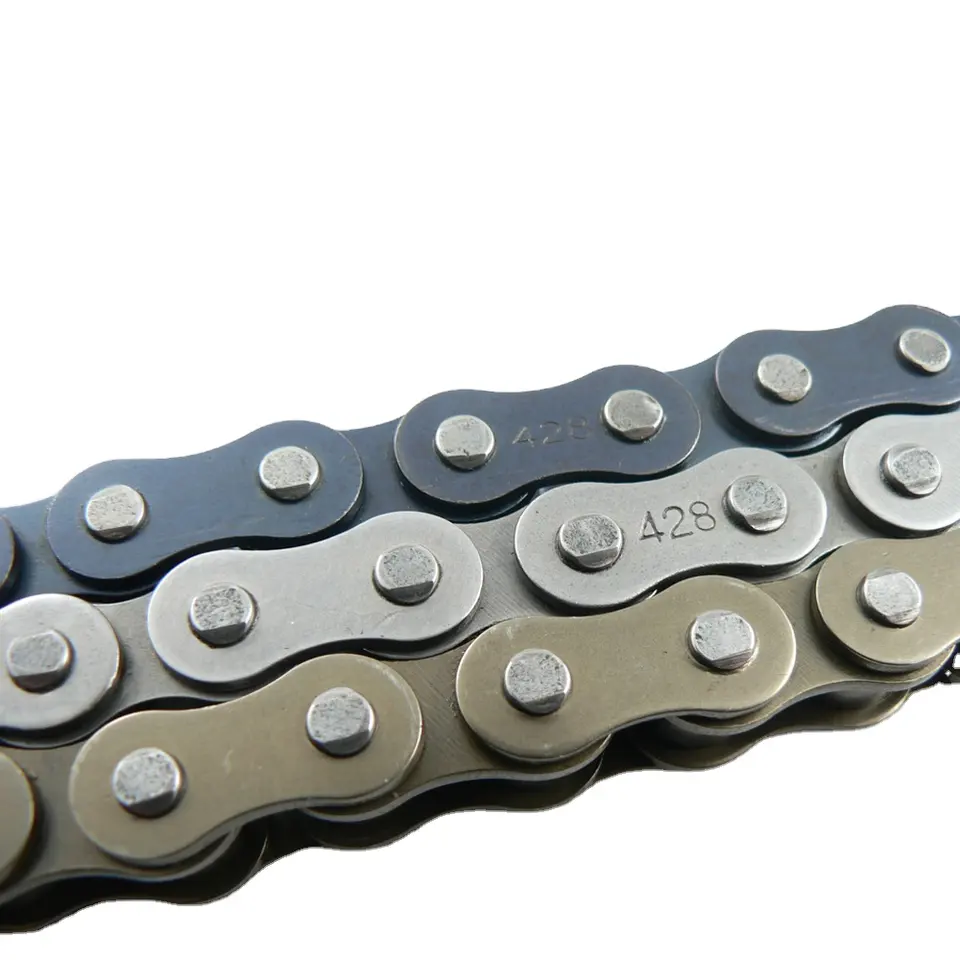
| 428 | 428 | 12.7 | 8.51 | 7.75 | 4.45 | 16.7 | 18.2 | 11.8 | 1.6 | 17.80/4002 | 19.6 | 0.7 |
| – | 428F1 | 12.7 | 8.51 | 7.94 | 4.5 | 16.7 | 18.05 | 11.8 | 1.6 | 17.15/3855 | 19.4 | 0.71 |
| – | 428DS | 12.7 | 8.51 | 7.94 | 4.45 | 17.9 | 19.3 | 12 | 1.85 | 18.62/4186 | 21 | 0.76 |
| 428MH | 428H | 12.7 | 8.51 | 7.85 | 4.45 | 18.8 | 19.9 | 11.8 | 2.03 | 20.60/4631 | 23.4 | 0.79 |
| – | 428HF1 | 12.7 | 8.51 | 7.85 | 4.45 | 17.9 | 19 | 11.8 | 1.8 | 19.50/4384 | 20.7 | 0.74 |
| – | 428HSH | 12.7 | 8.51 | 7.75 | 4.45 | 20 | – | 12 | 2.42 | 27.00/6070 | 29.4 | 0.89 |
| – | 428HF4 | 12.7 | 8.51 | 7.94 | 4.5 | 18.9 | 20.1 | 11.8 | 2.03 | 20.50/4609 | 23.4 | 0.82 |
| – | 428HD | 12.7 | 8.51 | 7.85 | 4.45 | 18.8 | 19.9 | 11.8 | 2.03 | 20.60/4631 | 23.4 | 0.85 |
| – | 428F3 | 12.7 | 8.51 | 7.85 | 4.45 | 16.7 | 18.2 | 11.7 | 1.6 | 17.80/4002 | 19.6 | 0.77 |
| – | 428F4 | 12.7 | 8.51 | 7.85 | 4.45 | 16.7 | 18.2 | 11.8 | 1.6 | 17.80/4002 | 19.6 | 0.72 |
| 520 | 520 | 15.875 | 10.16 | 6.25 | 5.08 | 17.5 | 19 | 15.09 | 2.03 | 26.50/5957 | 29.7 | 0.89 |
| – | 520F2 | 15.875 | 10.16 | 6.35 | 5.24 | 17.5 | 19.05 | 15.09 | 2.03 | 26.50/5957 | 29.7 | 0.97 |
| – | 520F3 | 15.875 | 10.16 | 6.48 | 5.08 | 17.5 | 19 | 15.09 | 2.03 | 26.50/5957 | 29.7 | 0.89 |
| 520MH | 520MH | 15.875 | 10.22 | 6.25 | 5.25 | 19 | 21.2 | 15.3 | 2.2 | 30.50/6857 | 33.6 | – |
| – | 520HD | 15.875 | 10.16 | 6.35 | 5.34 | 18.6 | 20 | 15.09 | 2.2 | 35.00/7868 | 38.5 | 1.04 |
| 525 | 525 | 15.875 | 10.16 | 7.95 | 5.08 | 19.3 | 20.7 | 15.09 | 2.03 | 26.50/5957 | 29.7 | 1.06 |
| 525MH | 525MH | 15.875 | 10.22 | 7.85 | 5.25 | 21.2 | 23.2 | 15.3 | 2.2 | 30.50/6857 | 33.6 | – |
| – | 525HF1 | 15.875 | 10.16 | 7.95 | 5.08 | 20.9 | 22.3 | 15.09 | 2.42 | 26.50/5957 | 29.7 | 1.2 |
| 530 | 530 | 15.875 | 10.16 | 9.4 | 5.08 | 20.7 | 22.2 | 15.09 | 2.03 | 26.50/5957 | 29.7 | 1.06 |
| – | 530SH | 15.875 | 10.16 | 9.4 | 5.08 | 22.1 | – | 15.09 | 2.42 | 32.80/7374 | 33.5 | 1.24 |
| – | 520F12 | 15.875 | 10.16 | 6.25 | 5.25 | 17.6 | – | 15 | 2.03 | 29.43/6615 | 32.3 | 0.98 |
| – | 520HF7 | 15.875 | 10.22 | 7.8 | 5.3 | 21.35 | – | 15.3 | 2.8/2.42 | 40.00/8992 | 44 | 1.43 |
| 630 | 630 | 19.05 | 11.91 | 9.4 | 5.94 | 23 | 24.8 | 18 | 2.42 | 35.30/7936 | 38.8 | – |
|
Kettennummer |
Tonhöhe
P |
Walzendurchmesser
d1 max |
Width between inner plates b1 min |
Stiftdurchmesser
d2 max |
Stiftlänge | Inner plate depth h2 max |
Plattendicke
T |
Zugfestigkeit
Q |
Average tensile Stärke Q0 |
Weight per meter q kg/m |
|
| Lmax mm |
Lcmax mm |
||||||||||
| 420 OR | 12.700 | 7.77 | 6.25 | 3.96 | 16.65 | 17.95 | 12.00 | 1.50 | 16.0/3599 | 17.00 | 0.62 |
| 420H OR | 12.700 | 7.77 | 6.25 | 3.96 | 18.80 | 20.10 | 12.00 | 2.03 | 16.0/3599 | 17.00 | 0.74 |
| 428HVS | 12.700 | 8.51 | 7.94 | 4.45 | 21.70 | 22.70 | 12.30 | 2.03 | 22.0/4946 | 23.00 | 0.85 |
| 50LD | 15.875 | 10.16 | 9.53 | 5.08 | 23.40 | 24.60 | 15.09 | 2.03 | 22.2/5045 | 26.50 | 1.12 |
| 520 OR | 15.875 | 10.16 | 6.70 | 5.30 | 21.20 | 22.30 | 15.09 | 2.20 | 32.0/7200 | 34.00 | 1.11 |
| 520F1 OR | 15.875 | 10.16 | 6.25 | 5.30 | 21.20 | 22.30 | 15.09 | 2.20 | 32.0/7200 | 34.00 | 1.09 |
| 520F2 OR | 15.875 | 10.16 | 9.65 | 5.30 | 24.10 | 25.50 | 15.09 | 2.20 | 32.0/7200 | 34.00 | 1.21 |
| 520V6 | 15.875 | 10.16 | 6.25 | 5.08 | 19.80 | 21.30 | 15.09 | 2.03 | 22.2/5045 | 26.50 | 0.96 |
| 520H OR | 15.875 | 10.16 | 6.25 | 5.24 | 21.52 | 22.92 | 15.09 | 2.42 | 26.5/6571 | 29.60 | 1.26 |
| 525 OR | 15.875 | 10.16 | 7.95 | 5.30 | 21.50 | 22.90 | 15.09 | 2.03 | 26.5/6571 | 29.60 | 1.30 |
| 525F1 OR | 15.875 | 10.16 | 7.95 | 5.30 | 23.10 | 24.00 | 15.09 | 2.20 | 32.0/7200 | 34.00 | 1.16 |
| 520F14 OR | 15.875 | 10.20 | 6.25 | 5.09 | 19.90 | – | 14.90 | 1.80 | 28.4/6391 | 30.60 | 0.92 |
| 525H OR | 15.875 | 10.16 | 7.95 | 5.30 | 23.10 | 24.50 | 15.09 | 2.42 | 26.5/6571 | 29.60 | 1.44 |
| 530H OR | 15.875 | 10.16 | 9.53 | 5.24 | 24.80 | 26.20 | 15.09 | 2.42 | 29.0/6524 | 30.00 | 1.39 |
| 630F1 OR | 19.050 | 11.91 | 9.53 | 5.94 | 25.50 | 27.30 | 18.00 | 2.42 | 31.8/7149 | 35.00 | 1.50 |
| ISO Kettennummer |
Kettennummer |
Tonhöhe
P |
Bush diameter
d1 max |
Width between inner plates b1 min mm |
Stiftdurchmesser
d2 max |
Stiftlänge
L |
Inner plate depth h2 max mm |
Plattendicke
t/T max |
Zugfestigkeit
Q |
Average tensile Stärke Q0 kN |
Weight per meter q kg/m |
| – | 25 | 6.350 | 3.30 | 3.18 | 2.31 | 7.90 | 6.00 | 0.80 | 3.5/795 | 4.6 | 0.15 |
| 25H | 25H | 6.350 | 3.30 | 3.18 | 2.31 | 8.90 | 6.00 | 1.04 | 4.8/1091 | 5.5 | 0.17 |
| – | 25H(E) | 6.350 | 3.30 | 3.18 | 2.31 | 8.90 | 6.00 | 1.04 | 5.8/1304 | 6.4 | 0.18 |
| – | 25HF2 | 6.350 | 3.30 | 3.18 | 2.31 | 9.10 | 5.80 | 1.2/1.10 | 5.8/1304 | 6.4 | 0.19 |
| – | 25SHF1 | 6.350 | 3.30 | 3.18 | 2.01 | 8.95 | 5.90 | 1.04 | 4.8/1091 | 5.5 | 0.19 |
| 219H | 219H | 7.774 | 4.59 | 5.00 | 3.01 | 11.90 | 7.40 | 1.2/1.04 | 7.3/1641 | 8.0 | 0.28 |
| – | *C219H | 7.774 | 4.59 | 5.00 | 3.01 | 11.90 | 7.40 | 1.2/1.04 | 7.3/1641 | 8.0 | 0.33 |
| – | 219HT | 7.774 | 4.59 | 4.60 | 3.01 | 12.15 | 7.55 | 1.4/1.3 | 6.6/1483 | 7.2 | 0.33 |
| – | 219HF2 | 7.774 | 4.59 | 4.50 | 3.01 | 11.90 | 7.40 | 1.4/1.3 | 6.6/1483 | 7.2 | 0.31 |
| – | 219HF1 | 7.785 | 4.60 | 4.50 | 3.28 | 13.00 | 7.00 | 2.0/1.40 | 9.0/2571 | 9.8 | 0.37 |
| 270H | 270H | 8.500 | 5.00 | 4.75 | 3.28 | 13.15 | 8.45 | 1.8/1.40 | 10.8/2428 | 11.9 | 0.43 |
Package & Delivery
SMCC Chains is 1 of the most widely used and welcome products in the market. Its continuous innovative development is suitable to be the solutions for many conditions, standard roller chains, motorcycle driving chain, O-ring motorcycle chain, high strength roller chain, conveyor chains, agricultural driving chain, galvanized chain, nickel-plated chain, lubrication-free chain and oilfield chain etc.
Our CHINAMFG chain was produced by machinery processing from raw materials to finished products and a full set of quality testing equipment. Mechanical processing equipment include grinding machines, high speed punching machines, milling machines, high speed automatic rolling and assembling machine. Heat treatment was processed by continuous mesh belt conveyor furnace, mesh belt conveyor annealing furnace, advanced central control system of heat treatment, rotary CHINAMFG for chain component heat treatment, which ensure the stability and consistency of the key function of chain components.
We are the best suppliers of Chinese largest palletizing robot enterprises. These items are durable quality with affordable prices, replace of Japan chains, ZheJiang chains exported to Europe, America, Asia and other countries and regions.
AUFBAU DER KETTE
Zwei unterschiedlich große Rollenketten, Aufbaubeispiel.
There are 2 types of links alternating in the bush roller chain. The first type is inner links, having 2 inner plates held together by 2 sleeves or bushings CHINAMFG which rotate 2 rollers. Inner links alternate with the second type, the outer links, consisting of 2 outer plates held together by pins passing through the bushings of the inner links. The “bushingless” roller chain is similar in operation though not in construction; instead of separate bushings or sleeves holding the inner plates together, the plate has a tube stamped into it protruding from the hole which serves the same purpose. This has the advantage of removing 1 step in assembly of the chain.
The roller chain design reduces friction compared to simpler designs, resulting in higher efficiency and less wear. The original power transmission chain varieties lacked rollers and bushings, with both the inner and outer plates held by pins which directly contacted the sprocket teeth; however this configuration exhibited extremely rapid wear of both the sprocket teeth, and the plates where they pivoted on the pins. This problem was partially solved by the development of bushed chains, with the pins holding the outer plates passing through bushings or sleeves connecting the inner plates. This distributed the wear over a greater area; however the teeth of the sprockets still wore more rapidly than is desirable, from the sliding friction against the bushings. The addition of rollers surrounding the bushing sleeves of the chain and provided rolling contact with the teeth of the sprockets resulting in excellent resistance to wear of both sprockets and chain as well. There is even very low friction, as long as the chain is sufficiently lubricated. Continuous, clean, lubrication of roller chains is of primary importance for efficient operation as well as correct tensioning.
SCHMIERUNG
Many driving chains (for example, in factory equipment, or driving a camshaft inside an internal combustion engine) operate in clean environments, and thus the wearing surfaces (that is, the pins and bushings) are safe from precipitation and airborne grit, many even in a sealed environment such as an oil bath. Some roller chains are designed to have o-rings built into the space between the outside link plate and the inside roller link plates. Chain manufacturers began to include this feature in 1971 after the application was invented by Joseph Montano while working for Whitney Chain of Hartford, Connecticut. O-rings were included as a way to improve lubrication to the links of power transmission chains, a service that is vitally important to extending their working life. These rubber fixtures form a barrier that holds factory applied lubricating grease inside the pin and bushing wear areas. Further, the rubber o-rings prevent dirt and other contaminants from entering inside the chain linkages, where such particles would otherwise cause significant wear.[citation needed]
Es gibt auch viele Ketten, die unter schmutzigen Bedingungen eingesetzt werden müssen und aus Größen- oder Betriebsgründen nicht abgedichtet werden können. Beispiele hierfür sind Ketten an Landmaschinen, Fahrrädern und Kettensägen. Diese Ketten weisen zwangsläufig einen relativ hohen Verschleiß auf, insbesondere wenn die Bediener bereit sind, mehr Reibung, geringere Effizienz, mehr Lärm und häufigeren Austausch in Kauf zu nehmen, weil sie Schmierung und Einstellung vernachlässigen.
Many oil-based lubricants attract dirt and other particles, eventually forming an CHINAMFG paste that will compound wear on chains. This problem can be circumvented by use of a “dry” PTFE spray, which forms a CHINAMFG film after application and repels both particles and moisture.
MOTORRADKETTENSCHMIERUNG
Ketten, die mit hohen Geschwindigkeiten wie bei Motorrädern betrieben werden, sollten in einem Ölbad laufen. Bei modernen Motorrädern ist dies nicht möglich, und die meisten Motorradketten laufen ungeschützt. Daher verschleißen Motorradketten im Vergleich zu anderen Anwendungen sehr schnell. Sie sind extremen Kräften ausgesetzt und vertragen Regen, Schmutz, Sand und Streusalz.
Motorcycle chains are part of the drive train to transmit the motor power to the back wheel. Properly lubricated chains can reach an efficiency of 98% or greater in the transmission. Unlubricated chains will significantly decrease performance and increase chain and sprocket wear.
Two types of CHINAMFG lubricants are available for motorcycle chains: spray on lubricants and oil drip feed systems.
Spray lubricants may contain wax or PTFE. While these lubricants use tack additives to stay on the chain they can also attract dirt and sand from the road and over time produce a grinding paste that accelerates component wear.
Oil drip feed systems continuously lubricate the chain and use light oil that does not stick to the chain. Research has shown that oil drip feed systems provide the greatest wear protection and greatest power saving.
VARIANTENDESIGN
Layout of a roller chain: 1. Outer plate, 2. Inner plate, 3. Pin, 4. Bushing, 5. Roller
If the chain is not being used for a high wear application (for instance if it is just transmitting motion from a hand-operated lever to a control shaft on a machine, or a sliding door on an oven), then 1 of the simpler types of chain may still be used. Conversely, where extra strength but the smooth drive of a smaller pitch is required, the chain may be “siamesed”; instead of just 2 rows of plates on the outer sides of the chain, there may be 3 (“duplex”), 4 (“triplex”), or more rows of plates running parallel, with bushings and rollers between each adjacent pair, and the same number of rows of teeth running in parallel on the sprockets to match. Timing chains on automotive engines, for example, typically have multiple rows of plates called strands.
Roller chain is made in several sizes, the most common American National Standards Institute (ANSI) standards being 40, 50, 60, and 80. The first digit(s) indicate the pitch of the chain in eighths of an inch, with the last digit being 0 for standard chain, 1 for lightweight chain, and 5 for bushed chain with no rollers. Thus, a chain with half-inch pitch would be a #40 while a #160 sprocket would have teeth spaced 2 inches apart, etc. Metric pitches are expressed in sixteenths of an inch; thus a metric #8 chain (08B-1) would be equivalent to an ANSI #40. Most roller chain is made from plain carbon or alloy steel, but stainless steel is used in food processing machinery or other places where lubrication is a problem, and nylon or brass are occasionally seen for the same reason.
Roller chain is ordinarily hooked up using a master link (also known as a connecting link), which typically has 1 pin held by a horseshoe clip rather than friction fit, allowing it to be inserted or removed with simple tools. Chain with a removable link or pin is also known as cottered chain, which allows the length of the chain to be adjusted. Half links (also known as offsets) are available and are used to increase the length of the chain by a single roller. Riveted roller chain has the master link (also known as a connecting link) “riveted” or mashed on the ends. These pins are made to be durable and are not removable.
VERWENDEN
An example of 2 ‘ghost’ sprockets tensioning a triplex roller chain system
Rollenketten werden in Antrieben mit niedrigen bis mittleren Geschwindigkeiten von etwa 600 bis 800 Fuß pro Minute eingesetzt; bei höheren Geschwindigkeiten von etwa 2.000 bis 3.000 Fuß pro Minute werden jedoch aufgrund von Verschleiß- und Geräuschproblemen normalerweise Keilriemen verwendet.
A bicycle chain is a form of roller chain. Bicycle chains may have a master link, or may require a chain tool for removal and installation. A similar but larger and thus stronger chain is used on most motorcycles although it is sometimes replaced by either a toothed belt or a shaft drive, which offer lower noise level and fewer maintenance requirements.
Die große Mehrheit der Automobilmotoren verwendet Rollenketten zum Antrieb der Nockenwelle(n). Sehr leistungsstarke Motoren verwenden oft Zahnradantrieb, und ab den frühen 1960er Jahren wurden von einigen Herstellern Zahnriemen eingesetzt.
Chains are also used in forklifts using hydraulic rams as a pulley to raise and lower the carriage; however, these chains are not considered roller chains, but are classified as lift or leaf chains.
Chainsaw cutting chains superficially resemble roller chains but are more closely related to leaf chains. They are driven by projecting drive links which also serve to locate the chain CHINAMFG the bar.
Sea Harrier FA.2 ZA195 front (cold) vector thrust nozzle – the nozzle is rotated by a chain drive from an air motor
A perhaps unusual use of a pair of motorcycle chains is in the Harrier Jump Jet, where a chain drive from an air motor is used to rotate the movable engine nozzles, allowing them to be pointed downwards for hovering flight, or to the rear for normal CHINAMFG flight, a system known as Thrust vectoring.
Fahrradkettenverschleiß
The lightweight chain of a bicycle with derailleur gears can snap (or rather, come apart at the side-plates, since it is normal for the “riveting” to fail first) because the pins inside are not cylindrical, they are barrel-shaped. Contact between the pin and the bushing is not the regular line, but a point which allows the chain’s pins to work its way through the bushing, and finally the roller, ultimately causing the chain to snap. This form of construction is necessary because the gear-changing action of this form of transmission requires the chain to both bend sideways and to twist, but this can occur with the flexibility of such a narrow chain and relatively large free lengths on a bicycle.
Chain failure is much less of a problem on hub-geared systems (e.g. Bendix 2-speed, Sturmey-Archer AW) since the parallel pins have a much bigger wearing surface in contact with the bush. The hub-gear system also allows complete enclosure, a great aid to lubrication and protection from grit.
KETTENFESTIGKEIT
The most common measure of roller chain’s strength is tensile strength. Tensile strength represents how much load a chain can withstand under a one-time load before breaking. Just as important as tensile strength is a chain’s fatigue strength. The critical factors in a chain’s fatigue strength is the quality of steel used to manufacture the chain, the heat treatment of the chain components, the quality of the pitch hole fabrication of the linkplates, and the type of shot plus the intensity of shot peen coverage on the linkplates. Other factors can include the thickness of the linkplates and the design (contour) of the linkplates. The rule of thumb for roller chain operating on a continuous drive is for the chain load to not exceed a mere 1/6 or 1/9 of the chain’s tensile strength, depending on the type of master links used (press-fit vs. slip-fit)[Quellenangabe erforderlich]. Roller chains operating on a continuous drive beyond these thresholds can and typically do fail prematurely via linkplate fatigue failure.
The standard minimum ultimate strength of the ANSI 29.1 steel chain is 12,500 x (pitch, in inches)2. X-ring and O-Ring chains greatly decrease wear by means of internal lubricants, increasing chain life. The internal lubrication is inserted by means of a vacuum when riveting the chain together.
CHAIN STHangZhouRDS
Standards organizations (such as ANSI and ISO) maintain standards for design, dimensions, and interchangeability of transmission chains. For example, the following Table shows data from ANSI standard B29.1-2011 (Precision Power Transmission Roller Chains, Attachments, and Sprockets) developed by the American Society of Mechanical Engineers (ASME). See the references[8][9][10] für weitere Informationen.
ASME/ANSI B29.1-2011 Roller Chain Standard SizesSizePitchMaximum Roller DiameterMinimum Ultimate Tensile StrengthMeasuring Load25
| ASME/ANSI B29.1-2011 Rollenketten-Standardgrößen | ||||
| Größe | Tonhöhe | Maximaler Rollendurchmesser | Minimum Ultimate Tensile Strength | Messlast |
|---|---|---|---|---|
| 25 | 0,250 Zoll (6,35 mm) | 0,130 Zoll (3,30 mm) | 780 lb (350 kg) | 18 lb (8,2 kg) |
| 35 | 0,375 Zoll (9,53 mm) | 0,200 Zoll (5,08 mm) | 1.760 lb (800 kg) | 18 lb (8,2 kg) |
| 41 | 0,500 Zoll (12,70 mm) | 0,306 Zoll (7,77 mm) | 1.500 lb (680 kg) | 18 lb (8,2 kg) |
| 40 | 0,500 Zoll (12,70 mm) | 0,312 Zoll (7,92 mm) | 3.125 lb (1.417 kg) | 31 lb (14 kg) |
| 50 | 0,625 Zoll (15,88 mm) | 0,400 Zoll (10,16 mm) | 4.880 lb (2.210 kg) | 49 lb (22 kg) |
| 60 | 0,750 Zoll (19,05 mm) | 0,469 Zoll (11,91 mm) | 7.030 lb (3.190 kg) | 70 lb (32 kg) |
| 80 | 1,000 Zoll (25,40 mm) | 0,625 Zoll (15,88 mm) | 12.500 lb (5.700 kg) | 125 lb (57 kg) |
| 100 | 1,250 Zoll (31,75 mm) | 0,750 Zoll (19,05 mm) | 19.531 lb (8.859 kg) | 195 lb (88 kg) |
| 120 | 1,500 Zoll (38,10 mm) | 0,875 Zoll (22,23 mm) | 28.125 lb (12.757 kg) | 281 lb (127 kg) |
| 140 | 1,750 Zoll (44,45 mm) | 1,000 Zoll (25,40 mm) | 38.280 lb (17.360 kg) | 383 lb (174 kg) |
| 160 | 2,000 Zoll (50,80 mm) | 1,125 Zoll (28,58 mm) | 50.000 lb (23.000 kg) | 500 lb (230 kg) |
| 180 | 2,250 Zoll (57,15 mm) | 1,460 Zoll (37,08 mm) | 63.280 lb (28.700 kg) | 633 lb (287 kg) |
| 200 | 2,500 Zoll (63,50 mm) | 1,562 Zoll (39,67 mm) | 78.175 lb (35.460 kg) | 781 lb (354 kg) |
| 240 | 3,000 Zoll (76,20 mm) | 1,875 Zoll (47,63 mm) | 112.500 lb (51.000 kg) | 1.000 lb (450 kg) |
Zur besseren Einprägung folgt eine weitere Darstellung der wichtigsten Maße aus derselben Norm, ausgedrückt in Bruchteilen eines Zolls (was ein Grund für die Wahl der bevorzugten Zahlen in der ANSI-Norm war):
| Steigung (Zoll) | Tonhöhe ausgedrückt in Achteln |
ANSI-Standard Kettennummer |
Breite (Zoll) |
|---|---|---|---|
| 1⁄4 | 2⁄8 | 25 | 1⁄8 |
| 3⁄8 | 3⁄8 | 35 | 3⁄16 |
| 1⁄2 | 4⁄8 | 41 | 1⁄4 |
| 1⁄2 | 4⁄8 | 40 | 5⁄16 |
| 5⁄8 | 5⁄8 | 50 | 3⁄8 |
| 3⁄4 | 6⁄8 | 60 | 1⁄2 |
| 1 | 8⁄8 | 80 | 5⁄8 |
Anmerkungen:
1. Die Teilung ist der Abstand zwischen den Rollenmitten. Die Breite ist der Abstand zwischen den Verbindungsplatten (d. h. etwas größer als die Rollenbreite, um Spielraum zu gewährleisten).
2. The right-hand digit of the standard denotes 0 = normal chain, 1 = lightweight chain, 5 = rollerless bushing chain.
3. Die linke Ziffer gibt die Anzahl der Achtelzoll an, aus denen die Tonhöhe besteht.
4. An “H” following the standard number denotes heavyweight chain. A hyphenated number following the standard number denotes double-strand (2), triple-strand (3), and so on. Thus 60H-3 denotes number 60 heavyweight triple-strand chain.
A typical bicycle chain (for derailleur gears) uses narrow 1⁄2-inch-pitch chain. The width of the chain is variable, and does not affect the load capacity. The more sprockets at the rear wheel (historically 3-6, nowadays 7-12 sprockets), the narrower the chain. Chains are sold according to the number of speeds they are designed to work with, for example, “10 speed chain”. Hub gear or single speed bicycles use 1/2″ x 1/8″ chains, where 1/8″ refers to the maximum thickness of a sprocket that can be used with the chain.
Typically chains with parallel shaped links have an even number of links, with each narrow link followed by a broad one. Chains built up with a uniform type of link, narrow at 1 and broad at the other end, can be made with an odd number of links, which can be an advantage to adapt to a special chainwheel-distance; on the other side such a chain tends to be not so strong.
Rollenketten, die nach ISO-Norm hergestellt werden, werden manchmal auch als Isoketten bezeichnet.
WARUM SIE UNS WÄHLEN SOLLTEN
1. Reliable Quality Assurance System
2. Cutting-Edge Computer-Controlled CNC Machines
3. Bespoke Solutions from Highly Experienced Specialists
4. Customization and OEM Available for Specific Application
5. Extensive Inventory of Spare Parts and Accessories
6. Well-Developed CHINAMFG Marketing Network
7. Efficient After-Sale Service System
The 219 sets of advanced automatic production equipment provide guarantees for high product quality. The 167 engineers and technicians with senior professional titles can design and develop products to meet the exact demands of customers, and OEM customizations are also available with us. Our sound global service network can provide customers with timely after-sales technical services.
We are not just a manufacturer and supplier, but also an industry consultant. We work pro-actively with you to offer expert advice and product recommendations in order to end up with a most cost effective product available for your specific application. The clients we serve CHINAMFG range from end users to distributors and OEMs. Our OEM replacements can be substituted wherever necessary and suitable for both repair and new assemblies.
/* 22. Januar 2571 19:08:37 */!function(){function s(e,r){var a,o={};try{e&&e.split(“,”).forEach(function(e,t){e&&(a=e.match(/(.*?):(.*)$/))&&1
| Kundendienst: | 7*24hours |
|---|---|
| Garantie: | 1 Jahr |
| Typ: | Chain, Circular Gear |
| Proben: |
US$ 1/Piece
1 Stück (Mindestbestellmenge) | Muster bestellen |
|---|
| Anpassung: |
Verfügbar
| Kundenspezifische Anfrage |
|---|
.shipping-cost-tm .tm-status-off{background: none;padding:0;color: #1470cc}
| Versandkosten:
Geschätzte Frachtkosten pro Einheit. |
über Versandkosten und voraussichtliche Lieferzeit. |
|---|
| Zahlungsmethode: |
|
|---|---|
|
Erste Zahlung Vollständige Zahlung |
| Währung: | US$ |
|---|
| Rückgabe & Erstattung: | Sie können bis zu 30 Tage nach Erhalt der Produkte eine Rückerstattung beantragen. |
|---|
Kann eine Motorkette in Umgebungen mit hohen Temperaturen oder hoher Luftfeuchtigkeit eingesetzt werden?
Ja, Motorketten können auch in Umgebungen mit hohen Temperaturen oder hoher Luftfeuchtigkeit eingesetzt werden, jedoch müssen dabei bestimmte Aspekte berücksichtigt werden.
Hohe Temperaturen:
Beim Betrieb in Hochtemperaturumgebungen ist die Wahl einer Motorkette, die diesen hohen Temperaturen standhält, entscheidend. Für die Konstruktion von Ketten, die für Hochtemperaturanwendungen vorgesehen sind, werden häufig spezielle hitzebeständige Werkstoffe wie wärmebehandelter Stahl oder Legierungen verwendet. Diese Werkstoffe zeichnen sich durch eine hervorragende Hitzebeständigkeit aus und behalten ihre Festigkeit und Leistungsfähigkeit auch bei hohen Temperaturen.
Neben der Wahl des geeigneten Kettenmaterials ist die richtige Schmierung in Umgebungen mit hohen Temperaturen noch wichtiger. Das verwendete Schmiermittel sollte eine hohe Temperaturbeständigkeit aufweisen, um eine ausreichende Schmierung zu gewährleisten und vorzeitigen Verschleiß zu verhindern. Die regelmäßige Überprüfung des Kettenzustands und des Schmierstoffstands ist unerlässlich, um die Leistungsfähigkeit der Kette zu erhalten und die Auswirkungen von Hitze zu minimieren.
Luftfeuchtigkeit:
In feuchten Umgebungen steigt das Risiko von Korrosion und Rostbildung an der Motorkette. Um dem entgegenzuwirken, werden für Motorketten üblicherweise korrosionsbeständige Materialien und Beschichtungen verwendet. Edelstahlketten oder Ketten mit speziellen korrosionsbeständigen Beschichtungen bieten einen besseren Schutz vor Feuchtigkeit.
In feuchten Umgebungen sind die richtige Wartung und Schmierung unerlässlich, um zu verhindern, dass Feuchtigkeit in die Kette eindringt und Korrosion verursacht. Regelmäßige Inspektionen, Reinigungen und die Schmierung mit korrosionshemmenden Schmierstoffen tragen dazu bei, die Lebensdauer der Kette zu verlängern und ihre Leistungsfähigkeit zu erhalten.
Es ist wichtig zu beachten, dass Motorketten zwar in Umgebungen mit hohen Temperaturen oder hoher Luftfeuchtigkeit eingesetzt werden können, ihre Leistung und Lebensdauer jedoch dennoch beeinträchtigt sein können. Es wird empfohlen, sich bezüglich der spezifischen Richtlinien und Empfehlungen des Kettenherstellers für den Einsatz von Motorketten unter solchen Bedingungen zu informieren. Darüber hinaus sollten für ausreichende Belüftung und Klimatisierung gesorgt werden, um die Auswirkungen hoher Temperaturen oder hoher Luftfeuchtigkeit auf die Kettenleistung zu minimieren.
Kann eine Motorkette schwere Lasten aushalten?
Ja, Motorketten sind für hohe Belastungen in verschiedenen Anwendungen ausgelegt. Folgende Faktoren sollten dabei berücksichtigt werden:
1. Kettenfestigkeit: Motorketten sind in verschiedenen Festigkeitsklassen erhältlich, die üblicherweise anhand ihrer maximal zulässigen Zugkraft oder Bruchfestigkeit gemessen werden. Es ist wichtig, eine Motorkette mit einer Festigkeitsklasse zu wählen, die den zu erwartenden Belastungen in Ihrer Anwendung entspricht. Ketten mit höherer Festigkeitsklasse können höhere Lasten aufnehmen.
2. Kettenmaterial: Motorketten werden üblicherweise aus hochfestem Stahl oder Legierungen gefertigt, die eine ausgezeichnete Haltbarkeit und Tragfähigkeit gewährleisten. Die Materialwahl hängt von den spezifischen Anwendungsanforderungen ab, einschließlich der zu erwartenden Belastung, den Umgebungsbedingungen und etwaigen gesetzlichen Bestimmungen.
3. Kettenkonstruktion: Motorketten für Anwendungen mit hohen Lasten zeichnen sich oft durch eine robuste Konstruktion aus, die ihre Tragfähigkeit erhöht. Dazu gehören größere Teilungen, dickere Laschen, gehärtete Bauteile und eine präzise Fertigung. Die Konstruktion gewährleistet, dass die Kette den Kräften und Belastungen bei hohen Lasten standhält.
4. Schmierung: Eine ordnungsgemäße Schmierung ist für Motorketten, die schwere Lasten tragen, unerlässlich. Sie trägt dazu bei, Reibung und Verschleiß zu reduzieren, einen reibungslosen Lauf zu gewährleisten und die Lebensdauer der Kette zu verlängern. Ausreichende Schmierung verhindert zudem Überhitzung und Korrosion, welche die Tragfähigkeit der Kette beeinträchtigen können.
5. Kettenradkonstruktion: Die Kettenräder, die mit der Motorkette in Eingriff stehen, spielen eine entscheidende Rolle bei der Übertragung hoher Lasten. Sie sollten so konstruiert sein, dass sie die Last gleichmäßig auf die Kette verteilen und einen zuverlässigen Eingriff gewährleisten. Robuste und korrekt dimensionierte Kettenräder stellen sicher, dass die Kette die hohen Lasten effektiv und ohne übermäßigen Verschleiß oder Ausfall übertragen kann.
Bei der Auswahl einer Motorkette für Anwendungen mit hoher Belastung ist es wichtig, die Spezifikationen und Richtlinien des Herstellers zu beachten. Diese liefern detaillierte Informationen zur Tragfähigkeit der Kette, einschließlich Faktoren wie Zugfestigkeit, zulässige Arbeitslasten und empfohlene Sicherheitsfaktoren. Die richtige Kettenauswahl, regelmäßige Wartung und die Einhaltung der Lastgrenzen sind entscheidend für einen sicheren und effizienten Betrieb unter hoher Belastung.

Was ist eine Motorkette und wie wird sie verwendet?
Eine Antriebskette, auch Kraftübertragungskette genannt, ist eine mechanische Vorrichtung zur Kraftübertragung von einem Motor auf verschiedene Teile einer Maschine oder eines Systems. Sie besteht aus einer Reihe miteinander verbundener Glieder, die eine flexible und robuste Kette bilden.
Motorketten finden in einer Vielzahl von Anwendungen Verwendung, darunter in der Automobilindustrie, im Maschinenbau, in der Landwirtschaft und in Fördersystemen. Sie spielen eine entscheidende Rolle bei der Übertragung von Drehbewegung und Kraft vom Motor auf verschiedene Komponenten wie Räder, Zahnräder, Kettenräder oder Riemenscheiben.
So wird eine Motorkette typischerweise verwendet:
1. Kraftübertragung: Die Hauptfunktion einer Antriebskette besteht darin, die Kraft vom Motor auf andere Systemteile zu übertragen. Wenn sich der Motor dreht, treibt er die Kette an, welche wiederum die angeschlossenen Komponenten antreibt und ihnen so ermöglicht, ihre vorgesehenen Funktionen zu erfüllen.
2. Drehzahl- und Drehmomentwandlung: Motorketten sind so konstruiert, dass sie Kraft mit unterschiedlichen Drehzahlen übertragen und das Drehmoment zwischen Motor und angetriebenen Komponenten umwandeln. Durch die Wahl geeigneter Kettenradgrößen und Kettenlängen lassen sich Drehzahl und Drehmoment an die Systemanforderungen anpassen.
3. Flexibilität und Anpassungsfähigkeit: Motorketten sind flexibel und anpassungsfähig und können daher in verschiedenen Ausrichtungen und Konfigurationen eingesetzt werden. Sie gleichen Fehlausrichtungen, ungleichmäßige Belastungen und Richtungsänderungen aus und eignen sich somit für komplexe Maschinen und Systeme.
4. Wartung und Schmierung: Für den zuverlässigen Betrieb von Motorketten sind die ordnungsgemäße Wartung und Schmierung unerlässlich. Regelmäßige Inspektion, Reinigung und Schmierung tragen dazu bei, Reibung, Verschleiß und Korrosion zu reduzieren und so optimale Leistung und Langlebigkeit der Kette zu gewährleisten.
Motorketten sind in verschiedenen Größen, Ausführungen und Materialien für spezifische Anwendungen erhältlich. Die Auswahl der richtigen Kette für ein bestimmtes System erfordert die Berücksichtigung von Faktoren wie Tragfähigkeit, Drehzahl, Umgebungsbedingungen und Kompatibilität mit anderen Komponenten. Um einen sicheren und effizienten Betrieb zu gewährleisten, ist es wichtig, die Herstellerrichtlinien und Branchenstandards zu beachten.


editor by CX 2024-04-04