Descrição do produto
HangZhou STAR MACHINE TECHNOLOGY CO.,LTD. is an professional manufacturer with 20 years of production experience for motocycle chains. We have the most advanced technical team and the most advanced processing experimental equipment and service team all over the world. Our products are mainly sold to Russia, Uzbekistan, Malaysia, Germany, Egypt, Brazil, mainland China and ZheJiang . Reliable quality and attractive price, we sincerely look CHINAMFG to working with you! Do not hesitate to contact us in any time if you have any needs or questions. We would supply you with high quality and cheap products and technical advice and support.
BASIC INFO
SMCC roller chain is 1 of the most widely used and welcome products in the market. Its continuous innovative development is suitable to be the solutions for many conditions, standard roller chains, motorcycle driving chain, O-ring motorcycle chain, high strength roller chain, conveyor chains, agricultural driving chain, galvanized chain, nickel-plated chain, lubrication-free chain and oilfield chain etc.
| ISO Número da corrente |
Número da corrente | Pitch P mm |
Diâmetro do rolo d1máx mm |
Largura entre as placas internas b1min mm |
Diâmetro do pino d2máx mm |
Comprimento do pino | Profundidade da placa interna h2máx |
Espessura da placa t/Tmax |
Resistência à tracção Qmin |
resistência média à tração Q0 |
Peso por metro q |
|
| Lmax | Lcmax | |||||||||||
| mm | mm | mm | mm | kN/lbf | kN | kg/m | ||||||
| – | 9.525 | 6 | 9.5 | 4.5 | 18.6 | 20 | 9.3 | 1.85/1.50 | 11.80/2653 | 13.6 | 0.61 | |
| 420 | 420 | 12.7 | 7.77 | 6.25 | 3.96 | 14.7 | 16.1 | 12 | 1.5 | 16.00/3597 | 17.6 | 0.55 |
| – | 420F3 | 12.7 | 7.77 | 6.4 | 3.97 | 15 | 16.6 | 11.8 | 1.60/1.45 | 16.00/3597 | 17.6 | 0.64 |
| – | 420HF1 | 12.7 | 7.77 | 6.25 | 3.96 | 17 | 18.4 | 12 | 2.03 | 16.00/3597 | 17.6 | 0.76 |
| – | 420HT | 12.7 | 7.77 | 6.25 | 3.96 | 17 | – | 12 | 2.03 | 21.40/4811 | 23.5 | 0.76 |
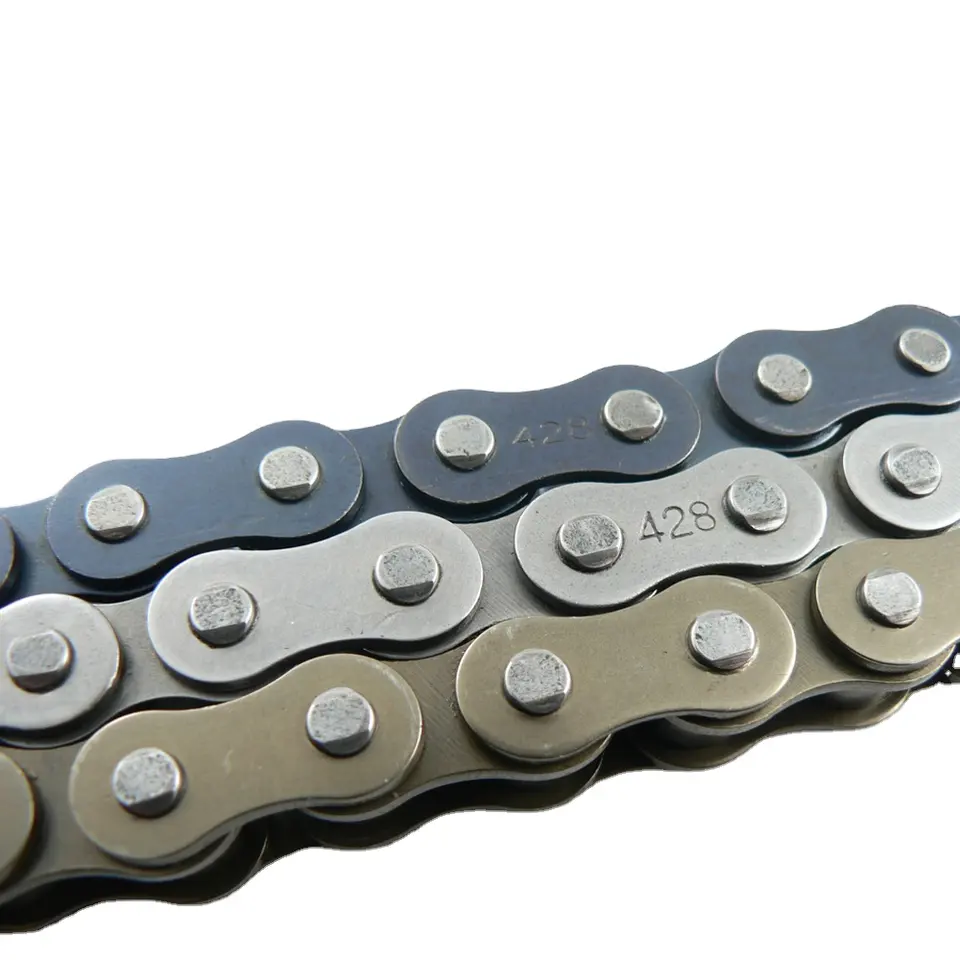
| 428 | 428 | 12.7 | 8.51 | 7.75 | 4.45 | 16.7 | 18.2 | 11.8 | 1.6 | 17.80/4002 | 19.6 | 0.7 |
| – | 428F1 | 12.7 | 8.51 | 7.94 | 4.5 | 16.7 | 18.05 | 11.8 | 1.6 | 17.15/3855 | 19.4 | 0.71 |
| – | 428DS | 12.7 | 8.51 | 7.94 | 4.45 | 17.9 | 19.3 | 12 | 1.85 | 18.62/4186 | 21 | 0.76 |
| 428MH | 428H | 12.7 | 8.51 | 7.85 | 4.45 | 18.8 | 19.9 | 11.8 | 2.03 | 20.60/4631 | 23.4 | 0.79 |
| – | 428HF1 | 12.7 | 8.51 | 7.85 | 4.45 | 17.9 | 19 | 11.8 | 1.8 | 19.50/4384 | 20.7 | 0.74 |
| – | 428HSH | 12.7 | 8.51 | 7.75 | 4.45 | 20 | – | 12 | 2.42 | 27.00/6070 | 29.4 | 0.89 |
| – | 428HF4 | 12.7 | 8.51 | 7.94 | 4.5 | 18.9 | 20.1 | 11.8 | 2.03 | 20.50/4609 | 23.4 | 0.82 |
| – | 428HD | 12.7 | 8.51 | 7.85 | 4.45 | 18.8 | 19.9 | 11.8 | 2.03 | 20.60/4631 | 23.4 | 0.85 |
| – | 428F3 | 12.7 | 8.51 | 7.85 | 4.45 | 16.7 | 18.2 | 11.7 | 1.6 | 17.80/4002 | 19.6 | 0.77 |
| – | 428F4 | 12.7 | 8.51 | 7.85 | 4.45 | 16.7 | 18.2 | 11.8 | 1.6 | 17.80/4002 | 19.6 | 0.72 |
| 520 | 520 | 15.875 | 10.16 | 6.25 | 5.08 | 17.5 | 19 | 15.09 | 2.03 | 26.50/5957 | 29.7 | 0.89 |
| – | 520F2 | 15.875 | 10.16 | 6.35 | 5.24 | 17.5 | 19.05 | 15.09 | 2.03 | 26.50/5957 | 29.7 | 0.97 |
| – | 520F3 | 15.875 | 10.16 | 6.48 | 5.08 | 17.5 | 19 | 15.09 | 2.03 | 26.50/5957 | 29.7 | 0.89 |
| 520MH | 520MH | 15.875 | 10.22 | 6.25 | 5.25 | 19 | 21.2 | 15.3 | 2.2 | 30.50/6857 | 33.6 | – |
| – | 520HD | 15.875 | 10.16 | 6.35 | 5.34 | 18.6 | 20 | 15.09 | 2.2 | 35.00/7868 | 38.5 | 1.04 |
| 525 | 525 | 15.875 | 10.16 | 7.95 | 5.08 | 19.3 | 20.7 | 15.09 | 2.03 | 26.50/5957 | 29.7 | 1.06 |
| 525MH | 525MH | 15.875 | 10.22 | 7.85 | 5.25 | 21.2 | 23.2 | 15.3 | 2.2 | 30.50/6857 | 33.6 | – |
| – | 525HF1 | 15.875 | 10.16 | 7.95 | 5.08 | 20.9 | 22.3 | 15.09 | 2.42 | 26.50/5957 | 29.7 | 1.2 |
| 530 | 530 | 15.875 | 10.16 | 9.4 | 5.08 | 20.7 | 22.2 | 15.09 | 2.03 | 26.50/5957 | 29.7 | 1.06 |
| – | 530SH | 15.875 | 10.16 | 9.4 | 5.08 | 22.1 | – | 15.09 | 2.42 | 32.80/7374 | 33.5 | 1.24 |
| – | 520F12 | 15.875 | 10.16 | 6.25 | 5.25 | 17.6 | – | 15 | 2.03 | 29.43/6615 | 32.3 | 0.98 |
| – | 520HF7 | 15.875 | 10.22 | 7.8 | 5.3 | 21.35 | – | 15.3 | 2.8/2.42 | 40.00/8992 | 44 | 1.43 |
| 630 | 630 | 19.05 | 11.91 | 9.4 | 5.94 | 23 | 24.8 | 18 | 2.42 | 35.30/7936 | 38.8 | – |
|
Número da corrente |
Tom
P |
Diâmetro do rolo
d1 máx. |
Width between inner plates b1 min |
Diâmetro do pino
d2 máx. |
Comprimento do pino | Inner plate depth h2 máx. |
Espessura da placa
T |
Resistência à tracção
Q |
Average tensile força Q0 |
Weight per meter q kg/m |
|
| Lmax mm |
Lcmax mm |
||||||||||
| 420 OR | 12.700 | 7.77 | 6.25 | 3.96 | 16.65 | 17.95 | 12.00 | 1.50 | 16.0/3599 | 17.00 | 0.62 |
| 420H OR | 12.700 | 7.77 | 6.25 | 3.96 | 18.80 | 20.10 | 12.00 | 2.03 | 16.0/3599 | 17.00 | 0.74 |
| 428HVS | 12.700 | 8.51 | 7.94 | 4.45 | 21.70 | 22.70 | 12.30 | 2.03 | 22.0/4946 | 23.00 | 0.85 |
| 50LD | 15.875 | 10.16 | 9.53 | 5.08 | 23.40 | 24.60 | 15.09 | 2.03 | 22.2/5045 | 26.50 | 1.12 |
| 520 OR | 15.875 | 10.16 | 6.70 | 5.30 | 21.20 | 22.30 | 15.09 | 2.20 | 32.0/7200 | 34.00 | 1.11 |
| 520F1 OR | 15.875 | 10.16 | 6.25 | 5.30 | 21.20 | 22.30 | 15.09 | 2.20 | 32.0/7200 | 34.00 | 1.09 |
| 520F2 OR | 15.875 | 10.16 | 9.65 | 5.30 | 24.10 | 25.50 | 15.09 | 2.20 | 32.0/7200 | 34.00 | 1.21 |
| 520V6 | 15.875 | 10.16 | 6.25 | 5.08 | 19.80 | 21.30 | 15.09 | 2.03 | 22.2/5045 | 26.50 | 0.96 |
| 520H OR | 15.875 | 10.16 | 6.25 | 5.24 | 21.52 | 22.92 | 15.09 | 2.42 | 26.5/6571 | 29.60 | 1.26 |
| 525 OR | 15.875 | 10.16 | 7.95 | 5.30 | 21.50 | 22.90 | 15.09 | 2.03 | 26.5/6571 | 29.60 | 1.30 |
| 525F1 OR | 15.875 | 10.16 | 7.95 | 5.30 | 23.10 | 24.00 | 15.09 | 2.20 | 32.0/7200 | 34.00 | 1.16 |
| 520F14 OR | 15.875 | 10.20 | 6.25 | 5.09 | 19.90 | – | 14.90 | 1.80 | 28.4/6391 | 30.60 | 0.92 |
| 525H OR | 15.875 | 10.16 | 7.95 | 5.30 | 23.10 | 24.50 | 15.09 | 2.42 | 26.5/6571 | 29.60 | 1.44 |
| 530H OR | 15.875 | 10.16 | 9.53 | 5.24 | 24.80 | 26.20 | 15.09 | 2.42 | 29.0/6524 | 30.00 | 1.39 |
| 630F1 OR | 19.050 | 11.91 | 9.53 | 5.94 | 25.50 | 27.30 | 18.00 | 2.42 | 31.8/7149 | 35.00 | 1.50 |
| ISO Número da corrente |
Número da corrente |
Tom
P |
Bush diameter
d1 máx. |
Width between inner plates b1 min mm |
Diâmetro do pino
d2 máx. |
Comprimento do pino
L |
Inner plate depth h2 máx. mm |
Espessura da placa
t/T max |
Resistência à tracção
Q |
Average tensile força Q0 kN |
Weight per meter q kg/m |
| – | 25 | 6.350 | 3.30 | 3.18 | 2.31 | 7.90 | 6.00 | 0.80 | 3.5/795 | 4.6 | 0.15 |
| 25H | 25H | 6.350 | 3.30 | 3.18 | 2.31 | 8.90 | 6.00 | 1.04 | 4.8/1091 | 5.5 | 0.17 |
| – | 25H(E) | 6.350 | 3.30 | 3.18 | 2.31 | 8.90 | 6.00 | 1.04 | 5.8/1304 | 6.4 | 0.18 |
| – | 25HF2 | 6.350 | 3.30 | 3.18 | 2.31 | 9.10 | 5.80 | 1.2/1.10 | 5.8/1304 | 6.4 | 0.19 |
| – | 25SHF1 | 6.350 | 3.30 | 3.18 | 2.01 | 8.95 | 5.90 | 1.04 | 4.8/1091 | 5.5 | 0.19 |
| 219H | 219H | 7.774 | 4.59 | 5.00 | 3.01 | 11.90 | 7.40 | 1.2/1.04 | 7.3/1641 | 8.0 | 0.28 |
| – | *C219H | 7.774 | 4.59 | 5.00 | 3.01 | 11.90 | 7.40 | 1.2/1.04 | 7.3/1641 | 8.0 | 0.33 |
| – | 219HT | 7.774 | 4.59 | 4.60 | 3.01 | 12.15 | 7.55 | 1.4/1.3 | 6.6/1483 | 7.2 | 0.33 |
| – | 219HF2 | 7.774 | 4.59 | 4.50 | 3.01 | 11.90 | 7.40 | 1.4/1.3 | 6.6/1483 | 7.2 | 0.31 |
| – | 219HF1 | 7.785 | 4.60 | 4.50 | 3.28 | 13.00 | 7.00 | 2.0/1.40 | 9.0/2571 | 9.8 | 0.37 |
| 270H | 270H | 8.500 | 5.00 | 4.75 | 3.28 | 13.15 | 8.45 | 1.8/1.40 | 10.8/2428 | 11.9 | 0.43 |
Package & Delivery
SMCC Chains is 1 of the most widely used and welcome products in the market. Its continuous innovative development is suitable to be the solutions for many conditions, standard roller chains, motorcycle driving chain, O-ring motorcycle chain, high strength roller chain, conveyor chains, agricultural driving chain, galvanized chain, nickel-plated chain, lubrication-free chain and oilfield chain etc.
Our CHINAMFG chain was produced by machinery processing from raw materials to finished products and a full set of quality testing equipment. Mechanical processing equipment include grinding machines, high speed punching machines, milling machines, high speed automatic rolling and assembling machine. Heat treatment was processed by continuous mesh belt conveyor furnace, mesh belt conveyor annealing furnace, advanced central control system of heat treatment, rotary CHINAMFG for chain component heat treatment, which ensure the stability and consistency of the key function of chain components.
We are the best suppliers of Chinese largest palletizing robot enterprises. These items are durable quality with affordable prices, replace of Japan chains, ZheJiang chains exported to Europe, America, Asia and other countries and regions.
CONSTRUCTION OF THE CHAIN
Two different sizes of roller chain, showing construction.
There are 2 types of links alternating in the bush roller chain. The first type is inner links, having 2 inner plates held together by 2 sleeves or bushings CHINAMFG which rotate 2 rollers. Inner links alternate with the second type, the outer links, consisting of 2 outer plates held together by pins passing through the bushings of the inner links. The “bushingless” roller chain is similar in operation though not in construction; instead of separate bushings or sleeves holding the inner plates together, the plate has a tube stamped into it protruding from the hole which serves the same purpose. This has the advantage of removing 1 step in assembly of the chain.
The roller chain design reduces friction compared to simpler designs, resulting in higher efficiency and less wear. The original power transmission chain varieties lacked rollers and bushings, with both the inner and outer plates held by pins which directly contacted the sprocket teeth; however this configuration exhibited extremely rapid wear of both the sprocket teeth, and the plates where they pivoted on the pins. This problem was partially solved by the development of bushed chains, with the pins holding the outer plates passing through bushings or sleeves connecting the inner plates. This distributed the wear over a greater area; however the teeth of the sprockets still wore more rapidly than is desirable, from the sliding friction against the bushings. The addition of rollers surrounding the bushing sleeves of the chain and provided rolling contact with the teeth of the sprockets resulting in excellent resistance to wear of both sprockets and chain as well. There is even very low friction, as long as the chain is sufficiently lubricated. Continuous, clean, lubrication of roller chains is of primary importance for efficient operation as well as correct tensioning.
LUBRICATION
Many driving chains (for example, in factory equipment, or driving a camshaft inside an internal combustion engine) operate in clean environments, and thus the wearing surfaces (that is, the pins and bushings) are safe from precipitation and airborne grit, many even in a sealed environment such as an oil bath. Some roller chains are designed to have o-rings built into the space between the outside link plate and the inside roller link plates. Chain manufacturers began to include this feature in 1971 after the application was invented by Joseph Montano while working for Whitney Chain of Hartford, Connecticut. O-rings were included as a way to improve lubrication to the links of power transmission chains, a service that is vitally important to extending their working life. These rubber fixtures form a barrier that holds factory applied lubricating grease inside the pin and bushing wear areas. Further, the rubber o-rings prevent dirt and other contaminants from entering inside the chain linkages, where such particles would otherwise cause significant wear.[citation needed]
There are also many chains that have to operate in dirty conditions, and for size or operational reasons cannot be sealed. Examples include chains on farm equipment, bicycles, and chain saws. These chains will necessarily have relatively high rates of wear, particularly when the operators are prepared to accept more friction, less efficiency, more noise and more frequent replacement as they neglect lubrication and adjustment.
Many oil-based lubricants attract dirt and other particles, eventually forming an CHINAMFG paste that will compound wear on chains. This problem can be circumvented by use of a “dry” PTFE spray, which forms a CHINAMFG film after application and repels both particles and moisture.
MOTORCYCLE CHAIN LUBRICATION
Chains operating at high speeds comparable to those on motorcycles should be used in conjunction with an oil bath. For modern motorcycles this is not possible, and most motorcycle chains run unprotected. Thus, motorcycle chains tend to wear very quickly relative to other applications. They are subject to extreme forces and are exposed to rain, dirt, sand and road salt.
Motorcycle chains are part of the drive train to transmit the motor power to the back wheel. Properly lubricated chains can reach an efficiency of 98% or greater in the transmission. Unlubricated chains will significantly decrease performance and increase chain and sprocket wear.
Two types of CHINAMFG lubricants are available for motorcycle chains: spray on lubricants and oil drip feed systems.
Spray lubricants may contain wax or PTFE. While these lubricants use tack additives to stay on the chain they can also attract dirt and sand from the road and over time produce a grinding paste that accelerates component wear.
Oil drip feed systems continuously lubricate the chain and use light oil that does not stick to the chain. Research has shown that oil drip feed systems provide the greatest wear protection and greatest power saving.
VARIANTS DESIGN
Layout of a roller chain: 1. Outer plate, 2. Inner plate, 3. Pin, 4. Bushing, 5. Roller
If the chain is not being used for a high wear application (for instance if it is just transmitting motion from a hand-operated lever to a control shaft on a machine, or a sliding door on an oven), then 1 of the simpler types of chain may still be used. Conversely, where extra strength but the smooth drive of a smaller pitch is required, the chain may be “siamesed”; instead of just 2 rows of plates on the outer sides of the chain, there may be 3 (“duplex”), 4 (“triplex”), or more rows of plates running parallel, with bushings and rollers between each adjacent pair, and the same number of rows of teeth running in parallel on the sprockets to match. Timing chains on automotive engines, for example, typically have multiple rows of plates called strands.
Roller chain is made in several sizes, the most common American National Standards Institute (ANSI) standards being 40, 50, 60, and 80. The first digit(s) indicate the pitch of the chain in eighths of an inch, with the last digit being 0 for standard chain, 1 for lightweight chain, and 5 for bushed chain with no rollers. Thus, a chain with half-inch pitch would be a #40 while a #160 sprocket would have teeth spaced 2 inches apart, etc. Metric pitches are expressed in sixteenths of an inch; thus a metric #8 chain (08B-1) would be equivalent to an ANSI #40. Most roller chain is made from plain carbon or alloy steel, but stainless steel is used in food processing machinery or other places where lubrication is a problem, and nylon or brass are occasionally seen for the same reason.
Roller chain is ordinarily hooked up using a master link (also known as a connecting link), which typically has 1 pin held by a horseshoe clip rather than friction fit, allowing it to be inserted or removed with simple tools. Chain with a removable link or pin is also known as cottered chain, which allows the length of the chain to be adjusted. Half links (also known as offsets) are available and are used to increase the length of the chain by a single roller. Riveted roller chain has the master link (also known as a connecting link) “riveted” or mashed on the ends. These pins are made to be durable and are not removable.
USE
An example of 2 ‘ghost’ sprockets tensioning a triplex roller chain system
Roller chains are used in low- to mid-speed drives at around 600 to 800 feet per minute; however, at higher speeds, around 2,000 to 3,000 feet per minute, V-belts are normally used due to wear and noise issues.
A bicycle chain is a form of roller chain. Bicycle chains may have a master link, or may require a chain tool for removal and installation. A similar but larger and thus stronger chain is used on most motorcycles although it is sometimes replaced by either a toothed belt or a shaft drive, which offer lower noise level and fewer maintenance requirements.
The great majority of automobile engines use roller chains to drive the camshaft(s). Very high performance engines often use gear drive, and starting in the early 1960s toothed belts were used by some manufacturers.
Chains are also used in forklifts using hydraulic rams as a pulley to raise and lower the carriage; however, these chains are not considered roller chains, but are classified as lift or leaf chains.
Chainsaw cutting chains superficially resemble roller chains but are more closely related to leaf chains. They are driven by projecting drive links which also serve to locate the chain CHINAMFG the bar.
Sea Harrier FA.2 ZA195 front (cold) vector thrust nozzle – the nozzle is rotated by a chain drive from an air motor
A perhaps unusual use of a pair of motorcycle chains is in the Harrier Jump Jet, where a chain drive from an air motor is used to rotate the movable engine nozzles, allowing them to be pointed downwards for hovering flight, or to the rear for normal CHINAMFG flight, a system known as Thrust vectoring.
BICYCLE CHAIN WEAR
The lightweight chain of a bicycle with derailleur gears can snap (or rather, come apart at the side-plates, since it is normal for the “riveting” to fail first) because the pins inside are not cylindrical, they are barrel-shaped. Contact between the pin and the bushing is not the regular line, but a point which allows the chain’s pins to work its way through the bushing, and finally the roller, ultimately causing the chain to snap. This form of construction is necessary because the gear-changing action of this form of transmission requires the chain to both bend sideways and to twist, but this can occur with the flexibility of such a narrow chain and relatively large free lengths on a bicycle.
Chain failure is much less of a problem on hub-geared systems (e.g. Bendix 2-speed, Sturmey-Archer AW) since the parallel pins have a much bigger wearing surface in contact with the bush. The hub-gear system also allows complete enclosure, a great aid to lubrication and protection from grit.
CHAIN STRENGTH
The most common measure of roller chain’s strength is tensile strength. Tensile strength represents how much load a chain can withstand under a one-time load before breaking. Just as important as tensile strength is a chain’s fatigue strength. The critical factors in a chain’s fatigue strength is the quality of steel used to manufacture the chain, the heat treatment of the chain components, the quality of the pitch hole fabrication of the linkplates, and the type of shot plus the intensity of shot peen coverage on the linkplates. Other factors can include the thickness of the linkplates and the design (contour) of the linkplates. The rule of thumb for roller chain operating on a continuous drive is for the chain load to not exceed a mere 1/6 or 1/9 of the chain’s tensile strength, depending on the type of master links used (press-fit vs. slip-fit)[citation needed]. Roller chains operating on a continuous drive beyond these thresholds can and typically do fail prematurely via linkplate fatigue failure.
The standard minimum ultimate strength of the ANSI 29.1 steel chain is 12,500 x (pitch, in inches)2. X-ring and O-Ring chains greatly decrease wear by means of internal lubricants, increasing chain life. The internal lubrication is inserted by means of a vacuum when riveting the chain together.
CHAIN STHangZhouRDS
Standards organizations (such as ANSI and ISO) maintain standards for design, dimensions, and interchangeability of transmission chains. For example, the following Table shows data from ANSI standard B29.1-2011 (Precision Power Transmission Roller Chains, Attachments, and Sprockets) developed by the American Society of Mechanical Engineers (ASME). See the references[8][9][10] for additional information.
ASME/ANSI B29.1-2011 Roller Chain Standard SizesSizePitchMaximum Roller DiameterMinimum Ultimate Tensile StrengthMeasuring Load25
| ASME/ANSI B29.1-2011 Roller Chain Standard Sizes | ||||
| Tamanho | Tom | Maximum Roller Diameter | Minimum Ultimate Tensile Strength | Measuring Load |
|---|---|---|---|---|
| 25 | 0.250 in (6.35 mm) | 0.130 in (3.30 mm) | 780 lb (350 kg) | 18 lb (8,2 kg) |
| 35 | 0,375 pol (9,53 mm) | 0,200 pol (5,08 mm) | 1.760 lb (800 kg) | 18 lb (8,2 kg) |
| 41 | 0,500 pol (12,70 mm) | 0,306 pol. (7,77 mm) | 1.500 lb (680 kg) | 18 lb (8,2 kg) |
| 40 | 0,500 pol (12,70 mm) | 0,312 pol. (7,92 mm) | 3.125 lb (1.417 kg) | 31 lb (14 kg) |
| 50 | 0,625 pol. (15,88 mm) | 0,400 pol (10,16 mm) | 4.880 lb (2.210 kg) | 49 lb (22 kg) |
| 60 | 0,750 pol (19,05 mm) | 0,469 pol (11,91 mm) | 7.030 lb (3.190 kg) | 70 lb (32 kg) |
| 80 | 1,000 pol. (25,40 mm) | 0,625 pol. (15,88 mm) | 12.500 lb (5.700 kg) | 125 lb (57 kg) |
| 100 | 1,250 pol. (31,75 mm) | 0,750 pol (19,05 mm) | 19.531 lb (8.859 kg) | 195 lb (88 kg) |
| 120 | 1,500 pol. (38,10 mm) | 0,875 pol. (22,23 mm) | 28.125 lb (12.757 kg) | 281 lb (127 kg) |
| 140 | 1,750 pol. (44,45 mm) | 1,000 pol. (25,40 mm) | 38.280 lb (17.360 kg) | 383 lb (174 kg) |
| 160 | 2,000 pol. (50,80 mm) | 1,125 pol. (28,58 mm) | 50.000 lb (23.000 kg) | 500 lb (230 kg) |
| 180 | 2,250 pol. (57,15 mm) | 1,460 pol. (37,08 mm) | 63.280 lb (28.700 kg) | 633 lb (287 kg) |
| 200 | 2,500 pol. (63,50 mm) | 1,562 pol. (39,67 mm) | 78.175 lb (35.460 kg) | 781 lb (354 kg) |
| 240 | 3,000 pol. (76,20 mm) | 1,875 pol. (47,63 mm) | 112.500 lb (51.000 kg) | 1.000 lb (450 kg) |
Para facilitar a memorização, segue abaixo outra apresentação das principais dimensões da mesma norma, expressas em frações de polegada (o que influenciou a escolha dos números preferenciais na norma ANSI):
| Inclinação (polegadas) | Tom expresso em oitavos |
Norma ANSI número da cadeia |
Largura (polegadas) |
|---|---|---|---|
| 1/4 | 2/8 | 25 | 1/8 |
| 3/8 | 3/8 | 35 | 3/16 |
| 1/2 | 4/8 | 41 | 1/4 |
| 1/2 | 4/8 | 40 | 5/16 |
| 5/8 | 5/8 | 50 | 3/8 |
| 3/4 | 6/8 | 60 | 1/2 |
| 1 | 8/8 | 80 | 5/8 |
Notas:
1. O passo é a distância entre os centros dos roletes. A largura é a distância entre as placas de ligação (ou seja, ligeiramente maior que a largura do rolete para permitir folga).
2. The right-hand digit of the standard denotes 0 = normal chain, 1 = lightweight chain, 5 = rollerless bushing chain.
3. O dígito à esquerda indica o número de oitavos de polegada que compõem o espaçamento.
4. An “H” following the standard number denotes heavyweight chain. A hyphenated number following the standard number denotes double-strand (2), triple-strand (3), and so on. Thus 60H-3 denotes number 60 heavyweight triple-strand chain.
A typical bicycle chain (for derailleur gears) uses narrow 1⁄2-inch-pitch chain. The width of the chain is variable, and does not affect the load capacity. The more sprockets at the rear wheel (historically 3-6, nowadays 7-12 sprockets), the narrower the chain. Chains are sold according to the number of speeds they are designed to work with, for example, “10 speed chain”. Hub gear or single speed bicycles use 1/2″ x 1/8″ chains, where 1/8″ refers to the maximum thickness of a sprocket that can be used with the chain.
Typically chains with parallel shaped links have an even number of links, with each narrow link followed by a broad one. Chains built up with a uniform type of link, narrow at 1 and broad at the other end, can be made with an odd number of links, which can be an advantage to adapt to a special chainwheel-distance; on the other side such a chain tends to be not so strong.
Correntes de rolos fabricadas segundo a norma ISO são por vezes designadas como isocorrentes.
POR QUE NOS ESCOLHER?
1. Reliable Quality Assurance System
2. Cutting-Edge Computer-Controlled CNC Machines
3. Bespoke Solutions from Highly Experienced Specialists
4. Customization and OEM Available for Specific Application
5. Extensive Inventory of Spare Parts and Accessories
6. Well-Developed CHINAMFG Marketing Network
7. Efficient After-Sale Service System
The 219 sets of advanced automatic production equipment provide guarantees for high product quality. The 167 engineers and technicians with senior professional titles can design and develop products to meet the exact demands of customers, and OEM customizations are also available with us. Our sound global service network can provide customers with timely after-sales technical services.
We are not just a manufacturer and supplier, but also an industry consultant. We work pro-actively with you to offer expert advice and product recommendations in order to end up with a most cost effective product available for your specific application. The clients we serve CHINAMFG range from end users to distributors and OEMs. Our OEM replacements can be substituted wherever necessary and suitable for both repair and new assemblies.
/* 22 de janeiro de 2571 19:08:37 */!function(){function s(e,r){var a,o={};try{e&&e.split(“”,).forEach(function(e,t){e&&(a=e.match(/(.*?):(.*)$/))&&1
| Serviço pós-venda: | 7*24hours |
|---|---|
| Garantia: | 1 ano |
| Tipo: | Chain, Circular Gear |
| Exemplos: |
US$ 1/Piece
1 unidade (pedido mínimo) | Solicitar amostra |
|---|
| Personalização: |
Disponível
| Solicitação personalizada |
|---|
.shipping-cost-tm .tm-status-off{background: none;padding:0;color: #1470cc}
| Custo do frete:
Frete estimado por unidade. |
sobre o custo do frete e o prazo estimado de entrega. |
|---|
| Método de pagamento: |
|
|---|---|
|
Pagamento inicial Pagamento integral |
| Moeda: | US$ |
|---|
| Devoluções e reembolsos: | Você pode solicitar um reembolso em até 30 dias após o recebimento dos produtos. |
|---|
É possível utilizar uma corrente de transmissão em ambientes com altas temperaturas ou umidade?
Sim, as correntes de transmissão podem ser usadas em ambientes com altas temperaturas ou umidade, mas certas considerações precisam ser levadas em conta.
Altas temperaturas:
Ao operar em ambientes de alta temperatura, é importante escolher uma corrente de transmissão que suporte as altas temperaturas. Materiais especiais resistentes ao calor, como aço ou ligas tratadas termicamente, são frequentemente usados na fabricação de correntes destinadas a aplicações em altas temperaturas. Esses materiais possuem resistência térmica superior e mantêm sua resistência e desempenho mesmo em temperaturas elevadas.
Além da seleção do material adequado para a corrente, a lubrificação correta torna-se ainda mais crucial em ambientes de alta temperatura. O lubrificante utilizado deve ter uma classificação de alta temperatura para garantir lubrificação adequada e evitar desgaste prematuro. O monitoramento regular da condição da corrente e dos níveis de lubrificação é essencial para manter seu desempenho e minimizar os efeitos do calor.
Umidade:
Em ambientes úmidos, o risco de corrosão e formação de ferrugem na corrente do motor aumenta. Para solucionar esse problema, materiais e revestimentos anticorrosivos são comumente utilizados em correntes de motores. Correntes de aço inoxidável ou com revestimentos especiais anticorrosivos oferecem melhor proteção contra umidade.
A manutenção e lubrificação adequadas também são cruciais em ambientes úmidos para evitar que a umidade penetre na corrente e cause corrosão. Inspeções regulares, limpeza e lubrificação com lubrificantes anticorrosivos podem ajudar a prolongar a vida útil da corrente e manter seu desempenho.
É importante observar que, embora as correntes de transmissão possam ser usadas em ambientes com alta temperatura ou umidade, seu desempenho e vida útil ainda podem ser afetados. Recomenda-se consultar o fabricante da corrente para obter diretrizes e recomendações específicas sobre o uso de correntes de transmissão nessas condições. Além disso, deve-se considerar a ventilação adequada e o controle ambiental para minimizar o impacto de altas temperaturas ou umidade no desempenho da corrente.
Uma corrente de motor consegue suportar cargas pesadas?
Sim, as correntes de transmissão são projetadas para suportar cargas pesadas em diversas aplicações. Aqui estão alguns fatores a serem considerados:
1. Resistência da Corrente: As correntes para motores estão disponíveis em diferentes níveis de resistência, geralmente medidos em termos de sua tensão máxima admissível ou resistência à ruptura. É importante selecionar uma corrente para motor com um nível de resistência adequado às cargas previstas para sua aplicação. Correntes com níveis de resistência mais altos podem suportar cargas mais pesadas.
2. Material da corrente: As correntes de motores são geralmente feitas de aço de alta resistência ou materiais de liga que proporcionam excelente durabilidade e capacidade de carga. A escolha do material depende dos requisitos específicos da aplicação, incluindo a carga esperada, as condições ambientais e quaisquer normas regulamentares.
3. Projeto da Corrente: Correntes de transmissão projetadas para aplicações de carga pesada geralmente possuem características de construção robustas para aumentar sua capacidade de suportar cargas. Essas características podem incluir passos maiores, placas mais espessas, componentes endurecidos e fabricação de precisão. O projeto garante que a corrente suporte as forças e tensões associadas a cargas pesadas.
4. Lubrificação: A lubrificação adequada é essencial para correntes de motores que suportam cargas pesadas. Ela ajuda a reduzir o atrito e o desgaste, garantindo uma operação suave e prolongando a vida útil da corrente. A lubrificação adequada também previne o superaquecimento e a corrosão, que podem afetar negativamente a capacidade de carga da corrente.
5. Projeto da Roda Dentada: As rodas dentadas que se engatam na corrente do motor também desempenham um papel crucial no manuseio de cargas pesadas. Elas devem ser projetadas para distribuir a carga uniformemente ao longo da corrente e proporcionar um engate confiável. Rodas dentadas robustas e com dimensões adequadas garantem que a corrente possa transmitir as cargas pesadas de forma eficaz, sem desgaste excessivo ou falhas.
Ao escolher uma corrente para motor para aplicações com cargas pesadas, é importante consultar as especificações e diretrizes do fabricante. Elas podem fornecer informações detalhadas sobre a capacidade de carga da corrente, incluindo fatores como resistência à tração, limites de carga de trabalho e fatores de segurança recomendados. A seleção adequada da corrente, a manutenção regular e o respeito aos limites de carga são essenciais para garantir uma operação segura e eficiente sob cargas pesadas.

O que é uma corrente de motor e como ela é usada?
Uma corrente de transmissão, também conhecida como corrente de potência, é um dispositivo mecânico usado para transmitir energia de um motor ou máquina para diversas partes de uma máquina ou sistema. Consiste em uma série de elos interligados que formam uma corrente flexível e durável.
As correntes de transmissão são comumente usadas em uma ampla gama de aplicações, incluindo automotiva, máquinas industriais, equipamentos agrícolas e sistemas de transporte. Elas desempenham um papel vital na transmissão do movimento rotacional e da potência do motor para diferentes componentes, como rodas, engrenagens, rodas dentadas ou polias.
Eis como uma corrente de motor é normalmente usada:
1. Transmissão de Potência: A função principal de uma cadeia de transmissão é transmitir potência do motor para outras partes do sistema. Quando o motor gira, ele aciona a cadeia, que por sua vez aciona os componentes conectados, permitindo que eles executem suas funções pretendidas.
2. Conversão de Velocidade e Torque: As correntes de transmissão são projetadas para transmitir potência em diferentes velocidades e converter o torque entre o motor e os componentes acionados. Selecionando os tamanhos de engrenagem e comprimentos de corrente adequados, a velocidade de rotação e o torque podem ser ajustados para atender às necessidades do sistema.
3. Flexibilidade e Adaptabilidade: As correntes de transmissão são flexíveis e adaptáveis, permitindo sua utilização em diversas orientações e configurações. Elas podem acomodar desalinhamentos, cargas desiguais e mudanças de direção, tornando-as adequadas para máquinas e sistemas complexos.
4. Manutenção e Lubrificação: A manutenção e a lubrificação adequadas são essenciais para o funcionamento confiável das correntes de transmissão. Inspeções, limpezas e lubrificações regulares ajudam a reduzir o atrito, o desgaste e a corrosão, garantindo o desempenho ideal e a longevidade da corrente.
As correntes para motores estão disponíveis em diferentes tamanhos, modelos e materiais para atender a aplicações específicas. A seleção da corrente adequada para um determinado sistema envolve a consideração de fatores como capacidade de carga, velocidade, ambiente e compatibilidade com outros componentes. É importante seguir as diretrizes do fabricante e as normas do setor para garantir uma operação segura e eficiente.


editor by CX 2024-04-04