Before Starting — Three Pre-Replacement Decisions
Three decisions made before the new chain arrives affect how smoothly the replacement goes:
View the tooth profile from the side under good lighting. Hook-shaped or asymmetric tooth tips mean the sprocket must also be replaced. Order the chain and sprockets together to avoid fitting a new chain on worn sprockets, which halves the new chain’s service life. The front (countershaft) sprocket should be replaced every time; the rear needs inspection and replacement if hook wear is visible.
Count the links on the old chain before removing it — count each pin as one link around the full circuit. Record this number. Alternatively, check the service manual for the OEM link count for your machine. Order one or two extra links for adjustment margin, especially if the rear axle is currently toward the front of its adjustment range.
Most replacement chains come with a master link included. Confirm whether it is a clip-type (quick-link with a spring clip) or a press-fit (rivet-type) master link. Clip-type links can be installed without tools. Press-fit links require a chain press tool to correctly peen the pin. Do not use a press-fit master link without the correct tool — an improperly pressed pin will fail under load.
Tools and Materials Needed
Step-by-Step Replacement Procedure
Loosen the rear axle and move it forward in the adjustment slot
Before removing the old chain, loosen the rear axle nut and wind both axle adjusters fully forward (toward the front of the swingarm slot). This maximises the available slack in the chain, making it possible to manoeuvre the old chain off the sprockets without forcing. Note the current adjuster positions by counting the threads visible beyond the lock nuts before adjusting — this gives you a reference for reinstalling the new chain at approximately the same tension before fine-tuning.
Remove the old chain — find and open the master link
Rotate the rear wheel slowly to find the master link — the link whose outer plate has a different profile or whose pins have a visible clip or flare. For a clip-type master link: use needle-nose pliers to slide the spring clip off the pins, then press the outer plate off. For a rivet-type or press-fit link on the old chain: use the chain breaker tool to push one pin out far enough to separate the link.
Once the chain is open, slide it off the rear sprocket and through any chain guide or slider. Feed it off the front sprocket. On machines with a one-piece swingarm, you may need to thread the chain out from one side.
Inspect and replace the sprockets
With the old chain removed, inspect both sprockets carefully. The front sprocket: remove the cover plate, undo the sprocket bolt (often has a locking tab that must be bent straight), and slide the old sprocket off the countershaft spline. Compare tooth profile against a straight edge — any hook or asymmetry means replace.
Fit the new front sprocket onto the countershaft spline — confirm it seats fully and the bolt thread is clean. Torque the sprocket bolt to specification (typically 40–80 Nm depending on machine — check service manual) and bend the locking tab back into position if applicable.
Size the new chain to the correct link count
Count the links in the new chain. If it is longer than needed (new chains typically come as standard bulk lengths), use the chain breaker to remove links until the count matches the old chain’s link count. Always remove links in pairs (one inner and one outer) to maintain the correct inner-outer link sequence — the chain must end with an inner link pair that the master link’s outer plates close over.
Thread the new chain and join with the master link
Thread the new chain over the front sprocket first (through any chain guide), around the rear sprocket, and bring the two ends together at the bottom of the rear sprocket or on the lower run. Insert the master link pins through the inner link plates on both chain ends, then fit the outer plate over the pins.
For clip-type master links, the spring clip must be installed with its closed end facing the direction of chain travel. The open end of the “U” shape must face away from the direction the chain moves.
Why: As the chain runs, the clip is exposed to vibration and minor lateral forces. If the open end faces forward (into chain travel), these forces tend to push the clip toward the open end — and off the pins. If the closed end faces forward, the same forces push the clip further onto the pins, preventing it from coming off.
Adjust tension, align axle, and torque
Rotate the rear wheel slowly one full revolution, pressing upward on the chain at mid-span to find the tightest point. At the tightest point, adjust both axle adjusters equally until the chain slack is within the OEM specification (check service manual — typically 20–35 mm of total vertical movement at the tightest point). Verify the alignment marks on both sides of the swingarm match. Torque the rear axle nut to specification.
Lubricate the new chain
Apply chain lubricant to the inner roller faces of the new chain — on the lower run, while rotating the rear wheel slowly. New chains come lightly lubricated from the factory but benefit from a full fresh application after installation. Allow the lubricant to penetrate for 10 minutes before the first ride.
After the first 500 km: New chains bed in during the initial riding period, with the joints settling under load. Check tension after the first 500 km and re-adjust if the slack has increased — this bedding-in adjustment is normal and does not indicate a problem with the chain.
Final checks before riding
- ✓Rear wheel spins freely with no resistance at any point in the rotation
- ✓Master link clip is correctly oriented (closed end forward) and seated on both pins
- ✓Chain slack is within OEM specification at the tightest point
- ✓Alignment marks on both sides of the swingarm match
- ✓Axle nut torqued to service manual specification
- ✓Rear brake is functioning — drum brake adjuster re-checked if fitted, disc caliper properly seated
- ✓Front sprocket cover reinstalled and bolts torqued

Sealed Chain Master Link — One Additional Step
Sealed chain master links (O-ring and X-ring types) include small rubber O-rings or X-rings that seat in grooves on the master link pins. These seals must be installed correctly — one on each pin on each side of the inner link — before the outer plate is pressed on. Missing a seal renders that joint unsealed, and the internal factory grease at that specific joint will migrate out over time just as in a non-sealed chain.
For clip-type sealed master links: fit one seal on each pin, thread the pins through the inner plates, fit a second seal on each pin on the outer face, then press the outer plate onto the pins until both pins are flush with the outer plate face, and install the spring clip. The seals compress slightly to form the seal when the outer plate is fully seated.
Apply a small amount of the grease supplied with the master link kit (if included) to the pin surfaces and seal grooves before assembly. This is the internal grease that protects the master link’s pin-bushing interface — the same role as the factory-packed grease in the other joints.
Ready to Order a Replacement Chain?
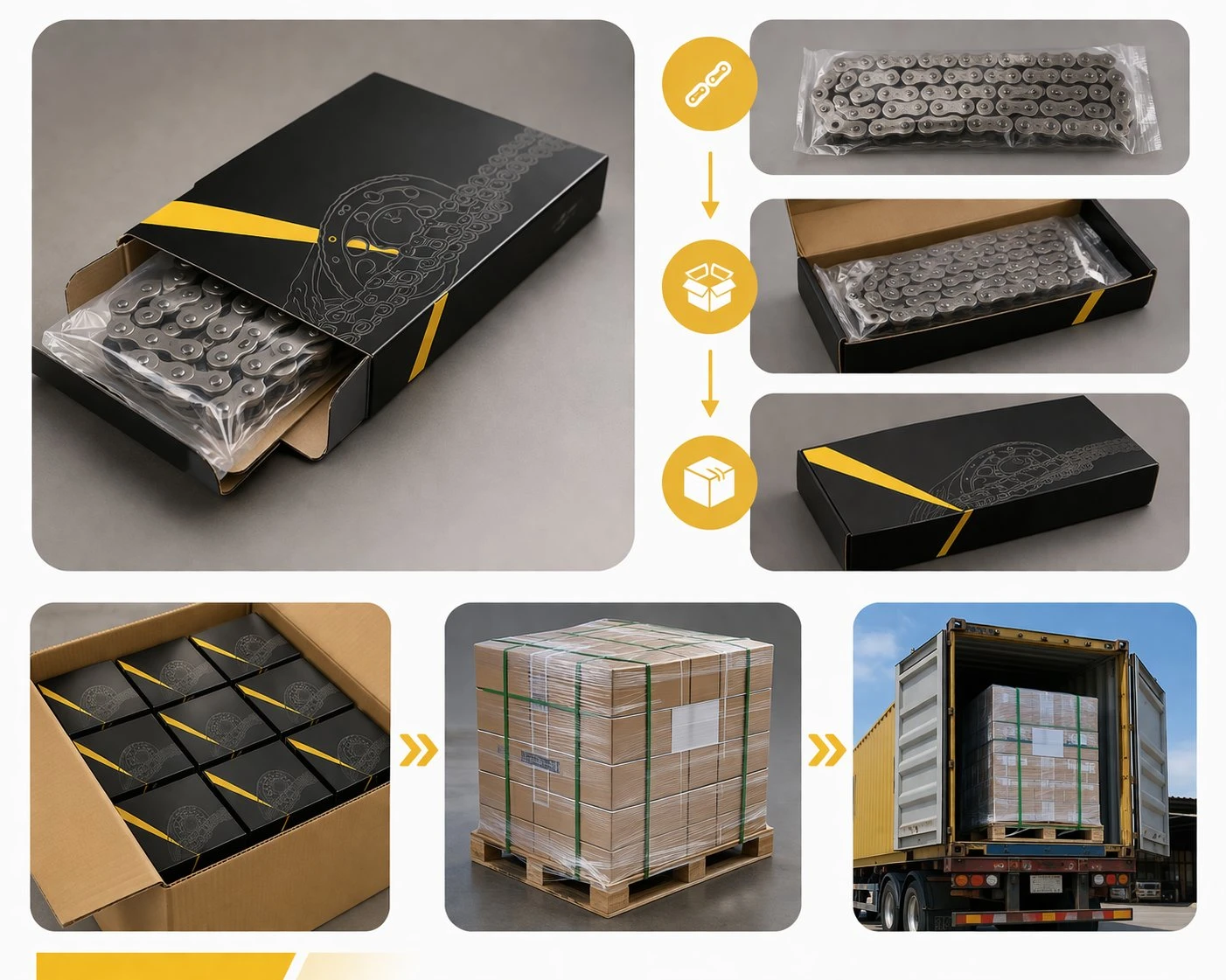
All sizes in stock — 420 through 530, standard through Super X-ring. Master link included with every chain. Dispatch within 3–7 business days. Send us your chain’s size code and we confirm the specification.
Frequently Asked Questions
Order Your Replacement Chain
Korea Ever-Power supplies all motorcycle chain sizes — 420 through 530 — in standard, H-grade, O-ring, X-ring, and Super X-ring. Master link included. Send us your size code and we confirm the specification before dispatch.
Editor: Cxm