Standard Motorcycle Chain — 420 / 428 / 520 / 525 / 530 Non-Sealed Series
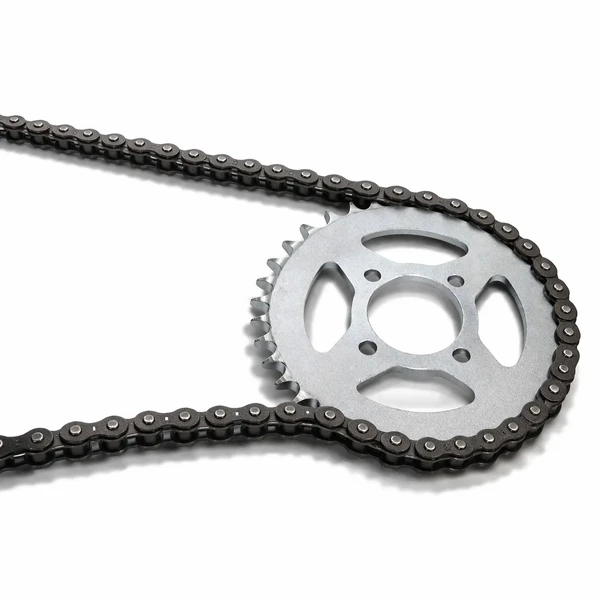
Non-sealed standard motorcycle chain in 420, 428, 520, 525, and 530 series. Curled-type bushing with tensile strength from 15.6 kN (420-series) to 26.5 kN (520/525/530). Affordable and lightweight for consistent-maintenance street, commuter, and casual recreational riding. Full spec table with pitch, roller diameter, plate thickness, pin length, and weight data.
Product Overview
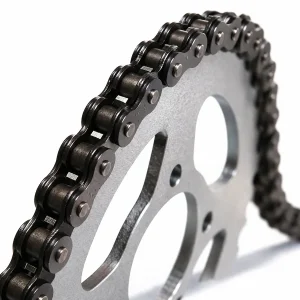
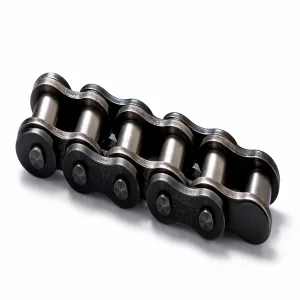
A standard motorcycle chain is a type of roller chain used to transmit power from the engine to the rear wheel. It is made up of a series of links connected by pins and rollers — the links are typically made of steel, and the pins and rollers are made of hardened steel. Standard motorcycle chains are available in a variety of sizes determined by pitch, width, and plate thickness. The pitch is the distance between the centres of two adjacent pins; the width is the distance between the outside of the two outer plates; the thickness is the distance between the inner plate faces.

The most common size of a standard motorcycle chain is 428, used on many types of motorcycles including street bikes, dirt bikes, and scooters. Other widely-used sizes include 520 and 530. Standard chains are relatively straightforward to replace and work well for riders who maintain a regular lubrication schedule. While they do not provide the sealed-lubrication advantage of O-ring or X-ring chains, they are lighter, more affordable, and the preferred choice in applications where maintenance is consistent or where chain replacement is performed frequently — such as track racing, where chains are changed every few rounds regardless of condition.
Standard Motorcycle Chain Size Chart
The table below covers the five standard non-sealed motorcycle drive chain sizes in our range. All five use a curled-type bushing — a bushing formed by rolling flat steel strip into a cylindrical form rather than machined from bar stock. This construction is appropriate for standard-service applications and produces a lighter chain than solid-bushing alternatives. Tensile strength values shown (kN) are measured break loads under controlled test conditions.
| Chain No. | Pitch (mm) | Bush Type | Width (mm) | Pin Dia (mm) | Pin Length (mm) | Roller Dia (mm) | Plate T Inner (mm) | Plate T Outer (mm) | Tensile Strength (kN) | Weight (kg/m) |
|---|---|---|---|---|---|---|---|---|---|---|
| 420 | 12.700 | Curled | 6.35 | 3.96 | 14.70 | 7.77 | 1.50 | 1.50 | 15.6 | 0.57 |
| 428 | 12.700 | Curled | 7.85 | 4.45 | 16.70 | 8.51 | 1.60 | 1.60 | 17.8 | 0.71 |
| 520 | 15.875 | Curled | 6.35 | 5.08 | 17.50 | 10.14 | 2.03 | 1.96 | 26.5 | 0.91 |
| 525 | 15.875 | Curled | 7.94 | 5.08 | 19.40 | 10.14 | 2.03 | 1.96 | 26.5 | 0.98 |
| 530 | 15.875 | Curled | 9.53 | 5.08 | 20.70 | 10.14 | 2.03 | 1.96 | 26.5 | 1.09 |
Advantages of the Standard Motorcycle Chain
Standard motorcycle chains — also known as non-sealed chains — are the most widely-fitted type of motorcycle chain. They are less expensive than O-ring and X-ring chains, lighter in weight, and easier to install and maintain. For riders operating primarily on paved roads with regular maintenance habits, a standard chain is a practical and economical choice.

- 🏅
Affordability: Standard motorcycle chains are the most cost-effective option in the range. This is because they do not incorporate the additional rubber seals and modified plate geometry found in O-ring and X-ring variants, keeping materials and manufacturing costs lower. - 🏅
Weight savings: Standard chains are lighter than sealed equivalents in the same pitch. For motorcycles designed for performance — sport bikes and racing bikes — reduced rotating mass has a measurable effect on acceleration response and handling feel. - 🏅
Ease of installation and maintenance: Standard chains are straightforward to install and maintain. No O-ring-safe cleaning products are required — any motorcycle-grade chain cleaner and chain lubricant is compatible. For fleet operators and workshops, this simplifies product stocking. - 🏅
Versatility: Standard motorcycle chains suit a wide range of bikes — from small 50cc scooters on 420-series through to 650–750cc naked and touring machines on 530-series. A single non-sealed chain covers most street and casual recreational applications provided maintenance is kept up.
Standard chains do require more frequent lubrication than sealed chains and are more susceptible to corrosion from moisture and road salt. For off-road, wet-condition, or low-maintenance riding, a sealed O-ring or X-ring chain is the better long-term investment. For consistent paved-road use with regular maintenance, the standard chain delivers reliable service at the lowest cost per kilometre.
How to Clean and Maintain Motorcycle Chain
Regular cleaning is the single most effective maintenance step for extending the life of a standard non-sealed motorcycle chain. Cleaning removes abrasive particles that embed in the lubricant film and accelerate wear at pin-bushing joints. A clean chain also takes up fresh lubricant more evenly and allows easier visual inspection for stretch, stiff links, or plate damage.
Cleaning Steps
- 1
Put the motorcycle on a centre stand. This makes it easier to rotate the rear wheel and access the chain from all sides. - 2
Spray the chain with motorcycle chain cleaner. Be sure to coat all sides of the chain, including the sprocket contact faces. - 3
Scrub with a motorcycle chain brush. Pay close attention to areas with heavy build-up of dirt and dried lubricant between the plates. - 4
Rinse with water to remove the cleaner. Allow the chain to drain briefly. - 5
Dry with a clean rag, then apply chain lubricant to the inner roller faces while rotating the wheel slowly. Wipe off excess after two minutes.
How often you clean your motorcycle chain depends on how frequently you ride and the conditions involved. Riding frequently in dusty or muddy conditions may require cleaning every few hundred kilometres. In dry conditions on paved roads, cleaning every 500–1,000 km is typical. By regularly cleaning and lubricating the chain, you extend its service life and keep the drivetrain running efficiently.

Standard Motorcycle Chain Selection Guide
Selecting the correct standard chain requires confirming the right pitch and inner width before ordering. A chain that fits incorrectly — even if the pitch is correct — can cause noise, accelerated wear, or jam in the tensioner guide. Work through these steps before placing an order.
What the Chain Number Tells You
The number stamped on the outer plate encodes pitch and width. The first digit represents pitch in eighths of an inch: "4" = 4/8 = 1/2 inch = 12.70 mm (420, 428 series); "5" = 5/8 inch = 15.875 mm (520, 525, 530 series). The last two digits indicate the roller width family. This pitch figure is non-negotiable — fitting a different pitch to existing sprockets is not possible without replacing both sprockets as well.
Four Parameters to Confirm Before Ordering
- 📐
Pitch: Check the number on the existing chain or in the owner's manual. The pitch must match both front and rear sprockets exactly. - 📐
Inner width: Must clear the front sprocket hub without lateral friction. Measure across the inner plates of the existing chain if the number is worn or unclear. - 📐
Link count: Count every complete link on the removed chain, or check the owner's manual for OEM link count. You can adjust by one or two links using a joining link, but significant deviations indicate an incorrect length order. - 📐
Sprocket condition: Before ordering a replacement chain, inspect front and rear sprocket tooth profiles. If teeth show hook-shaped wear, plan to replace sprockets at the same time — fitting a new chain to worn sprockets shortens the new chain's life substantially.
Overall, standard motorcycle chains are a good choice for riders looking for an affordable, easy-to-maintain option. They are suitable for a variety of motorcycles and work well for commuting, casual touring, or track use where chains are replaced frequently. Riders who need the extra durability and lower maintenance frequency that sealed chains offer should consider the O-ring or X-ring variants instead.
Motorcycle Sprockets for Standard Motorcycle Chain
Motorcycle sprockets are toothed wheels that work with the motorcycle chain to transmit power from the engine to the rear wheel. Every motorcycle has two sprockets: a front sprocket attached to the output shaft of the engine, and a rear sprocket attached to the rear axle. When the engine turns, the front sprocket moves the chain, which turns the rear sprocket and consequently the rear wheel.
The sizes of front and rear sprockets determine the motorcycle's final drive ratio — the ratio of teeth on the front to teeth on the rear. A higher ratio gives more acceleration but lower top speed; a lower ratio gives higher top speed with less low-end acceleration. When choosing replacement sprockets, consider your riding style and whether you ride primarily in city traffic, on highways, or on mixed terrain.
It is important to replace both the chain and the sprockets as a matched set whenever worn. A worn front sprocket is extremely damaging to a new chain — it shifts contact forces to the tips of the worn teeth, accelerating roller wear and shortening chain life significantly. Replacing all three components together at the same service interval delivers the longest combined service life and the most consistent drivetrain performance.
We supply matching sprockets across all standard chain pitches. Browse our full range of chain and sprockets, or contact us with your motorcycle make, model, and year to confirm the correct tooth counts and fitting dimensions before ordering.

Korea Ever-Power Motorcycle Chain Co., Ltd. — Manufacturer
Korea Ever-Power Motorcycle Chain Co., Ltd. is a professional transmission chain supplier. We specialise in chains produced to customer drawings and specifications — our advantage is reliable quality, competitive pricing, and prompt delivery. Our standard product range covers transmission and conveyor chains of all types, from roller chains and hollow pin chains to silent chains and specialty agricultural chains.
We can supply a wide range of standard, reinforced, and sealed motorcycle chain types, and provide all kinds of matching sprockets. Contact us directly if you have custom specifications or if you would like to confirm compatibility before ordering.

Frequently Asked Questions — Standard Motorcycle Chain
How does a standard motorcycle chain differ from an O-ring chain?
A standard chain has no rubber seal at the pin-bushing joint. It is lighter and less expensive but relies entirely on externally applied lubricant to protect the joint. An O-ring chain seals internal grease for the chain's lifetime, requiring less frequent lubrication and lasting considerably longer under equivalent riding conditions — typically 3–5 times the service life of a standard chain.
What is the correct chain slack for most motorcycles?
Most street motorcycles specify 25–35 mm of vertical freeplay measured at the midpoint of the lower chain run between sprockets, with the bike on its sidestand or centre stand. Off-road bikes typically require 35–45 mm to accommodate greater rear suspension travel. Always refer to your owner's manual specification rather than a general guideline.
How often should I lubricate a standard motorcycle chain?
Every 400–500 km under normal paved-road conditions. In wet weather, high dust, or after washing the bike, lubricate immediately once the chain has dried. A standard chain dries out faster than a sealed chain because there is no internal grease reservoir — each external lubrication application is what protects the pin-bushing contact surface.
Can I reuse the master link clip when fitting a new chain?
No. Master link clips are designed for single use only — fitting and removing a clip flexes and stresses it slightly, reducing its retention force. Always use a new clip with every chain installation. This is a preventable failure mode involving a component that costs very little to replace.
How do I know when a standard motorcycle chain is worn out?
Measure 20 complete links using a ruler under slight tension. For 428-series: nominal 20-link length is 254.0 mm (20 × 12.70 mm). For 520/525/530-series: 317.5 mm (20 × 15.875 mm). If the measured length exceeds nominal by 3% or more, replace the chain. A worn chain can also be identified by visible ability to pull the chain away from the rear sprocket to expose more than half a tooth root.
Should I replace chain and sprockets at the same time?
Yes, always. Worn sprockets develop hook-shaped tooth profiles that wear a new chain within a few hundred kilometres. Fitting a new chain on worn sprockets negates the benefit of the replacement entirely. The correct practice is a complete drivetrain renewal — front sprocket, rear sprocket, and chain together.
Are these chains compatible with OEM sprockets already fitted to my bike?
Yes. Our standard chains match OEM dimensional specifications for each pitch number. Fit directly onto existing OEM sprockets without modification, provided the sprockets are in serviceable condition. If sprockets show hook-shaped wear, replace them at the same time.
Customer Reviews
Baek Seung-ho, Scooter Commuter, Seoul Mapo-gu (February 2025)
"Replaced the 420 on my 125cc scooter myself for the first time. Chain came with a clip link, went on without any special tools. Fits well on the sprocket and runs quietly. I lube it every 400 km. No issues after three months of daily commuting."
Kim Hye-rim, Workshop Parts Buyer, Gwangju (March 2025)
"We order 428 and 520 standard chains in batches of 20 for our workshop. Consistency is good from order to order — same pitch measurement, same stiffness profile when we check articulation. No stiff links in the last four batches. That matters more than price because a stiff link wastes more time diagnosing than the chain costs."
Nam Gi-hun, Casual Weekend Rider, Suwon (November 2024)
"I ride about 800 km a month on a CB400 — mostly weekend road trips around Gyeonggi-do. Fitted a 530 standard about six months ago. Cleaned and lubed it four times since. Still holding tension correctly, no unusual wear visible on the rollers."
Im Joon-hyuk, Track Paddock Mechanic, Incheon (January 2025)
"At club track days we change chains frequently because we inspect and replace at every round regardless of measured wear. Standard chains make sense for us — cost is lower and we don't need the O-ring's longevity when replacement is scheduled anyway. The 520 standard from Korea Ever-Power gives consistent performance at a reasonable price for our volume."
Oh Soo-yeon, Student Commuter, Daejeon (October 2024)
"Budget was tight so I chose a standard 428 instead of a sealed chain. I clean and lube every two weeks. Chain is quiet, no unusual play. For a student budget this was the right call and I haven't had any problems."
Jang Min-woo, Motorcycle Instructor, Busan (December 2024)
"The training bikes at our school use 428 standard chains. Heavy use, lots of student riders, chains take a beating from inconsistent riding. Korea Ever-Power's 428 has held up well. Shipping to Busan was quick — no complaints on service or logistics."
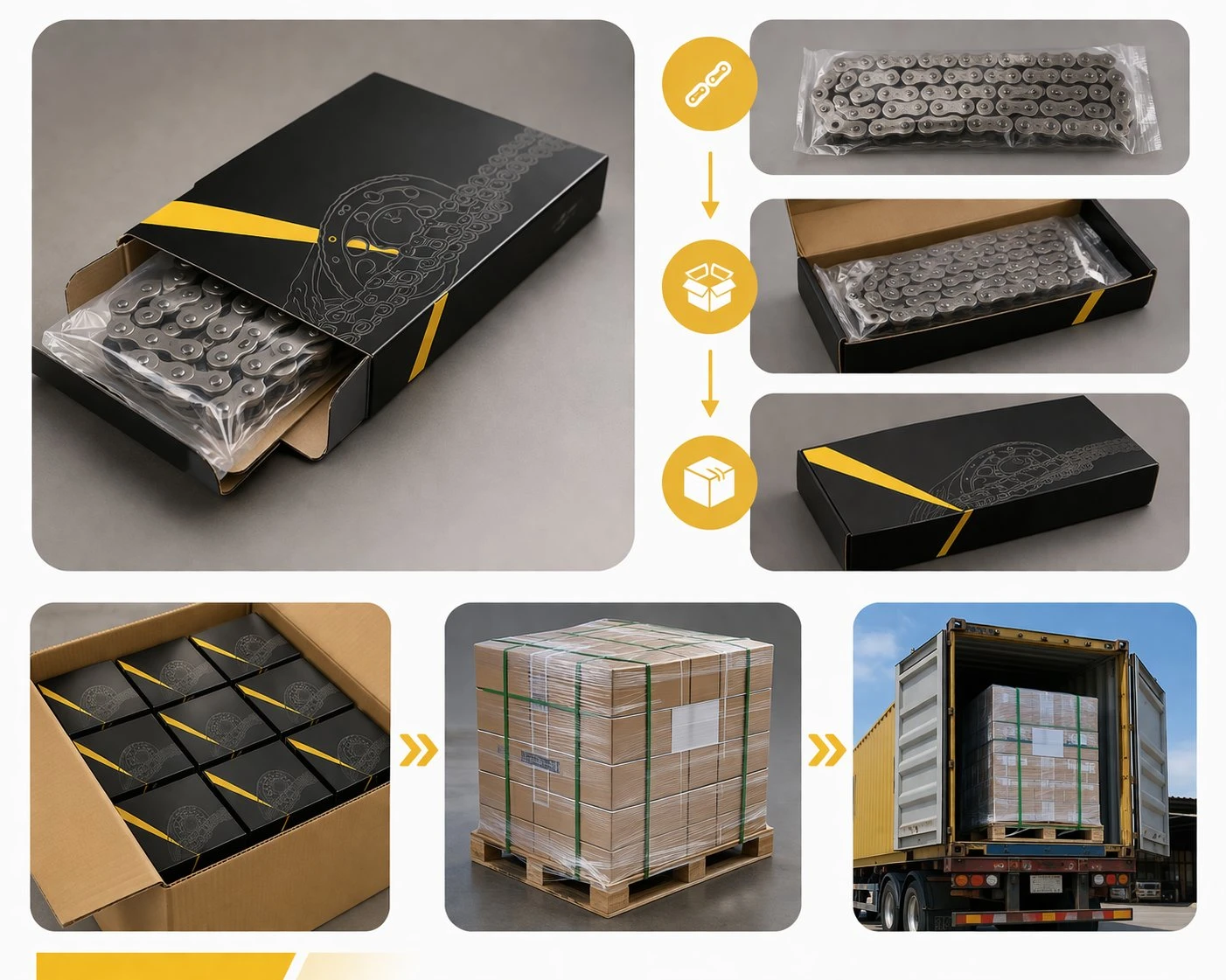
Packing and Shipping
Additional information
| Editor | Cxm |
|---|
Related products
-
420 Standard Motorcycle Chain | 12.700mm Pitch, 15.6 kN
-

Motorcycle Timing Chain *25 *25H *25SH 06B Series
-

Super X-Ring Motorcycle Chain 428SX 520-SX 525-SX 530-SX
-
X-Ring Motorcycle Chain 428H-X 520H-X 525H-X 530H-X | Korea Ever-Power
-

O-Ring Motorcycle Chain — 415 – 530 H-O Sealed Series
-

Professional Motorcycle Chain — 415P / 420P / 428P / 520P / 530P Solid-Bush Serie
-
Reinforced Motorcycle Chain 415H 420H 428H 520H 525H 530H | Korea Ever-Power
-
Motorcycle Chain — Full Drive Chain Range from 25-Series to 530H