What All Motorcycle Chain Types Share
Regardless of type, every motorcycle drive chain is a roller chain — inner link plates connected by a bushing and roller, outer link plates connected by a carburized pin, alternating end to end. Pitch and inner width are specified under JIS B 1801 and determine sprocket compatibility. The five types differ only in bushing construction and seal system — but those two differences change maintenance intervals and service life substantially.
Quick reference: If you already know what type you have and just need specifications, go directly to the motorcycle chain specification pages. If you’re deciding which type to specify for a replacement, read on.
| Тип | Seal (lips/side) | Bush | Интервал подмазивања | Service Life | Tensile (428) |
|---|---|---|---|---|---|
| Стандардно | Ниједан | Увијен | 400–600 км | 1× baseline | 17,8 kN |
| H-разред | Ниједан | Увијен | 400–600 км | ~1.3× | 20,6 kN |
| О-прстен | O-Ring (1) | Чврсто | 600–1.000 км | 2–3× | 23,8 kN |
| X-прстен | X-Ring (2) | Чврсто | 800–1.200 км | 3–4× | 23,8 kN |
| Супер X-прстен | SX (3) | Чврсто | 1.000–1.500 км | 3–5× | 28,0 kN |
Standard Roller Chain — The Non-Sealed Baseline
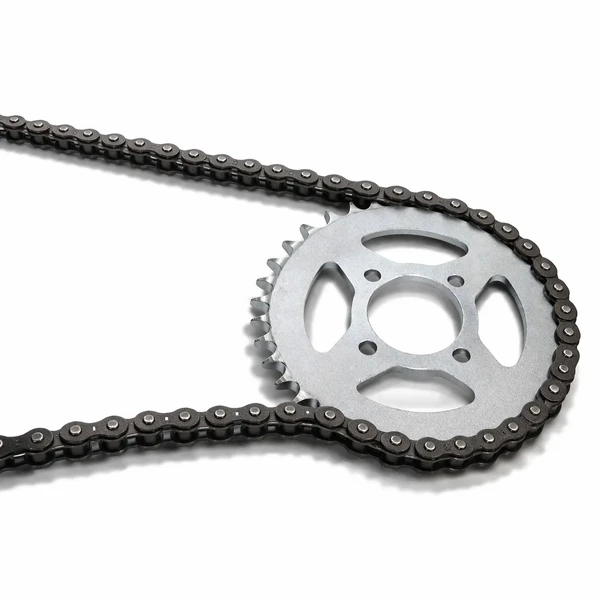
A standard motorcycle chain has no seals between the inner and outer plates. The bushing bore — the surface that contacts the pin during each articulation — receives all its lubrication from chain lube applied externally at the maintenance interval. Once that lubricant film degrades, dries, or washes away, pin and bushing are in direct metal contact and wear accelerates.
The curled-type bushing is formed by rolling flat steel strip into a cylinder. This production method works efficiently at normal street loads. For riders who maintain consistent lubrication schedules on paved roads, a standard chain delivers adequate service at the lowest purchase price. For off-road or high-impact applications where the bushing seam can open under shock loading, the standard type is not appropriate.
Choose standard when:
- ▸Track use where chains are replaced on a scheduled interval regardless of wear
- ▸Fleet operations with strictly managed maintenance schedules
- ▸Scooters and commuters where the per-km cost of frequent replacement is lower than a sealed chain’s upfront cost

Reinforced H-Grade — More Plate, Same Sprockets
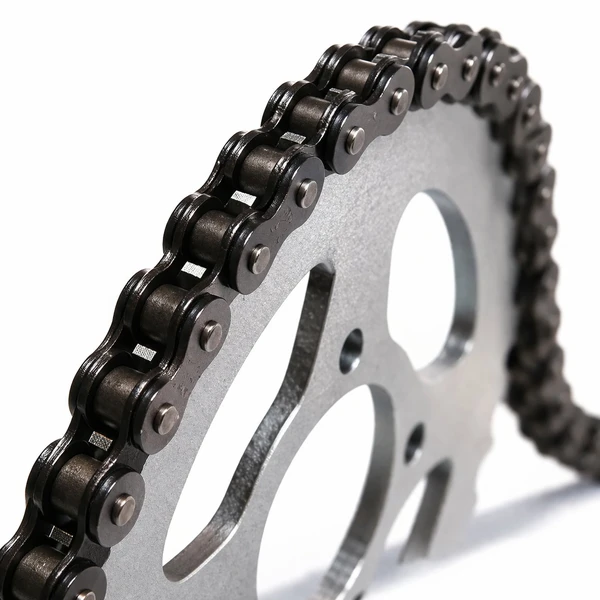

H-grade chains are structurally identical to standard chains except for heavier inner and outer plate gauges. The “H” designation in the chain number (428H, 520H, 530H) marks this difference. No seals, same curled bushing, same maintenance interval — but the thicker plates increase tensile strength and fatigue life proportionally.
The numbers are specific: the 428H uses 2.03 mm inner plates versus the standard 428’s 1.60 mm. That plate thickness increase alone delivers 20.6 kN tensile strength against 17.8 kN for the standard — a 15.7% gain without any change in pitch or inner width. The 428H fits exactly the same sprockets as the 428; the upgrade costs only the chain itself.
H-grade in the 520 family: 520H at 29.0 kN versus 520 standard at 26.5 kN. 530H at 30.4 kN versus 530 standard at 26.5 kN. Each H-grade variant fits the equivalent standard sprockets with no changes — a direct strength upgrade at chain-replacement time.
O-Ring Sealed Chain — Retained Grease, Extended Life
An O-ring chain differs from standard in two structural ways: the bushing is solid-bore (machined from tube stock, no seam) and an NBR rubber O-ring is seated in a groove on the inner plate face at every joint. During assembly, each joint is packed with grease before the outer plate is pressed onto the pin, compressing the O-ring by 10–15% of its cross-section to create a seal.
That factory grease cannot wash out in rain, cannot fling off at speed, and does not require a strict maintenance schedule to remain at the pin-bushing interface. External lubrication is still required — but its purpose shifts from protecting the pin-bushing interface to protecting the roller-sprocket contact and outer plate surfaces. Service life is typically 2–3× that of a standard chain under the same riding conditions.
The 428H-O reaches 23.8 kN — higher than the non-sealed 428H’s 20.6 kN — because the solid-bore bushing adds structural contribution that the curled bushing cannot match. Use only O-ring-safe cleaners; petroleum solvents degrade NBR rubber and destroy seal function.


X-Ring Chain — Dual Lip, Lower Friction

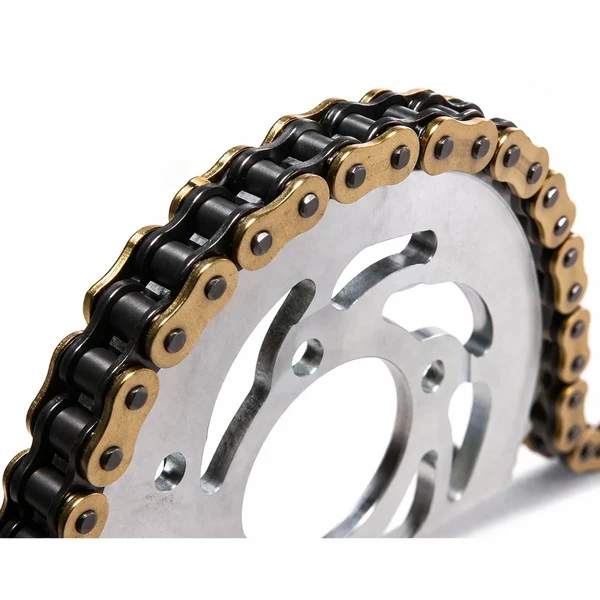
An X-ring chain seals internal grease at every joint exactly as an O-ring chain does — the difference is in the seal geometry. Where an O-ring is circular in cross-section and contacts the plate face across a rounded surface, an X-ring has four raised lips in an X pattern. Compressed between plates, only the two outer lips per side contact the plate face — two narrow sealing lines per side rather than one broad contact zone.
That narrower contact area produces approximately 20% less seal-face friction per articulation cycle compared to an O-ring. Over sustained high-rpm operation this is measurable on a dynamometer. The second lip also acts as a backup: if the outer lip is compromised by a contaminant particle or surface variation during assembly, the inner lip continues to seal independently.
Available as 428H-X, 520H-X, 525H-X, and 530H-X. The 520H-X at 34.0 kN and 1.21 kg/m gives the best strength-to-weight ratio in the sealed 520 family.
X-Ring vs O-Ring summary: Both seal internal grease, both use solid-bore bushings, both fit the same sprockets. X-ring’s narrower contact produces ~20% less seal friction and provides a secondary sealing surface. The practical difference is more pronounced over 10,000+ km where the X-ring’s superior grease retention keeps the pin-bushing joint consistently lubricated.
Super X-Ring — Triple Lip, Maximum Seal Performance
The Super X-ring (SX) uses a wider cross-section than a standard X-ring, producing three contact lips per side rather than two. Three sealing lines per side is the highest count in any current production motorcycle chain. As the outer lips wear fractionally over service life, the innermost lip maintains sealing integrity as a final barrier — extending the effective sealed life of each joint beyond what two-lip designs can sustain.
The tensile figures for SX-grade chains reflect the combination of solid-bore bushing, heavy plate gauge, and optimised seal geometry. The 530-SX reaches 43,0 kN — the highest value in the Korea Ever-Power motorcycle chain range. The 525-SX reaches 40.0 kN, and 525H-SX 38.0 kN. These are batch-tested break loads, not theoretical values.
For riders covering 15,000+ km per year who want 1,000–1,500 km between lubrication events, the SX grade earns its higher purchase price through extended replacement intervals and fewer service stops per year.
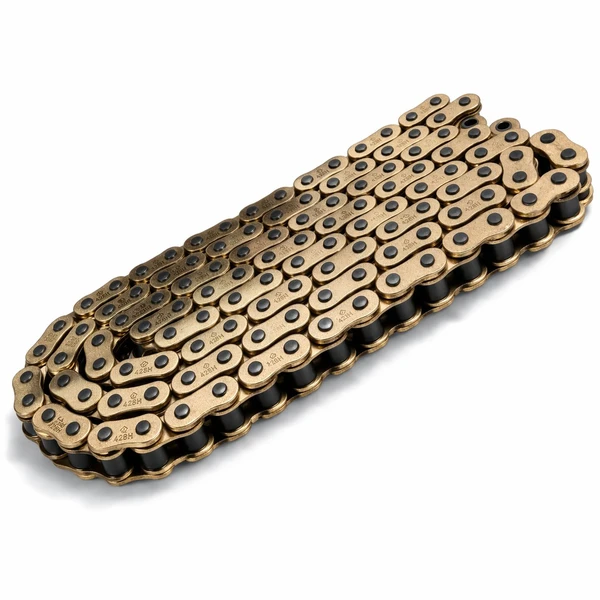

Professional & Motocross Chains — Solid Bush for Off-Road

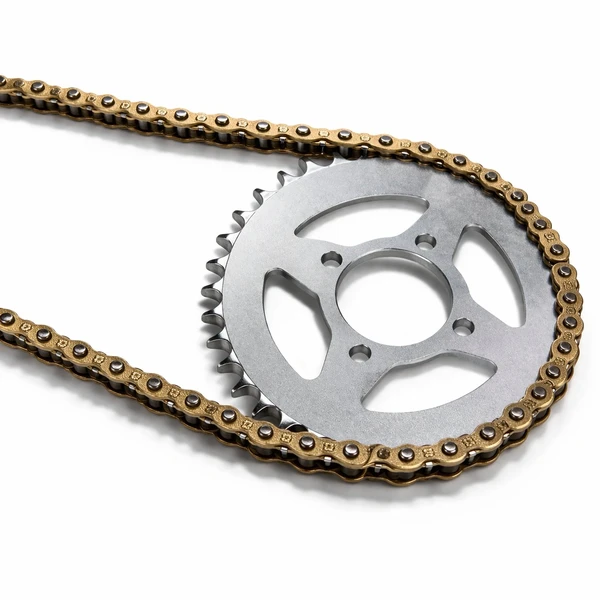
Both the professional and motocross chain series use solid-bore bushings as their defining construction feature. A solid bushing is machined from tube stock — no longitudinal seam, consistent bore geometry under any load. A standard curled bushing has a seam that can gradually open under the sustained shock loads of jump landings and hard off-road acceleration, progressively enlarging the bore and accelerating pin wear.
The 520MX solid-bush motocross chain reaches 36.0 kN at just 0.91 kg/m — the same weight as a standard 520 but meaningfully stronger and structurally suited to the shock loading profile of off-road riding. For enduro, trail, or dual-sport use where water crossings and mud exposure compound the impact loads, the sealed O-ring variants (428H-O, 520H-O) combine solid-bore structural integrity with sealed internal lubrication.

Which Type Is Right for Your Application?
The right chain type is the intersection of your machine’s power output, your riding environment, and your actual maintenance habits — not your theoretical intentions.
Can you lubricate reliably every 500 km?
Yes → Standard or H-grade is viable if the engine’s output is within the chain’s load capacity. No → Choose a sealed type — O-ring at minimum; X-ring or SX if your interval regularly exceeds 800 km.
Do you ride regularly in wet, muddy, or off-road conditions?
Yes → O-ring or X-ring sealed. The X-ring’s dual lip is more resilient than an O-ring under sustained water immersion. For sustained off-road shock loading, the solid-bore motocross variant.
Is the engine output at the upper limit for the standard chain in this pitch?
Yes → Move to H-grade (non-sealed) or the sealed H-O / H-X equivalent. No sprocket change needed — same pitch and inner width, higher plate gauge and tensile strength.
Covering 15,000+ km per year and want minimum maintenance stops?
Yes → Super X-ring. The higher unit cost is recovered through 1,000–1,500 km lubrication intervals and the extended service life of the triple-lip seal.

Our Manufacturing Standard
ISO 9001 certified quality management. Tensile testing on every production batch. Dimensional verification against JIS B 1801 reference gauges. Articulation inspection for stiff links before packaging.


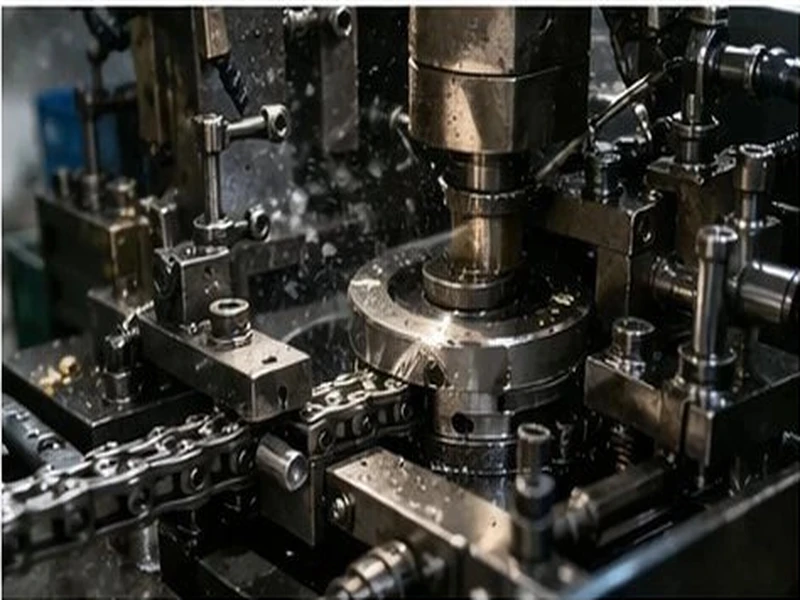
Korea Ever-Power Motorcycle Chain Co., Ltd. — production and quality control
All Chain Types In Stock — Ready to Ship
Stocked sizes dispatch within 3–7 business days. No minimum order. Contact us with your chain number or motorcycle model for a confirmed specification before ordering.
Често постављана питања
Match Your Riding Conditions to the Right Chain Type
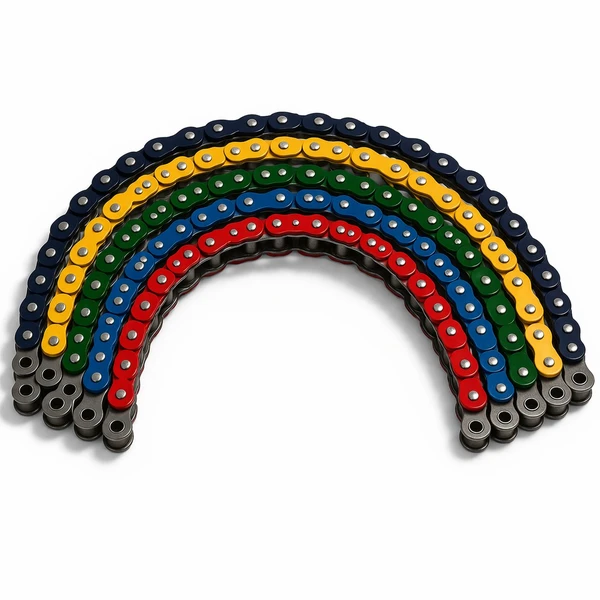
Korea Ever-Power supplies all five types in 420–530 pitch — standard, H-grade, O-ring, X-ring, and Super X-ring. Send us your chain number and we confirm the correct type and specification before you order.
Уредник: Cxm