The Honest Answer — It Depends on Three Things
Motorcycle chain lifespan is one of the most variable maintenance figures in motorcycling. Ask ten different riders and you will get answers from 5,000 km to 30,000+ km — and all of them may be accurate for their specific combination of chain type, maintenance habits, and riding conditions. The question “how long does a motorcycle chain last” cannot be answered with a single number without specifying those three factors.
Chain elongation — the measurable change in the 20-link length that triggers replacement — is caused by wear at the pin-bushing interface inside each joint. JIS B 1801 defines the replacement threshold at 3% above nominal 20-link length: 327 mm for 15.875 mm pitch chains (nominal 317.5 mm) and 261.6 mm for 12.70 mm pitch chains (nominal 254.0 mm). Every variable that affects how quickly that threshold is reached — lubrication consistency, contamination exposure, load, seal type, bushing construction — determines the chain’s practical service life.
Realistic Lifespan Ranges — by Chain Type and Maintenance
| Tipo di catena | Disciplined maintenance | Realistic maintenance | Irregular / neglected |
|---|---|---|---|
| Standard non sigillato | 12,000–18,000 km | 8,000–12,000 km | 3,000–6,000 km |
| Grado H non sigillato | 15,000–22,000 km | 10,000–15,000 km | 4,000–8,000 km |
| Guarnizione O-ring | 20,000–28,000 km | 15,000–22,000 km | 8,000–14,000 km |
| Sigillato con anello X | 24,000–32,000 km | 18,000–26,000 km | 10,000–18,000 km |
| Sigillato Super X-Ring | 28,000–38,000 km | 22,000–32,000 km | 14,000–22,000 km |
Conditions assumed: These figures are for street riding on predominantly paved roads, 125–250cc engine class for standard/H-grade, 400–600cc for sealed variants. Off-road, track use, or sustained two-up loaded riding will compress these ranges toward the lower end significantly. Dry, clean, consistently maintained conditions push toward the upper end.
Factor 1 — Lubrication Consistency
Lubrication is the single largest determinant of chain life for non-sealed chains. The pin-bushing interface operates under high contact pressure with no external lubrication source — every articulation under load removes microscopic metal from both surfaces. When the lubrication film at this interface is maintained, the friction and wear rate is low. When it dries out or is washed away, wear rate escalates sharply.
The practical consequence: a standard 428 chain lubricated every 400–500 km without exception can last 15,000–18,000 km. The same chain lubricated every 1,500–2,000 km whenever the rider remembers typically reaches replacement in 6,000–8,000 km. Missing lubrication entirely for extended periods can bring a standard chain to replacement threshold in under 3,000 km on a 250cc street bike. This is not hyperbole — a dry non-sealed chain produces several times the wear rate of a correctly lubricated one.
Sealed chains (O-ring, X-ring, Super X-ring) are far less sensitive to external lubrication frequency because the factory-packed grease at the pin-bushing interface provides continuous internal lubrication regardless of external service. A sealed chain that misses three consecutive lubrication intervals continues to protect the critical wear interface. A non-sealed chain in the same situation is running dry at the bushing.
Factor 2 — Chain Type and Seal Design
Chain type is the second major lifespan determinant, and it is the one that can be pre-selected before riding begins. The difference between a standard non-sealed chain and a Super X-ring sealed chain, under the same conditions and maintenance schedule, is the difference between reaching the 3% elongation threshold at 12,000 km versus 30,000+ km.
Standard — Curled Bushing, No Seal
The pin-bushing interface is entirely dependent on externally applied lubricant. Between lubrication events, the lubrication film thins. After rain, it washes off. After a wet ride, it may be effectively gone. Wear rate between maintenance events is high, and the curled bushing’s seam can open slightly under sustained loading, further accelerating pin wear.
O-Ring — Solid Bushing, Single-Lip Seal
Factory-packed grease is sealed at every joint from assembly. The solid-bore bushing maintains consistent bore geometry. The pin-bushing interface is permanently lubricated regardless of external maintenance frequency. Wear rate is a fraction of the non-sealed chain’s rate under comparable conditions. Service life 2–3× standard under identical conditions.
X-Ring — Dual-Lip Seal, Improved Retention
Two sealing lips per side provide better long-term grease retention than the O-ring’s single lip as the seal conforms to the plate surface over mileage. Lower seal friction (~20% less than O-ring) reduces heat generation at the seal interface over the chain’s life. Service life 3–4× standard.
Super X-Ring — Triple-Lip, Maximum Retention
Three contact lips per side maintain seal integrity as outer lips wear over high mileage — the innermost lip continues sealing as the outer lips gradually conform to the plate surface. This is the mechanism that extends service intervals to 1,000–1,500 km externally and produces the longest total service life in the standard roller chain range. Service life 3–5× standard.
Factor 3 — Riding Conditions and Load
Riding conditions affect chain life through two mechanisms: contamination and load. Clean dry paved roads at moderate speeds produce the minimum chain wear rate — external lubricant stays on the chain longer, no abrasives penetrate the pin-bushing area, and chain tension during normal street riding is a fraction of the rated capacity.
Rain, salt water, and road grime displace external lubricant and introduce corrosive agents into the roller-sprocket interface. Mud and sand are directly abrasive — grit particles trapped between the roller and sprocket tooth accelerate tooth and roller wear simultaneously. One session of riding through beach sand or post-harvest agricultural dust can remove more material from an unsealed chain’s pin-bushing area than hundreds of kilometres on clean tarmac.
Load affects wear through chain tension. A fully-laden touring motorcycle generates several times the chain tension of the same machine ridden solo with no luggage at the same throttle position. Two-up riding, carrying heavy luggage, and sustained hard acceleration all increase the average chain tension and therefore the rate of pin-bushing wear.
- Clean dry paved roads
- Consistent lubrication schedule
- Solo riding, no luggage
- Smooth riding style, gradual acceleration
- Sealed chain type
- Rain, salt roads, mud exposure
- Sporadic or skipped lubrication
- Two-up riding with heavy luggage
- Aggressive acceleration, hard braking
- Non-sealed chain in variable conditions

How to Measure Chain Wear — The Definitive 20-Link Method
Visual inspection is not sufficient to determine when a chain needs replacement. A chain can appear clean and rust-free while being significantly elongated — the external appearance of the plates tells you nothing about pin-bushing wear. The measurement method is the only reliable indicator.
- 1
Find the tightest point: Slowly rotate the rear wheel through a full revolution while gently pressing upward on the chain mid-span. The position where chain slack is minimum is the tightest point — chain wear is uneven due to minor sprocket eccentricity, and measuring at the tightest point gives the most representative elongation reading. - 2
Measure 20 consecutive links: Place the zero point of a steel rule at the centre of one pin, then measure to the centre of the pin 20 links further along. Apply light tension to the chain segment being measured — let gravity tension it naturally, do not pull. - 3
Compare to replacement threshold: For 15.875 mm pitch (520/525/530 series): nominal 317.5 mm, replace at 327 mm. For 12.70 mm pitch (428 series): nominal 254.0 mm, replace at 261.6 mm. These thresholds are defined under JIS B 1801 as the 3% elongation limit beyond which sprocket engagement geometry is compromised. - 4
Plan replacement before threshold, not after: Once a chain reaches the 3% threshold, chain-to-sprocket engagement geometry is compromised — the chain rides higher on the tooth and begins wearing the sprocket tooth tips at an accelerated rate. Replacing at 2.5% elongation (before threshold) preserves the sprockets and avoids emergency chain replacement.

Other Signals That Mean Replace Now — Not Later
The 20-link measurement is the primary replacement indicator, but several other conditions require immediate replacement regardless of elongation measurement:
Stiff Link
Any link that does not flex freely through a full articulation range has been kinked or damaged. A stiff link cannot engage the sprocket correctly and will eventually cause the chain to skip under load — replace immediately.
Chain Rides High on Sprocket
If the chain can be pulled away from the rear sprocket enough to expose more than half the tooth root height, elongation is excessive. The chain is no longer seating in the tooth valley correctly and sprocket wear is accelerating rapidly.
Visible Rust on Internal Surfaces
Rust on the rollers, inner plates, or between the plates indicates corrosion at the pin-bushing interface. A rusted joint has significantly reduced material at the contact surface — the chain’s actual tensile capacity may be well below its rated value.
Seal Damage on Sealed Chain
Cracked, missing, or flat-profile O-ring or X-ring seals indicate the internal grease seal has failed at those joints. The chain will continue to function but those specific joints now behave as non-sealed — wear rate at those joints increases immediately. If multiple seals are compromised, replacement is warranted.

Always replace sprockets with the chain: Worn sprocket teeth develop a hook or asymmetric profile that accelerates new chain wear from the first kilometre — a new chain on hook-worn sprockets can reach replacement threshold in half the normal service distance. Inspect both front and rear sprockets when replacing the chain. The front (countershaft) sprocket is smaller and typically wears faster; if in doubt, replace it along with the chain. See our complete catena e pignone per motocicletta range for matched replacements in all pitches.
Start with Quality — Batch Tested Before Dispatch
The starting quality of the chain matters too. Carburized alloy steel pins, batch tensile testing, dimensional verification against JIS B 1801 gauges, and articulation inspection for stiff links — these are the production checkpoints that determine the chain’s quality ceiling before maintenance and conditions shape its actual service life.


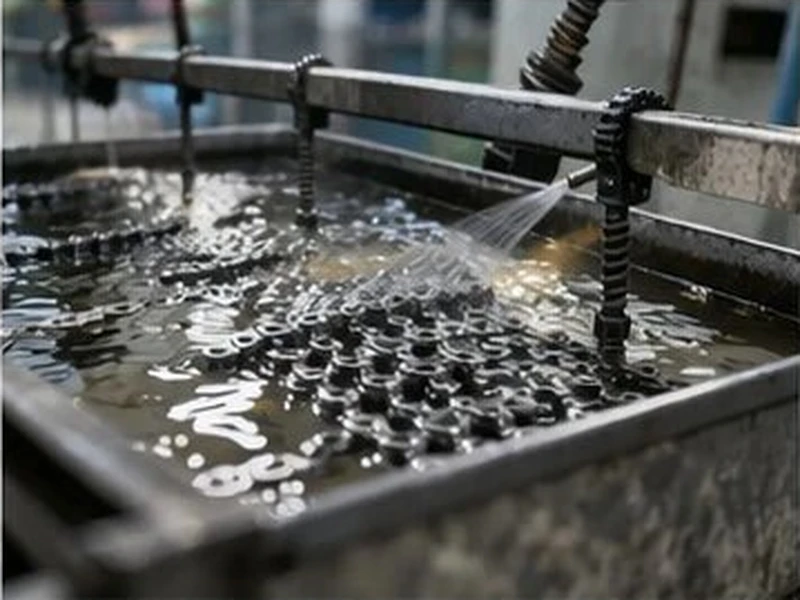

Korea Ever-Power Motorcycle Chain Co., Ltd. — Certificazione ISO 9001 · 5 stabilimenti di produzione
Choose the Chain Type That Fits Your Actual Maintenance Habits
All chain types in stock — 420 through 530, standard through Super X-ring. Dispatch within 3–7 business days.
Domande frequenti
Choose a Chain That Lasts Longer
Korea Ever-Power stocks all chain types from standard to Super X-ring, in every pitch from 420 to 530. Send us your chain number or motorcycle model and we confirm the right type for your maintenance habits and riding conditions before you order.
Redattore: Cxm