O-Ring Motorcycle Chain — 415 – 530 H-O Sealed Series
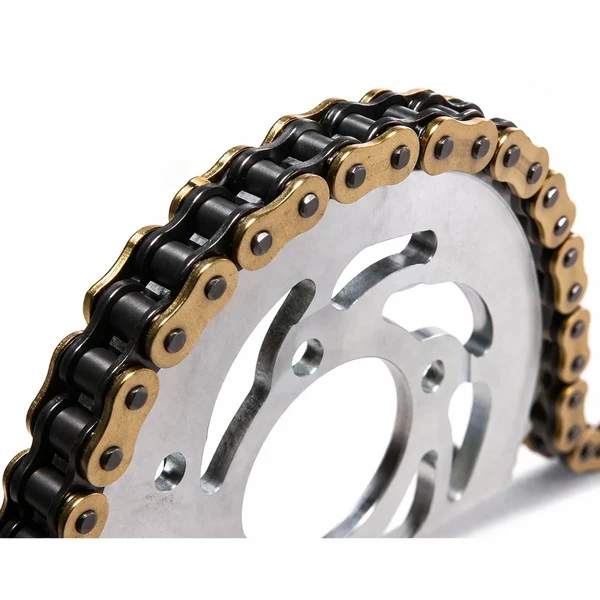
Sealed O-ring motorcycle chains in 415H-O, 4205-O, 428HPO, 428H-O, 520-VO, 520H-O, 525H-O, and 530H-O — solid-bushing construction with tensile strength from 10.0 kN (415H-O) to 34.0 kN (520H-O/525H-O/530H-O). NBR O-ring seals retain internal grease for the chain’s lifetime. Full size chart plus O-ring vs X-ring comparison table included.
Product Overview
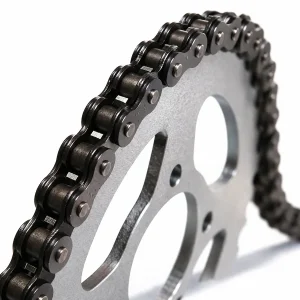
An O-ring motorcycle chain is a type of drive chain that incorporates rubber O-rings between the inner and outer link plates at every pin-bushing joint. When the chain is assembled, these O-rings are compressed slightly against the plate faces, forming a seal that retains factory-applied grease inside the joint and prevents dirt, water, and abrasive particles from entering. Unlike non-sealed chains, which depend entirely on externally applied lubricant to protect the pin-bushing contact surfaces, an O-ring chain carries its own internal lubrication from the moment of assembly — and that lubrication remains in place for the chain's entire service life regardless of what the chain passes through during operation.
O-ring chains are an investment that pays back through reduced maintenance demands and longer service life compared to non-sealed equivalents. They are especially well-suited for riders who ride frequently, in wet or dusty conditions, or who cannot always maintain the short lubrication intervals that non-sealed chains require. They are also the practical choice for off-road use, where immersion in mud and water would strip lubricant from a non-sealed chain within a single riding session.
Korea Ever-Power Motorcycle Chain Co., Ltd. supplies O-ring sealed chains across eight specifications: 415H-O, 4205-O, 428HPO, 428H-O, 520-VO, 520H-O, 525H-O, and 530H-O. All use solid-bore bushing construction and NBR nitrile rubber O-ring seals. Tensile strengths range from 10.0 kN on the 415H-O through to 34.0 kN on the 520H-O, 525H-O, and 530H-O.
O-Ring Motorcycle Chain Size Chart
All eight O-ring motorcycle chain specifications in our range use solid-bore bushings. Pin lengths on O-ring chains are longer than those on non-sealed chains of the same pitch because the O-ring groove machined into the inner plate face and the additional pin projection required to accommodate the O-ring compression displacement add to the overall pin length. All other dimensional data is consistent with standard pitch series specifications.
| Chain No. | Pitch (mm) | Bush Type | Width (mm) | Pin Dia (mm) | Pin Length (mm) | Roller Dia (mm) | Plate T Inner (mm) | Plate T Outer (mm) | Tensile Strength (kN) | Weight (kg/m) |
|---|---|---|---|---|---|---|---|---|---|---|
| 415H-O | 12.700 | Solid | 4.88 | 3.96 | 16.10 | 7.77 | 1.50 | 1.50 | 10.0 | 0.67 |
| 4205-O | 12.700 | Solid | 6.35 | 3.96 | 18.60 | 7.77 | 1.50 | 1.50 | 17.0 | 0.75 |
| 428HPO | 12.700 | Solid | 7.85 | 4.45 | 20.10 | 8.51 | 2.03 | 1.85 | 20.6 | 0.85 |
| 428H-O | 12.700 | Solid | 7.85 | 4.45 | 21.60 | 8.51 | 2.20 | 2.03 | 23.8 | 1.00 |
| 520-VO | 15.875 | Solid | 6.35 | 5.24 | 20.80 | 10.16 | 2.20 | 2.20 | 32.0 | 1.11 |
| 520H-O | 15.875 | Solid | 6.35 | 5.24 | 22.00 | 10.16 | 2.40 | 2.40 | 34.0 | 1.21 |
| 525H-O | 15.875 | Solid | 7.94 | 5.24 | 23.80 | 10.16 | 2.40 | 2.40 | 34.0 | 1.35 |
| 530H-O | 15.875 | Solid | 9.60 | 5.24 | 25.40 | 10.16 | 2.40 | 2.40 | 34.0 | 1.39 |
Benefits of the O-Ring Motorcycle Chain
O-ring motorcycle chains offer a number of concrete advantages over non-sealed standard chains. The benefits stem directly from the sealing mechanism — once the internal grease is protected from the riding environment, a chain's service life is determined primarily by the wear rate of the sealed components rather than the much faster rate of unlubricated metal-on-metal contact.

- 🔒
Extended service life: O-ring chains last considerably longer than non-sealed equivalents under the same riding conditions — commonly 2–3 times as long in practical use. The rubber seals keep factory grease in the pin-bushing joint throughout the chain's life, eliminating the primary wear mechanism that causes standard chain elongation: dry metal-to-metal contact as external lubricant is displaced or degrades between maintenance intervals. - 🔒
Reduced maintenance frequency: Because internal lubrication is retained by the seals, O-ring chains do not require the frequent external lubrication intervals that non-sealed chains demand. External lubricant still needs to be applied periodically to protect the roller-to-sprocket contact surfaces and reduce corrosion on the outer plate faces, but the intervals can be longer — typically every 600–1,000 km instead of every 300–500 km for a non-sealed chain in equivalent conditions. - 🔒
Smoother, more consistent operation: A chain whose internal joints are consistently lubricated throughout its service life maintains more uniform articulation characteristics than one that cycles between lubricated and dry states between maintenance events. This translates to lower noise levels, less vibration transmitted through the chain to the frame, and more consistent power delivery feel — particularly noticeable at low throttle openings. - 🔒
Better corrosion resistance: The O-rings prevent moisture from reaching the pin-bushing contact surfaces inside the joint. Standard chains exposed to rain, road spray, or high humidity corrode from the inside out at the pin-bushing interface — often invisible from the outside until the chain is already significantly weakened. O-ring chains protect this surface, and their solid bushing construction also has less susceptibility to moisture-induced deformation than curled bushings. - 🔒
Lower wear on sprockets: A chain that maintains accurate pitch throughout its service life causes less accelerated wear on sprocket teeth than one that elongates rapidly. Each link that moves through the sprocket at the correct spacing loads the tooth at the designed contact point; an elongated chain shifts that contact point toward the tip and edge of the tooth, accelerating surface wear and leading to the hook-shaped tooth profiles that in turn accelerate chain wear in a compounding feedback loop.
Difference Between O-Ring and X-Ring Motorcycle Chain
Both O-ring and X-ring motorcycle chains are sealed designs that use rubber elements between the inner and outer link plates to retain internal lubrication and exclude contaminants. The fundamental difference is seal geometry. An O-ring has a circular cross-section; it contacts the plate face at one line around its circumference on each side, creating a single sealing surface per face. An X-ring has an X-shaped cross-section with four raised lips — two per side — creating two distinct sealing contact lines per plate face. This gives the X-ring some functional advantages, though also at a higher cost.
Which type suits you depends on riding habits and budget. If you ride primarily on paved roads and the occasional mixed-surface route, an O-ring chain is more than sufficient — the single-surface seal handles normal street conditions for the full service life of the chain. For sustained off-road, enduro, or extreme-condition riding where maximum seal integrity over a longer maintenance cycle is the priority, an X-ring chain's additional sealing contact area provides a meaningful advantage.

| Feature | O-Ring Motorcycle Chain | X-Ring Motorcycle Chain |
|---|---|---|
| Seal shape | Circular | X-shaped |
| Sealing surfaces | One | Two |
| Friction | Higher | Lower |
| Wear resistance | Lower | Higher |
| Durability | Shorter | Longer |
| Cost | Lower | Higher |
Motorcycle Sprockets and O-Ring Motorcycle Chains
Motorcycle sprockets and O-ring chains work as a coupled system. The front sprocket is located at the engine's output shaft and the rear sprocket is attached to the rear wheel hub — the O-ring chain connects the two and transfers rotational drive between them. When selecting replacement sprockets to pair with an O-ring chain, three factors determine correct fitment: pitch (must match the chain exactly), tooth count (determines final drive ratio and affects acceleration vs. top speed), and hub bore and bolt pattern (must match the wheel hub and sprocket carrier).

Choosing the right combination requires considering how you ride. For street use where broad power delivery and reasonable top speed both matter, OEM tooth counts are a practical starting point. Reducing rear sprocket teeth (or increasing front teeth) raises top speed and reduces low-end pull; the reverse improves acceleration and low-speed torque. Off-road and enduro riders often run slightly lower gearing to improve usable low-range power delivery on technical terrain.
It is important to inspect your sprockets at every chain cleaning interval. Signs that sprockets need replacement alongside the O-ring chain include hook-shaped leading tooth faces, visibly thinned tooth tips, or asymmetric wear on one side of the tooth face. Replacing an O-ring chain on worn sprockets will accelerate the new chain's wear rate significantly — always replace chain and both sprockets together as a matched set.
We supply matching sprockets for all O-ring chain pitch sizes — 415, 420, 428, and 520/525/530. Browse our full range of motorcycle chains and sprockets, or contact us with your motorcycle make, model, and year to confirm tooth counts and fitting dimensions before ordering.
Korea Ever-Power Motorcycle Chain Co., Ltd. — Manufacturer
Korea Ever-Power Motorcycle Chain Co., Ltd. is a professional transmission chain supplier. We specialise in chains produced to customer specifications — our range covers standard, reinforced, professional, O-ring sealed, and X-ring sealed motorcycle chains, as well as all types of matching sprockets. The manufacturing network behind our supply includes ISO 9001 certified quality management, more than 180 registered patents in chain engineering, and products exported to over 80 countries across a catalogue of more than 2,000 chain varieties.
For O-ring chain production specifically, quality controls include O-ring compression verification on assembled chains — each chain is inspected to confirm the O-rings are correctly seated and compressing to the designed interference dimension before packing. Tensile testing, articulation inspection, and dimensional verification are applied across all production batches before dispatch.
Frequently Asked Questions — O-Ring Motorcycle Chain
How does an O-ring motorcycle chain retain internal lubrication?
At each pin-bushing joint, a measured quantity of grease is packed into the annular gap between the pin and the bushing before the outer plate is pressed home during assembly. As the outer plate closes, it compresses the O-ring — which sits in a groove on the inner plate face — to approximately 10–15% of its cross-sectional diameter. This compression creates a contact seal around the pin that prevents grease from migrating outward and contaminants from entering inward. The sealed grease remains in the joint for the chain's entire service life.
What chain cleaner is safe to use on an O-ring motorcycle chain?
Use only cleaners specifically labelled as O-ring-safe or seal-compatible. Petroleum-based solvents — petrol, diesel, kerosene, contact cleaner, and most workshop degreasers — attack and degrade NBR rubber. Over repeated application they cause the O-rings to swell, crack, or flatten, destroying the seal and converting the chain to an unsealed state without any external indication until the chain stretches noticeably. Water-based or citrus-based chain cleaners are generally safe; confirm on the product label before use.
How often should I lubricate an O-ring motorcycle chain?
Every 600–1,000 km under normal street conditions. The O-rings handle internal pin-bushing lubrication independently; external lubricant is needed to protect the roller-to-sprocket contact surface and the outer plate faces from corrosion. Do not skip external lubrication — a correctly maintained O-ring chain still needs it. After washing the bike or riding in heavy rain, lubricate the chain as soon as it has dried, regardless of interval.
Can I use WD-40 on an O-ring motorcycle chain?
Not as a primary chain lubricant. WD-40 is a water displacer and light penetrant — it is not a chain lubricant, and some formulations contain petroleum-based carriers that can degrade NBR O-ring seals over repeated application. For displacing water after a wet ride, a quick application followed immediately by a dedicated O-ring-safe chain lubricant is acceptable. Long-term use of WD-40 as a sole lubricant is not.
What is the difference between the 428HPO and the 428H-O?
Both are 428-pitch O-ring chains with solid bushings. The 428HPO has 2.03/1.85 mm (inner/outer) plate thickness and 20.6 kN tensile strength, with a 20.10 mm pin length. The 428H-O has heavier 2.20/2.03 mm plates, 23.8 kN tensile strength, and a 21.60 mm pin length. The 428H-O is the higher-specification variant — appropriate for higher-power 125–250cc engines or heavier loads. The 428HPO suits lighter machines where reduced weight is the priority alongside sealed lubrication.
Are O-ring chains compatible with the same sprockets as non-sealed chains?
Yes. O-ring chain pitch and roller diameter are identical to non-sealed chains in the same series number. The only dimensional difference is pin length (longer, due to O-ring groove accommodation), which does not affect sprocket mesh or compatibility. Fit directly onto existing OEM sprockets without modification, provided they are in serviceable condition.
How do I inspect whether the O-rings are still functioning correctly?
At each cleaning interval, visually inspect the O-rings visible between the outer and inner plates at multiple joints around the full chain length. Seals in good condition appear round in cross-section, uniformly seated, and free of cracking or splitting. Signs of O-ring failure include visibly flat or asymmetric ring profile, cracking in the rubber, or grease tracking outside the seal face onto the outer plate surface. If multiple joints show seal failure, replace the chain — a chain with failed O-rings at multiple joints behaves as a non-sealed chain and will wear rapidly.
Customer Reviews
Kwon Min-jun, Enduro Rider, Gangwon Province (March 2025)
"Running the 520H-O on my off-road bike through the winter season. Stream crossings, muddy tracks, the usual. After 30+ hours of riding over two months, the O-rings are still seated correctly on inspection and the chain has stretched only a few millimetres past nominal. Non-sealed chains I used before would need replacing twice in the same period."
Oh Soo-hyun, Commuter, Seoul Gwangjin-gu (January 2025)
"Switched from a standard 428 to the 428H-O for my daily ride. The main reason was wanting to lube less often — I was doing it every 500 km with the standard chain. With the O-ring I'm extending to 800–900 km and the chain looks better at that interval than the standard one did at 500 km. Clear difference in maintenance demand."
Lim Ji-wan, Motorcycle Workshop Owner, Daejeon (February 2025)
"We stock the 428H-O and 520H-O as our two main sealed chain SKUs for customers who want lower maintenance demands. Korea Ever-Power's O-ring seal quality is consistent — we've had no returns from customers reporting premature seal failure in the past year. The 520H-O at 34.0 kN is a strong chain for the price point."
Shin Tae-woo, Adventure Tourer, North Jeolla Province (November 2024)
"Fitted the 525H-O before a 12-day trip through mixed mountain and coastal roads. Total mileage around 3,800 km including three unpaved sections. Lubed it twice during the trip. O-rings looked perfect on inspection at the end — no cracking, no grease tracking. The 34.0 kN tensile strength gives good peace of mind for a loaded adventure bike."
Kim Hyeon-seok, Dual-Sport Rider, Gyeonggi-do (December 2024)
"Using the 520-VO on a dual-sport machine I ride both on commuting routes and weekend dirt roads. The sealed chain handles the transition between conditions without needing immediate attention after each off-road section. Previous non-sealed chain needed lubrication within 200 km of any off-road use. The O-ring version genuinely extends the maintenance window."
Park Ye-jin, Trail Rider, South Gyeongsang Province (October 2024)
"The 415H-O works perfectly on my 110cc trail bike. Smaller machine but I ride it hard in the hills and it gets wet regularly. The O-ring keeps the joint protected between my weekly clean-and-lube sessions. Service life has been noticeably longer than the standard chains I used on the same bike previously."
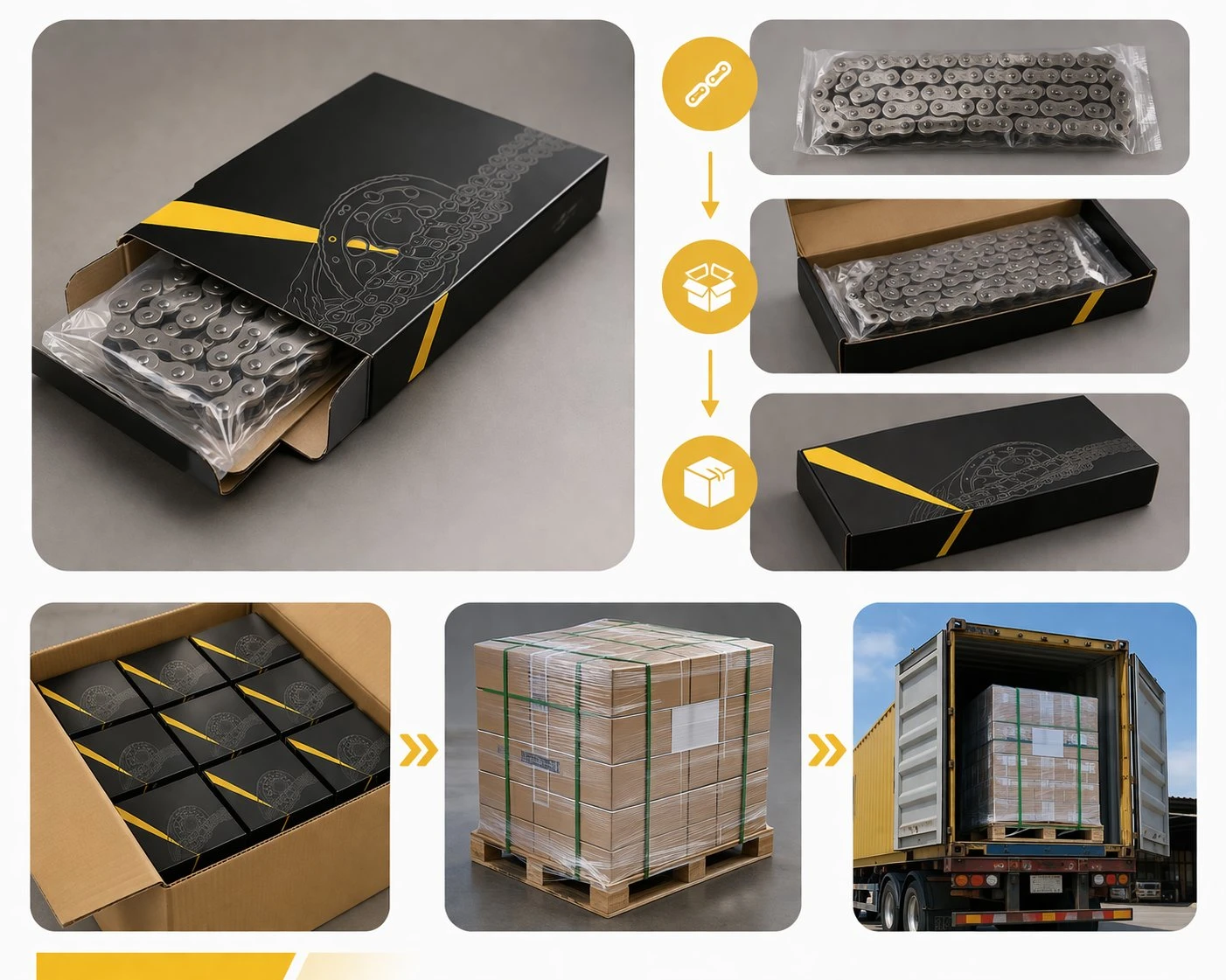
Packing and Shipping
Additional information
| Editor | Cxm |
|---|
Related products
-
420 Standard Motorcycle Chain | 12.700mm Pitch, 15.6 kN
-

Motorcycle Timing Chain *25 *25H *25SH 06B Series
-

Super X-Ring Motorcycle Chain 428SX 520-SX 525-SX 530-SX
-
X-Ring Motorcycle Chain 428H-X 520H-X 525H-X 530H-X | Korea Ever-Power
-

Professional Motorcycle Chain — 415P / 420P / 428P / 520P / 530P Solid-Bush Serie
-
Reinforced Motorcycle Chain 415H 420H 428H 520H 525H 530H | Korea Ever-Power
-

Standard Motorcycle Chain — 420 / 428 / 520 / 525 / 530 Non-Sealed Series
-
Motorcycle Chain — Full Drive Chain Range from 25-Series to 530H