What Makes a Good Commuter Chain
The best motorcycle chain for daily commuting is not necessarily the most expensive or the highest-strength option. It is the chain that performs reliably within the actual maintenance discipline of a working commuter — which typically means less frequent servicing than a weekend sport rider, exposure to rain and urban grime, and accumulation of 8,000–20,000 km per year through sheer consistency.
Three factors determine the correct commuter chain specification. First: engine displacement, which determines the pitch and minimum tensile strength required. Second: how reliably lubrication actually happens — chains serviced every 400–500 km on schedule can use standard non-sealed types efficiently; chains serviced whenever the owner remembers should be sealed to protect the pin-bushing interface between services. Third: total annual mileage, which determines whether the service life difference between standard and sealed chains produces a meaningful cost difference over time.
Chain Specification by Commuter Machine Type
50–125cc Scooters and Mopeds
Chain size: 420
The 420 chain’s 6.35 mm inner width and 15.6 kN tensile strength is engineered for the 50–125cc engine class. At 0.57 kg/m, a 100-link chain weighs approximately 570 g — and for a 65–80 kg machine, this low chain mass matters more than it would on a larger bike. Fitting a 428 where a 420 is specified adds rotating mass for no benefit at these power levels.
For delivery scooters and mopeds accumulating 20,000+ km per year, the standard 420 with consistent 500 km lubrication intervals is the most cost-effective approach — the unit cost advantage of standard over sealed chains compounds significantly across high replacement frequency. Fleet operators maintaining consistent service schedules find standard 420 chains cost-competitive over the full service life calculation.
420 standard key figures: Pitch 12.700 mm · Inner width 6.35 mm · Tensile 15.6 kN · Weight 0.57 kg/m · Lube interval 400–600 km
When to consider sealed: If the machine covers 15,000+ km/year in rain-heavy urban conditions and maintenance is sporadic, a sealed 420-O variant extends the lube interval to 600–1,000 km and protects the pin-bushing interface between services.

125–250cc Street and Commuter Bikes
Chain size: 428
The 428-pitch chain is the highest-volume single motorcycle chain size globally — it serves the 125–250cc class that represents the majority of commuter and urban motorcycle ownership in Korea, Japan, and Southeast Asia. The standard 428 at 17.8 kN carries a significant safety factor over the working loads of engines in this class, while the 428H at 20.6 kN is the appropriate specification for higher-output 200–250cc engines or machines regularly ridden two-up.
For urban commuters who are honest about their maintenance habits, the 428H-O is the most practical all-round specification: the sealed internal lubrication protects the pin-bushing interface between services (every 600–1,000 km rather than 400–600 km), and the solid-bore bushing produces noticeably lower elongation rates than the curled-bush standard chain over the same mileage.
428 standard: 17.8 kN · 0.71 kg/m · Lube 400–600 km
428H: 20.6 kN (2.03 mm plate vs 1.60 mm standard)
428H-O: 23.8 kN · Solid bore · Lube 600–1,000 km
250–600cc Urban and Inter-City Commuters
Chain size: 520 / 525
Larger commuter machines — 250–600cc nakeds, parallel twins, and mid-displacement roadsters used as primary daily transport — typically specify 520 or 525 pitch. The standard 520 at 26.5 kN covers the full power range of 250–600cc engines with comfortable margin, and the 520H-X at 34.0 kN is the natural upgrade for sealed commuting with extended service intervals.
For the 250–600cc daily commuter, the X-ring sealed chain’s 800–1,200 km lubrication interval is particularly practical — it typically aligns with a monthly service visit rather than requiring a mid-week chain service for riders covering 200–300 km per week. The sealed chain’s protection during the intervals between services means that a missed lubrication event is not immediately destructive at the pin-bushing interface.
520 standard: 26.5 kN · 0.91 kg/m · Lube 400–600 km
520H-O: 28.0 kN · Sealed · Lube 600–1,000 km
520H-X: 34.0 kN · Dual-lip sealed · Lube 800–1,200 km
The Maintenance Honesty Question — Standard or Sealed?
The single most important question in commuter chain selection is not “what is the best chain” but “what is the best chain for how I actually maintain it.” A standard 428 chain that is cleaned and lubricated every 500 km without exception will outlast a sealed 428H-O that is lubricated once every 2,000 km. But a sealed 428H-O with realistic 700–800 km lubrication intervals will outlast a standard 428 maintained only when the owner notices increasing chain noise or stiffness.
Urban commuters face a specific challenge: the chain is used every day in conditions — rain, stop-start traffic, dust and brake debris — that are harder on the chain than weekend leisure riding, but the commuter’s time for chain maintenance is more constrained than a dedicated rider’s. The sealed chain was specifically developed to address this scenario: retaining internal lubrication at the critical wear interface between external maintenance events.
Maintenance Reality Check
Be honest about which column describes your actual behaviour
Disciplined rider
- Lubes every 400–500 km
- Checks tension monthly
- Cleans after wet rides
- → Standard is fine
Realistic commuter
- Lubes when it occurs to them
- Sometimes skips wet-day service
- Busy schedule, less time
- → Sealed is better
Fleet maintenance consideration: For delivery fleets with 40+ machines and a centralised maintenance schedule, the standard chain with fixed-interval lubrication is often the most cost-controlled approach — every machine is serviced on the same schedule regardless of individual rider habits. For individual rider-owned machines where maintenance consistency varies, the sealed chain provides a buffer against the real-world variability in service frequency.
Commuter Chain Options — Specification Comparison
| Chain |
Pitch |
Tensile |
Seal |
Lube Interval |
Best For |
| 420 standard |
12.700 mm |
15.6 kN |
None |
400–600 km |
50–125cc disciplined maintenance |
| 428 standard |
12.700 mm |
17.8 kN |
None |
400–600 km |
125–250cc fleet, disciplined service |
| 428H |
12.700 mm |
20.6 kN |
None |
400–600 km |
High-output 200–250cc, two-up riding |
| 428H-O |
12.700 mm |
23.8 kN |
O-Ring |
600–1,000 km |
125–250cc realistic commuter |
| 428H-X |
12.700 mm |
23.8 kN |
X-Ring |
800–1,200 km |
125–250cc high mileage, mixed weather |
| 520H-O |
15.875 mm |
28.0 kN |
O-Ring |
600–1,000 km |
250–400cc daily commuter |
| 520H-X |
15.875 mm |
34.0 kN |
X-Ring |
800–1,200 km |
400–600cc daily, monthly service realistic |
A Practical Commuter Maintenance Schedule
For a commuter covering 200–400 km per week, this schedule keeps the chain in good condition without requiring constant attention:
Weekly
- →Visually inspect for stiff links, corrosion, or damage (30 seconds, chain stationary)
- →Check slack — push chain up at midpoint between sprockets, should not exceed OEM spec
Every 600–1000 km
- →Clean with O-ring-safe cleaner, rinse, allow to dry
- →Apply chain lubricant to inner roller faces while slowly rotating rear wheel
- →Adjust tension if slack exceeds OEM specification
Every 3,000–5,000 km
- →Measure 20-link elongation with a ruler
- →Inspect sprocket tooth profiles for hook wear or asymmetry
- →Replace chain and sprockets together when elongation threshold is reached

Delivery Fleets and Workshop Buyers — Ordering Mixed Specifications
Delivery fleet operators running 20–100 scooters and commuter bikes typically need consistent chain specifications across the fleet for simplified parts inventory and maintenance procedures. A fleet standardised on 428 or 428H with a fixed weekly or distance-based lubrication schedule benefits from bulk ordering of identical specifications.
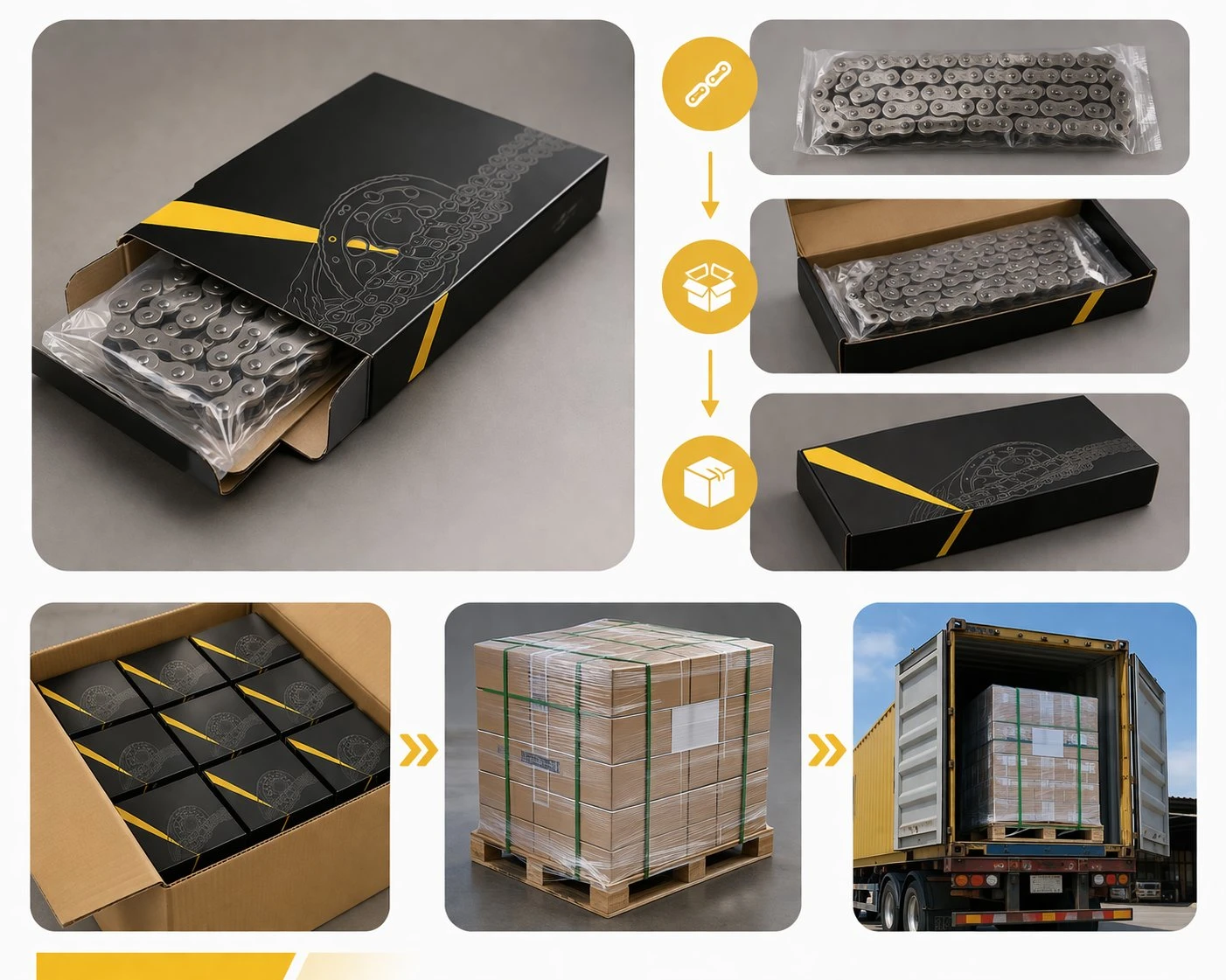
Korea Ever-Power handles mixed-specification orders in a single shipment — a common fleet order might include 428 standard for scooters, 428H for larger machines, and a small stock of 428H-O for machines with less reliable maintenance schedules, all consolidated in one export shipment with individual labelling per specification.
No minimum order quantity applies. Wholesale accounts with tiered pricing are available for workshop buyers and fleet operators — contact us with your typical order volume and machine specifications for a pricing discussion.
Consistent Quality Across All Commuter Chain Variants
Every chain variant — from the 420 standard for scooters to the 428H-X for high-mileage urban riders — goes through the same quality gates: incoming steel certification, carburizing temperature recording, tensile batch testing, JIS B 1801 dimensional verification, and articulation inspection.
Korea Ever-Power Motorcycle Chain Co., Ltd. — ISO 9001 certified · 5 production facilities
Commuter Chain Series — All Specifications In Stock
420 through 528 pitch, standard and sealed variants. Individual units accepted. Stocked sizes dispatch within 3–7 business days. Fleet orders consolidated in single shipment.
Standard — 420 / 428 / 520
Non-sealed · 15.6–26.5 kN · Fleet-friendly
Reinforced — 420H / 428H
Heavier plates · 428H at 20.6 kN
O-Ring — 428H-O / 520H-O
Sealed · 600–1,000 km lube · Most popular commuter spec
X-Ring — 428H-X / 520H-X
Sealed · 800–1,200 km lube · High mileage commuters
Frequently Asked Questions
How long should a motorcycle chain last on a daily commuter?+
A standard 428 chain with consistent 500 km maintenance on paved roads: typically 8,000–15,000 km before the 3% elongation replacement threshold is reached. A sealed 428H-O under the same conditions: 15,000–25,000 km. A sealed 428H-X: 20,000–30,000 km. These figures degrade significantly if lubrication is sporadic — a neglected standard chain can reach replacement threshold in under 5,000 km.
Is the 428H-O worth the extra cost over the standard 428 for a commuter?+
For most urban commuters: yes. The 428H-O’s 2–3× longer service life versus the standard 428 means that over 30,000 km, one or two sealed chains replace three to four standard chains. When the labour time for chain replacement is factored in — particularly for riders who pay a mechanic for the service — the sealed chain’s higher unit cost is typically recovered. The longer lube interval also reduces the number of maintenance events per year.
Should I replace sprockets every time I replace the commuter chain?+
Inspect both sprockets when replacing the chain. The front (countershaft) sprocket is smaller and wears faster — after one chain replacement on a commuter covering 15,000+ km/year, the front sprocket is usually worn enough to benefit from replacement. Hook-shaped tooth profiles, asymmetric tooth wear, or visible tooth thinning all indicate replacement is due. Fitting a new chain on worn sprockets accelerates new chain wear significantly. Ordering the chain and sprocket set together ensures correct pitch compatibility and simplifies the service.
Can I use the same chain cleaner I use for the rest of the motorcycle on a sealed chain?+
Only if it is specifically labelled O-ring-safe or X-ring-safe. General-purpose degreasers, brake cleaner, and petrol-based solvents degrade NBR rubber — the material used in O-ring and X-ring seals. The chain will look unchanged externally while the seal has already lost its compression and the internal grease is migrating out. Stick to chain-specific cleaners for sealed chains.
What is the correct chain slack for a commuter motorcycle?+
Chain slack specification varies by machine — check the service manual or the label on the swingarm. A common range for 125–250cc commuters is 20–30 mm of vertical movement measured at the chain’s tightest point (found by slowly rotating the rear wheel to find the position of minimum slack). Always measure and adjust with the motorcycle on its main stand or centre stand, at the specified measurement point — not at the slackest spot on the chain, which gives a misleadingly large reading.
Ready to Order the Right Commuter Chain?
Korea Ever-Power stocks the full 420 and 428 commuter chain range — standard, H-grade, O-ring, and X-ring — with dispatch within 3–7 business days. Send us your chain number or machine model and we confirm the correct specification before you order.
View All Commuter Chain Options