X-Ring Motorcycle Chain 428H-X 520H-X 525H-X 530H-X | Korea Ever-Power
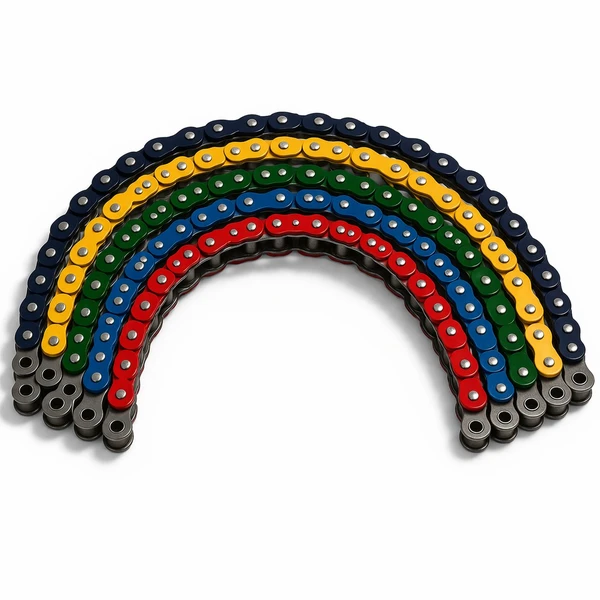
X-ring motorcycle chain in 428H-X, 520H-X, 525H-X, and 530H-X — solid-bushing sealed series with four-lip X-shaped seals. Tensile strength 23.8 kN (428H-X) to 34.0 kN (520H–530H). Lower friction than O-ring seals, longer service life than standard chains.
What Is an X-Ring Chain?
An X-ring motorcycle chain is a sealed roller drive chain that uses rubber seals with an X-shaped cross-section in place of the circular O-rings found in standard sealed chains. Each X-shaped seal has four raised lips — two per side — that contact the plate faces, creating two separate sealing lines per joint instead of one. This geometry distributes the seal contact pressure across a smaller effective surface area, which reduces friction compared with O-ring seals while actually improving sealing reliability by providing a secondary contact line in case the first is compromised by microscopic debris or surface variation.
The result is a chain that sits above both standard non-sealed chains and conventional O-ring designs in the performance hierarchy: it runs longer between lubrication events than either, experiences lower seal-face friction losses than O-ring chains, and delivers the corrosion protection and internal grease retention that no non-sealed chain can match. Korea Ever-Power Motorcycle Chain Co., Ltd. supplies X-ring sealed chains in four specifications — 428H-X, 520H-X, 525H-X, and 530H-X — all with solid-bore bushing construction and NBR X-ring seals.
Specifications — 428H-X / 520H-X / 525H-X / 530H-X
Pin lengths on X-ring chains are longer than non-sealed chains in the same pitch because the X-ring groove machined into the inner plate face adds to the total pin projection at each joint. The tensile strength data below reflects tested break loads on solid-bushing construction with the X-ring seals fully assembled.
| Chain No. | Pitch (mm) | Bush Type | Width (mm) | Pin Dia (mm) | Pin Length (mm) | Roller Dia (mm) | Plate T Inner (mm) | Plate T Outer (mm) | Tensile Strength (kN) | Weight (kg/m) |
|---|---|---|---|---|---|---|---|---|---|---|
| 428H-X | 12.700 | Solid | 7.85 | 4.45 | 21.60 | 8.51 | 2.20 | 2.03 | 23.8 | 1.00 |
| 520H-X | 15.875 | Solid | 6.35 | 5.24 | 22.00 | 10.16 | 2.40 | 2.40 | 34.0 | 1.21 |
| 525H-X | 15.875 | Solid | 7.94 | 5.24 | 23.80 | 10.16 | 2.40 | 2.40 | 34.0 | 1.35 |
| 530H-X | 15.875 | Solid | 9.60 | 5.24 | 25.40 | 10.16 | 2.40 | 2.40 | 34.0 | 1.39 |
Standard vs O-Ring vs X-Ring — Which Seal Type Suits Your Riding?
Choosing between a standard, O-ring, and X-ring chain is fundamentally a decision about where you want to spend effort: either in frequent maintenance to keep a lighter, cheaper chain performing, or in a higher upfront cost that reduces what the chain demands of you over its service life. The table below compares the three seal types across the dimensions that most riders actually care about.

| Comparison Point | Standard (No Seal) | O-Ring Sealed | X-Ring Sealed |
|---|---|---|---|
| Seal contact surfaces | None | 1 per side | 2 per side |
| Internal grease retention | None — washes out | Sealed for chain life | Sealed, dual-lip redundancy |
| Seal friction losses | None (no seal) | Moderate | Lower than O-ring |
| External lube interval | 300–500 km | 600–1,000 km | 800–1,200 km |
| Service life vs standard | 1× (baseline) | ~2–3× | ~3–4× |
| Performance in mud / water | Joint grease lost rapidly | Well protected | Best protection |
| Purchase cost | Lowest | Mid | Higher |
| Best suited for | Regular maintenance, dry roads, racing | Mixed-condition, moderate lubrication | Long-distance, harsh conditions, low-maintenance preference |
The X-ring's advantage over O-ring is not dramatic in light conditions — both outperform standard chains by a large margin. The difference becomes more apparent at higher mileage, in sustained wet or off-road use, and for riders who push their lubrication intervals. If you ride more than 10,000 km per year in mixed conditions, the X-ring's longer service life and extended lube intervals typically recoup the price premium within one chain replacement cycle.
Why Riders Choose X-Ring Over Other Sealed Chains
Beyond the seal geometry comparison above, X-ring chains offer specific practical advantages that translate to measurable riding and ownership differences.
- 🏎️
Longer chain life: X-ring chains typically outlast O-ring chains under the same conditions — the dual-lip seal is less likely to admit contaminants that degrade the O-ring material itself. Seal degradation over time allows moisture and fine abrasive particles to begin entering previously sealed joints; the X-ring's redundant sealing surface delays this crossover point. - 🏎️
Reduced friction at the seal face: An X-ring's four lips contact the plate face at narrow ridges rather than across the full circular profile of an O-ring. The contact area is smaller, so the friction losses from seal articulation as the chain flexes around the sprocket are lower. This is more relevant on high-power machines and over long distances where cumulative friction losses in the drivetrain add up. - 🏎️
Quieter operation: The consistent internal lubrication retained by the X-ring seals means the pin-bushing joint articulates smoothly throughout the chain's service life — not just when freshly lubricated. This produces measurably less drivetrain noise at low throttle openings and under deceleration compared with chains that dry internally between maintenance events. - 🏎️
Lower maintenance frequency: An external lube interval of 800–1,200 km is achievable with X-ring chains in normal conditions — roughly double that of a standard non-sealed chain. For riders covering long daily distances or commuters who prefer minimal maintenance, this reduces how often the bike needs to come off the road for drivetrain attention.
Cleaning and Lubrication Guide
Even with extended internal lubrication, X-ring chains need periodic cleaning and external lubrication to protect roller-sprocket contact surfaces and plate faces from external corrosion. The cleaning process differs from standard chains in one critical respect: only O-ring-safe or X-ring-safe cleaners should be used — petroleum solvents will degrade the NBR rubber seals over repeated application.
- 1
Place the motorcycle on a centre stand or paddock stand so the rear wheel can rotate freely. Ensure the engine is off. - 2
Spray the chain with a cleaner specifically labelled as O-ring-safe or X-ring-safe. Apply to all sides — inner plates, outer plates, rollers, and the sprocket contact faces. Avoid kerosene, petrol, or general-purpose degreasers. - 3
Allow the cleaner to soak for 2–3 minutes, then scrub with a chain brush. Pay attention to the inner plate gap at each link — this is where road grit collects closest to the roller faces. - 4
Rinse with water, then dry the chain thoroughly with a clean rag. Allow any remaining moisture to evaporate before applying lubricant — lubrication over a wet chain traps water in the outer plate gaps. - 5
Apply a thin coat of chain lubricant — ideally a wax-type or spray designated X-ring-compatible — to the entire chain while rotating the rear wheel slowly. Apply to the inner roller faces rather than the outer plate surfaces. - 6
Allow the lubricant to penetrate for 2 minutes, then wipe the outer plate faces with a clean rag to remove excess. Excess lubricant on the outer surfaces collects road debris and can contact the rear tyre sidewall. - 7
Allow the lubricant to dry before riding. For wax-based lubricants this typically takes 5–10 minutes in ambient air.

Choosing Sprockets for an X-Ring Chain
Sprockets are toothed wheels connected to the engine's output shaft (front) and the rear axle (rear) — the chain meshes with both and transfers rotational drive between them. When choosing replacement sprockets to pair with an X-ring sealed chain, three factors matter: the pitch of the sprocket teeth must match the chain exactly; the tooth profile should be in unworn condition to allow the new chain to seat correctly; and the material should match the riding intensity.
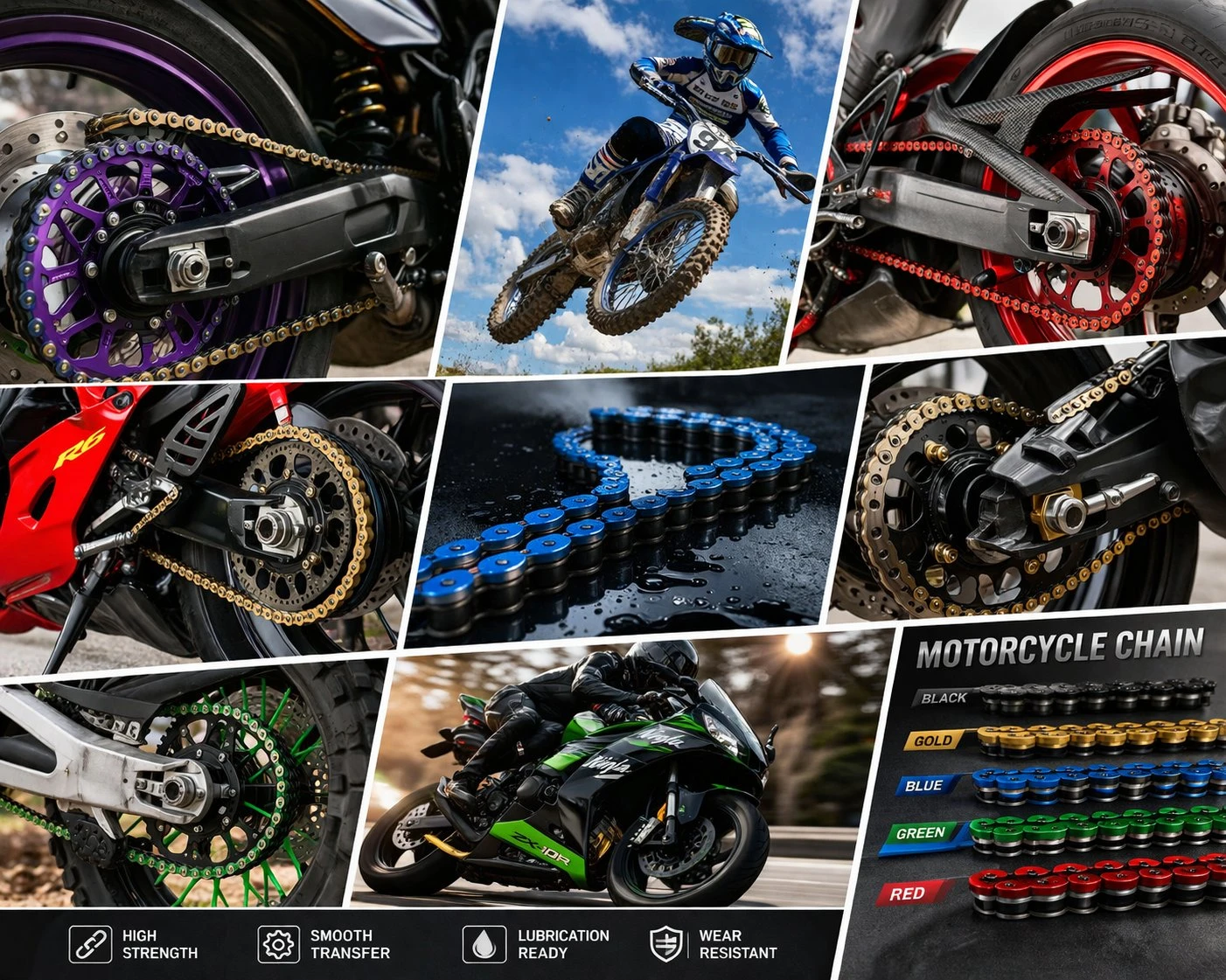
Steel sprockets offer the best overall durability and are the practical choice for daily use, touring, and any application where the chain-and-sprocket set needs to last as long as possible. Aluminium sprockets are lighter — useful for track-use machines where weight reduction is a priority — but wear faster, typically requiring replacement two to three times for every chain service interval on a high-power machine. For a touring or commuting context where an X-ring chain is chosen precisely for its service life, steel sprockets are the consistent recommendation.
When selecting sprocket tooth counts, the front-to-rear tooth ratio determines the final drive ratio. Increasing the number of rear teeth (or reducing front teeth) gives more low-end torque and acceleration; reducing rear teeth improves cruising rpm and top speed. Most OEM tooth counts represent a good balance for street riding; custom ratios make sense only for specific performance requirements.
We supply compatible sprockets for all four X-ring chain pitch sizes. Visit chains-sprockets.com for the full range, or contact us with your motorcycle chain model to confirm correct fitment. When you order a sprocket and chain together, confirm that both the front and rear sprocket tooth profiles are free of hook-shaped wear before committing to a chain-only replacement.

Korea Ever-Power Motorcycle Chain Co., Ltd.
Korea Ever-Power Motorcycle Chain Co., Ltd. is a professional transmission chain supplier with access to a manufacturing network spanning five facilities, ISO 9001 certified quality management, and export coverage exceeding 80 countries. The X-ring sealed chain series is manufactured to the same dimensional standards as our O-ring range — pin-bushing fit, plate gauge, and roller geometry are all consistent with the equivalent sealed chain specification — with the addition of the X-ring groove machining and ring geometry that distinguishes these chains from standard O-ring production.
Pre-shipment quality controls for X-ring chains include tensile testing by batch, articulation inspection for stiff links, and X-ring compression verification at assembled joints. We supply matching sprockets across all X-ring chain pitch sizes. Contact us with your part number or motorcycle details for fitment confirmation.

Frequently Asked Questions
Is an X-ring chain compatible with OEM sprockets for O-ring or standard chains?
Yes. X-ring chains have the same pitch and roller diameter as other sealed and non-sealed chains in the same series number. The only dimensional change is pin length, which is longer due to the X-ring groove accommodation — this does not affect sprocket mesh. The chain installs directly onto existing OEM sprockets without modification.
Can I use WD-40 or petroleum solvent to clean an X-ring chain?
No. Petroleum-based solvents degrade NBR rubber — the material used in both O-ring and X-ring seals — causing swelling, cracking, or loss of elasticity over repeated applications. Once seals lose their compression fit, internal grease migrates out and contaminants enter the joint. Use cleaners specifically labelled for O-ring-safe or X-ring-safe use.
At what mileage should an X-ring chain be replaced?
Replace when 20 consecutive links measured under slight tension exceed the nominal pitch distance by 3% or more. For 428-pitch: replace at or above 261.6 mm (nominal 254.0 mm). For 520/525/530-pitch: replace at or above 327.0 mm (nominal 317.5 mm). Also check X-ring condition at each cleaning — replace the chain if multiple seals show visible cracking, flattening, or grease tracking past the seal face.
Is the X-ring chain noticeably heavier than an O-ring chain?
Marginally. The 520H-X at 1.21 kg/m is the same weight as the 520H-O. The 530H-X at 1.39 kg/m compares with the 530H-O also at 1.39 kg/m. The weight difference between X-ring and O-ring in equivalent specifications is not practically significant on street or touring machines.
How do I inspect X-ring seals during maintenance?
With the chain clean and dry, visually inspect the seals visible between the inner and outer plates at multiple joints. A functioning X-ring appears symmetrical and round in cross-section when viewed from the side. Failed seals look flat, cracked, or extruded beyond the plate contact face. Any chain with multiple failed seals at different joints should be replaced.
Customer Reviews
Han Tae-soo, Long-Distance Tourer, Busan (March 2025)
"Switched to the 525H-X after running an O-ring chain on the same bike. Now at 14,000 km and the chain still measures within spec. I lube it every 1,000 km and clean it every other lube session. The O-ring chain I had previously needed replacing at around 11,000 km. Measurable difference."
Kim Jun-ho, Sport Bike Rider, Seoul (January 2025)
"The 520H-X on my ZX-6R runs noticeably quieter than the 520H-O I used before. At low throttle on city streets the drivetrain noise is clearly reduced. No idea if it's the dual-lip seal or something else in the construction, but the difference is real."
Yoo Sung-jin, Workshop Owner, Incheon (February 2025)
"We spec 520H-X for customers who ask about the best sealed option for high-mileage commuting. The feedback we get is consistently good — less chain noise, longer stretch intervals, and no complaints about the lubrication frequency. Korea Ever-Power's supply has been consistent across several orders."
Lim Soo-jin, Adventure Rider, Gangwon Province (December 2024)
"Used the 530H-X on a 10-day mixed-surface trip. Cleaned it twice over the whole trip. It went through some gravel sections and one muddy track access road. Chain looked clean on inspection at the end — X-rings fully seated, no visible grit intrusion. Solid performance for this kind of use."
Park Dong-woo, Commuter, Daejeon (November 2024)
"The 428H-X is doing exactly what I expected. At 6,000 km it still holds proper tension with only two adjustments since new. I was replacing O-ring 428 chains at around 8,000–9,000 km. The X-ring seems to be tracking to last considerably longer."
Packing and Shipping
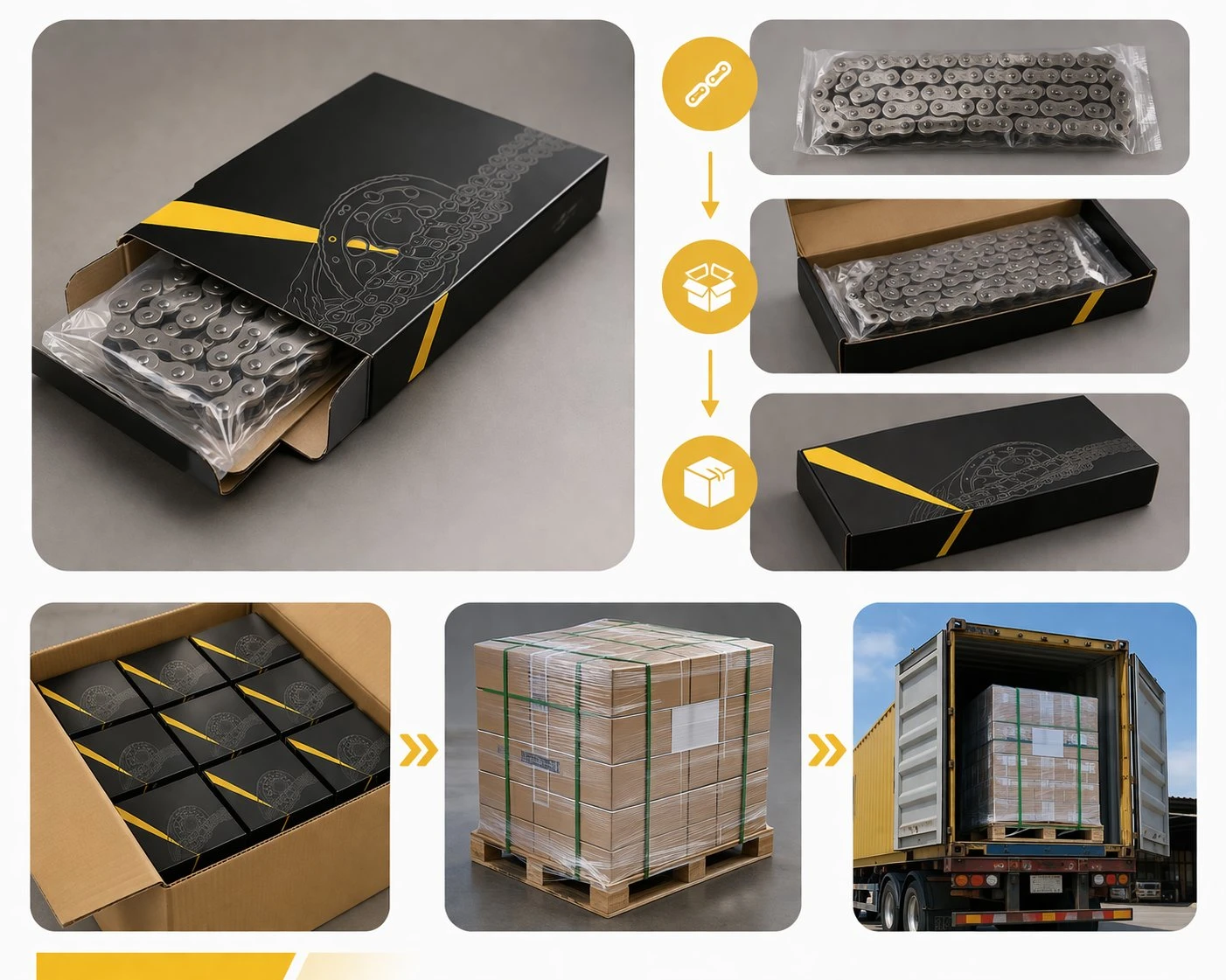
Additional information
| Editor | Cxm |
|---|
Related products
-
420 Standard Motorcycle Chain | 12.700mm Pitch, 15.6 kN
-

Motorcycle Timing Chain *25 *25H *25SH 06B Series
-

Super X-Ring Motorcycle Chain 428SX 520-SX 525-SX 530-SX
-

O-Ring Motorcycle Chain — 415 – 530 H-O Sealed Series
-
Reinforced Motorcycle Chain 415H 420H 428H 520H 525H 530H | Korea Ever-Power
-

Motocross Motorcycle Chain — 428 / 520 Series
-

Standard Motorcycle Chain — 420 / 428 / 520 / 525 / 530 Non-Sealed Series
-
Motorcycle Chain — Full Drive Chain Range from 25-Series to 530H