비교 가이드

Standard vs Reinforced Motorcycle Chain
H-Grade Explained

H-grade and standard chains fit the same sprockets. The only physical difference is plate gauge — heavier inner and outer plates that increase tensile strength and fatigue resistance. The question is whether your engine output actually needs that upgrade.

See Standard and H-Grade Series

What “H-Grade” Actually Means in Engineering Terms

The “H” designation in a 강화 오토바이 체인 number (428H, 520H, 530H) identifies chains produced with heavier-gauge inner and outer plates than the standard specification in the same pitch and inner width. Everything else about the chain — pitch, inner width, roller diameter, pin diameter, bushing type — is identical to the standard equivalent. The chain fits the same sprockets. The only physical change is the plate material section.

This plate gauge increase has two direct consequences. First, the heavier plates provide more cross-sectional area for the tensile load to act through — the chain’s break load increases proportionally. Second, the heavier plates have higher stiffness in bending, which improves fatigue resistance under the cyclic loading of the chain engaging and disengaging sprocket teeth at every revolution.

The practical implication: an H-grade chain in the same pitch as the standard equivalent is a direct drop-in upgrade with no other changes required. No new sprockets, no different master link (the master link is matched to the chain variant, supplied with the chain), no alignment adjustments. At chain replacement time, you can fit an H-grade chain wherever a standard fits — provided the H-grade’s slightly greater outer width clears any chain guides or tensioners on that specific machine.

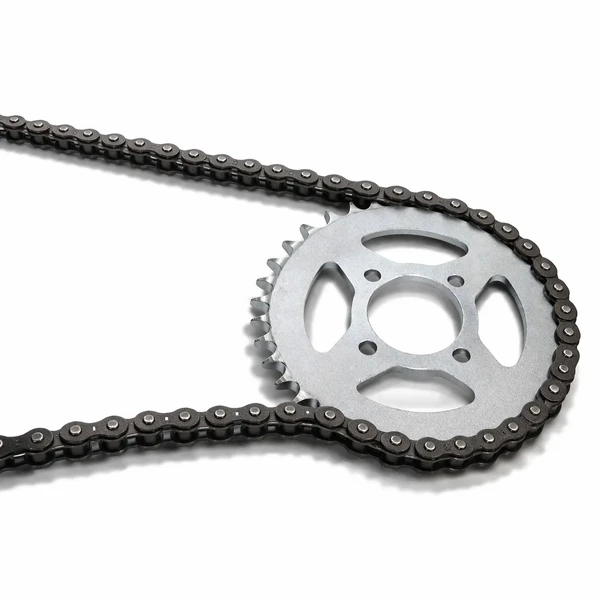
standard motorcycle chain 420 428 520 525 530 non-sealed standard plate gauge curled bush

Standard — e.g. 428: 1.60 mm inner plate, 17.8 kN

reinforced H-grade motorcycle chain 428H 520H heavier plate gauge higher tensile strength

H-Grade — e.g. 428H: 2.03 mm inner plate, 20.6 kN

The Plate Thickness Numbers — What They Mean in Practice

The plate thickness difference between standard and H-grade is not large in absolute terms — 0.43 mm on the 428 inner plate (2.03 vs 1.60 mm). But that 27% increase in plate thickness translates to a 15.7% increase in tensile strength (20.6 vs 17.8 kN) because the break load is determined by the plate area perpendicular to the loading direction. The heavier plate contributes proportionally more cross-sectional material to carry the load.

체인 크기 Standard Inner Plate (mm) H-Grade Inner Plate (mm) 표준 인장력 H-Grade Tensile Tensile Increase
428 / 428H 1.60 mm 2.03 mm 17.8kN 20.6kN +15.7%
520 / 520H 1.80 mm 2.20 mm 26.5kN 29.0kN +9.4%
525 / 525H 1.80 mm 2.20 mm 26.5kN 29.4 kN +10.9%
530 / 530H 1.80 mm 2.40 mm 26.5kN 30.4kN +14.7%

Compatibility note: H-grade chains in the same base size (e.g. 428H vs 428) are dimensionally compatible with the same sprockets. The slight increase in outer plate thickness marginally increases the chain’s overall outer width — ensure this clears any chain guides, tensioner rollers, or swingarm-integrated chain sliders before fitting. On most motorcycles, H-grade clearance is not an issue; on bikes with very close chain guides, verify first.

Standard vs H-Grade — Full Comparison

비교점 Standard Chain H-Grade Chain
Plate gauge Standard thickness Heavier (e.g. 428: +0.43 mm inner)
인장 강도 17.8 kN (428 example) 20.6 kN (428H — +15.7%)
Fatigue resistance 기준 Improved — heavier plates resist bending fatigue
Bushing type 곱슬 곱슬
Seal type None (non-sealed) None (non-sealed)
Lubrication interval 400~600km 400~600km
스프로킷 호환성 Fits standard sprockets Fits same sprockets as standard
무게 낮추다 Marginally heavier (plate gauge only)
Unit cost 낮추다 Slightly higher
Can be sealed? Standard only (no seal); upgrade to O/X-ring changes bushing H-grade plates available in O-ring (428H-O) and X-ring (428H-X) variants

Fatigue Resistance — Why It Matters More Than Break Load for Most Riders

A motorcycle chain never experiences anything close to its rated break load in normal use. A 428H at 20.6 kN is not at risk of breaking from a 20 hp 250cc engine’s torque — the actual chain tension in operation is a fraction of the break load. The more relevant structural property is fatigue resistance: the chain’s ability to withstand millions of loading and unloading cycles without crack initiation in the plates.

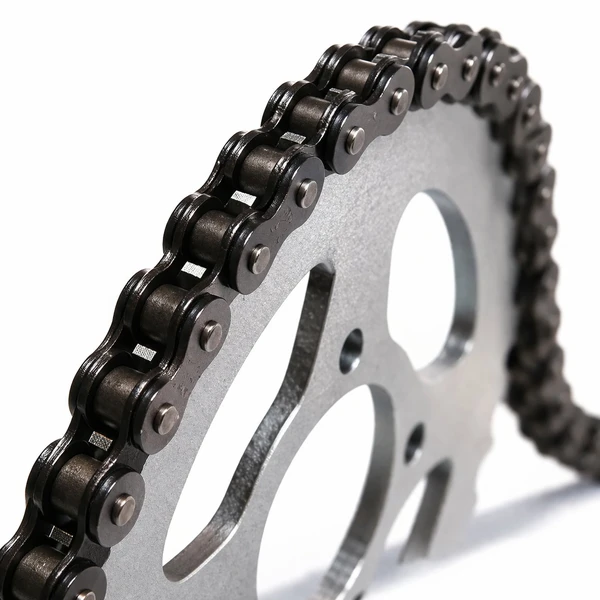
Each time a chain link engages a sprocket tooth, the inner and outer plates bend slightly as the chain articulates from straight to curved. As the link leaves the sprocket, the plates straighten. This bending-and-straightening cycle, repeated thousands of times per kilometre, is what fatigues the plate material over time — not a single high-tension event.

The H-grade’s heavier plates are stiffer in bending — meaning the plates deflect less per articulation cycle under the same load. Lower deflection means lower bending stress per cycle, which directly extends fatigue life. This fatigue benefit is often more practically valuable than the tensile strength increase, particularly for machines that accumulate high mileage through sustained use rather than occasional peak-load events.

motorcycle chain inner and outer plate detail showing plate thickness and bending fatigue structure

Practical example: A 150cc street bike accumulating 30,000 km per year on urban roads never loads the chain close to its break limit — but it articulates the chain roughly 1.5 billion times at its typical sprocket rpm over that distance. In this application, the fatigue resistance improvement of the H-grade is more relevant to the chain’s service life than the 15.7% tensile strength increase. For a high-mileage fleet application, the incremental cost of H-grade versus standard is typically recovered in reduced replacement frequency.

When Standard Is Correct and When H-Grade Pays Back

Standard chain is correct for:

  • Small-displacement scooters and mopeds (50–125cc) where the standard chain’s tensile strength is many times the actual working load
  • Track use where chains are replaced frequently by race schedule rather than wear
  • Budget-constrained applications where replacement is done on a fixed schedule
  • Machines where the OEM specified standard and engine output is well within the standard chain’s working load margin

H-Grade pays back its cost for:

  • Higher-output engines in the same pitch class — where standard chains show accelerated plate wear or fatigue cracking at high-mileage
  • Loaded touring machines that regularly carry a pillion plus luggage, increasing sustained chain tension
  • High-mileage fleet applications where extended service life before replacement reduces total cost per kilometre
  • Machines tuned above stock engine output where the standard chain’s safety factor has been reduced by the power increase

H-Grade with Sealing — The 428H-O, 428H-X, and 520H-X Advantage

The most capable non-sealed chain in any pitch class is an H-grade, but the most practical upgrade path for most street riders combines H-grade plate strength with sealed internal lubrication. The 428H-O, 428H-X, 520H-O, 520H-X, and their 525/530 equivalents carry the heavier H-grade plates and the sealed internal grease system simultaneously.

The 428H-O is a specific example worth looking at: it achieves 23.8 kN — higher than the non-sealed 428H’s 20.6 kN. This is because the O-ring and X-ring variants use solid-bore bushings rather than the curled bushing of the H-grade non-sealed chain. The solid-bore bushing contributes an additional structural element at the roller-pin contact that the curled bushing does not provide, pushing the sealed variant’s tensile strength above the non-sealed equivalent despite the additional material required for the seal groove.

The practical result: a 520H-X 34.0kN outperforms both the standard 520 (26.5 kN) and the non-sealed 520H in tensile strength, while adding the maintenance benefits of sealed internal lubrication. For most street riders considering an H-grade upgrade, the H-grade sealed variants are the more comprehensive solution.

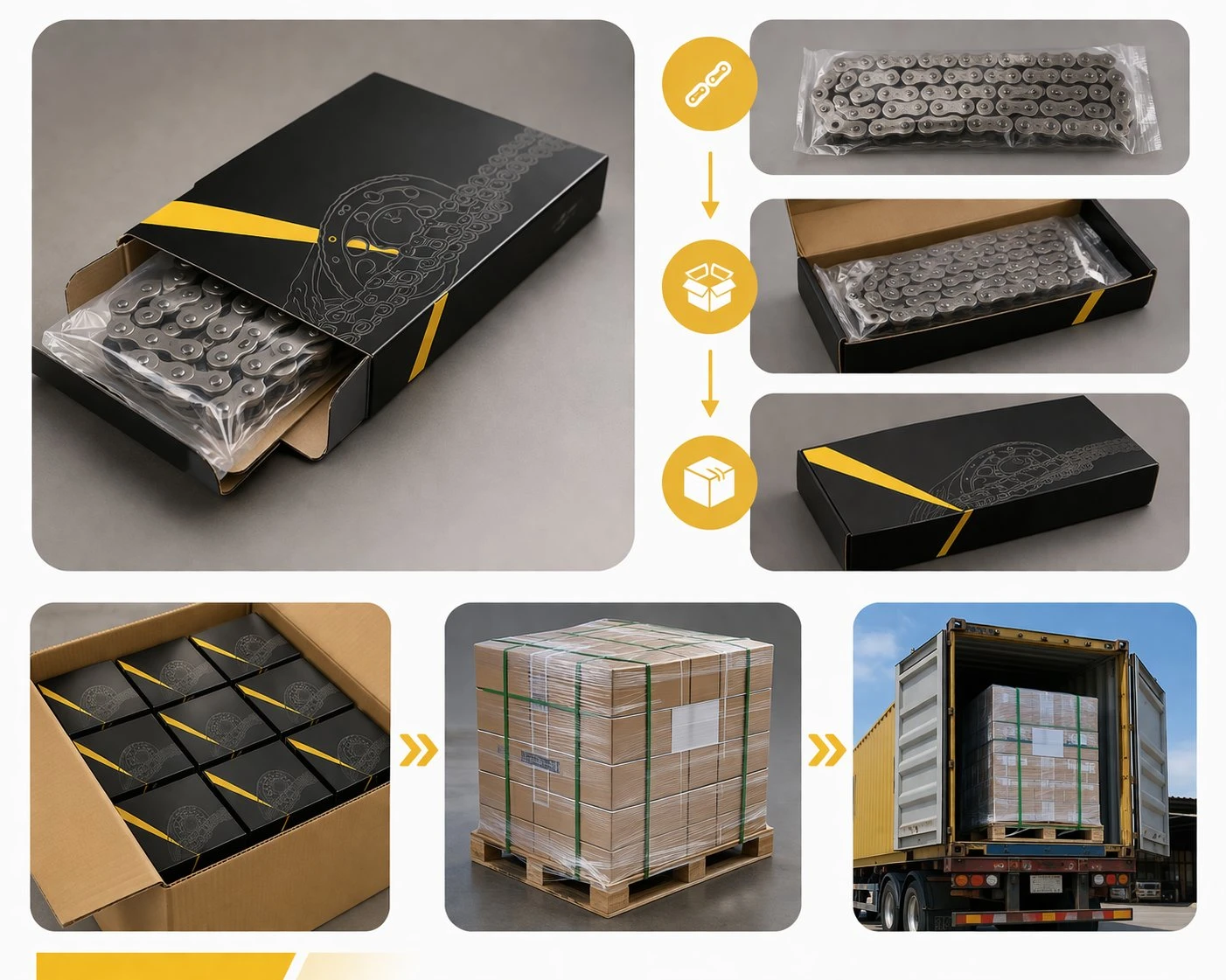
motorcycle chain packing and shipping Korea Ever-Power sealed and reinforced chain series export packaging

All chains ship pre-lubricated in moisture-resistant packaging, individually labelled with series number, link count, and batch reference number for quality traceability.

motorcycle chain installation maintenance inspection checking H-grade reinforced chain tension and sprocket engagement

The H-Grade Upgrade Path — By Size and Application

415 and 420 class: 415H

The 415H is specifically designed for 50cc two-stroke racing machines and high-revving small-displacement engines where the narrow 415-pitch chain is required but standard plate gauge shows premature fatigue under sustained high-rpm loading. Fits the same 415-pitch sprockets.

428 class: 420H and 428H

The 428H is the most significant H-grade upgrade in practical terms — it covers the 125–250cc class where the highest volume of motorcycle ownership occurs. The 428H at 20.6 kN versus the standard 428 at 17.8 kN represents a meaningful structural improvement for higher-output 200–250cc engines and loaded two-up riding in the 125–200cc class. The 420H serves the same function for the narrower 420-pitch scooter class.

520/525/530 class: 520H, 525H, 530H

In the 15.875 mm pitch family, H-grade is typically specified for machines above 600cc where sustained high-torque output reduces the safety factor of the standard chain to an uncomfortable margin for demanding use. The 530H at 30.4 kN versus 26.5 kN standard is the largest absolute tensile gain in the 5/8-inch pitch family. For most sealed-chain applications in this pitch family, however, the X-ring sealed variants (520H-X, 525H-X, 530H-X at 34.0 kN) deliver both the H-grade plate strength and the sealed maintenance advantage simultaneously.

Produced on Dedicated Lines — Batch Tested

Standard and H-grade chains share the same production facilities and quality checkpoints. Incoming steel certified to composition specs. Carburizing temperature recorded per batch. Tensile testing of every production batch. Dimensional verification against JIS B 1801 reference gauges.

Korea Ever-Power motorcycle chain workshop production quality
Korea Ever-Power motorcycle chain workshop 2
Korea Ever-Power motorcycle chain factory 8 production
Korea Ever-Power motorcycle chain factory quality control 9

한국 에버파워 모터사이클 체인 주식회사 — ISO 9001 인증 획득 · 5개 생산 시설 보유

Standard and H-Grade Chains — All Sizes Stocked

Both standard and H-grade available in 415, 420, 428, 520, 525, 530 pitch. H-grade variants available with O-ring and X-ring sealing. Dispatch within 3–7 business days. No minimum order.

표준 롤러 체인
420 · 428 · 520 · 525 · 530
Non-sealed · 15.6–26.5 kN


강화 H등급 체인
415H · 420H · 428H · 520H · 525H · 530H
Up to 30.5 kN · Non-sealed


H-Grade + O-Ring Sealed
428H-O · 520H-O · 525H-O · 530H-O
Up to 30.4 kN · 600–1,000 km lube


H-Grade + X-Ring Sealed
428H-X · 520H-X · 525H-X · 530H-X
34.0kN · 800–1,200km 윤활유


Replacing chain and sprocket together? 오토바이 체인 및 스프로킷 세트 모든 피치에 적용됩니다.
스프로킷 →

자주 묻는 질문

Do I need to change sprockets when upgrading from standard to H-grade?+
No. H-grade chains in the same base size (e.g. 428 and 428H) have the same pitch and inner width and fit the same sprockets. The heavier outer plates marginally increase the chain’s overall outer width — confirm that this clears any chain guides, tensioner rollers, or swingarm-integrated slider features on your specific motorcycle before fitting. On the vast majority of street and adventure machines, this clearance is not an issue.
Can I get a sealed H-grade chain, or is H-grade always non-sealed?+
Yes. The H-grade plate specification is available in O-ring sealed (428H-O, 520H-O, 525H-O, 530H-O) and X-ring sealed (428H-X, 520H-X, 525H-X, 530H-X) variants. These chains combine the heavier plate gauge of H-grade with the solid-bore bushing and sealed internal lubrication of the O-ring or X-ring construction. The sealed H-grade variants actually reach higher tensile strength than the non-sealed H-grade equivalents due to the additional structural contribution of the solid-bore bushing.
My 250cc motorcycle uses a 428. Is the 428H worth the upgrade?+
For a stock 250cc engine producing moderate power on regular street riding, the 428 standard has more than adequate tensile strength. The 428H upgrade is most beneficial if: (a) the engine is tuned above stock output, (b) the machine is regularly ridden two-up with luggage, (c) you are covering high annual mileage where the H-grade’s improved fatigue resistance extends the replacement interval, or (d) you want the best non-sealed option before moving to a sealed type. If sealing is the priority, consider the 428H-O or 428H-X instead — you get both the H-grade plates and sealed maintenance benefits.
Why does the sealed 428H-O at 23.8 kN outperform the non-sealed 428H at 20.6 kN?+
The sealed variants (O-ring and X-ring) use solid-bore bushings — machined from tube stock with no longitudinal seam. The non-sealed H-grade uses a curled bushing. Under tensile loading, the solid-bore bushing provides additional structural contribution at the roller-pin contact that a curled bushing cannot replicate — the curled bushing can open slightly at its seam under load, while the solid bushing maintains its geometry. This structural difference, combined with the H-grade plate gauge, pushes the sealed 428H-O above the non-sealed 428H in break load despite the additional material used for the seal groove.
How do I measure my chain to know if replacement is needed?+
Measure 20 consecutive links pin-centre to pin-centre under light tension, at the same point on the chain each time (find the tightest point first by rotating the rear wheel to find maximum tension). For 15.875 mm pitch chains (520/525/530 family), the 20-link nominal is 317.5 mm — replace when measured length reaches 327 mm. For 12.70 mm pitch (428 family), nominal is 254.0 mm — replace at 261.6 mm. Both standard and H-grade chains use the same replacement threshold; the H-grade’s heavier plates do not change the measurement threshold, only how long the chain takes to reach it.

Standard or H-Grade — Confirmed Before You Order

Korea Ever-Power stocks both standard and H-grade chains in 415 through 530 pitch, with sealed variants (O-ring and X-ring) available across the H-grade family. Send us your chain number or motorcycle model and we confirm the right specification before you commit.

View Standard and Reinforced Chains


편집자: Cxm